Committees
Diverging Opinions Among Bid Evaluation Committee Members
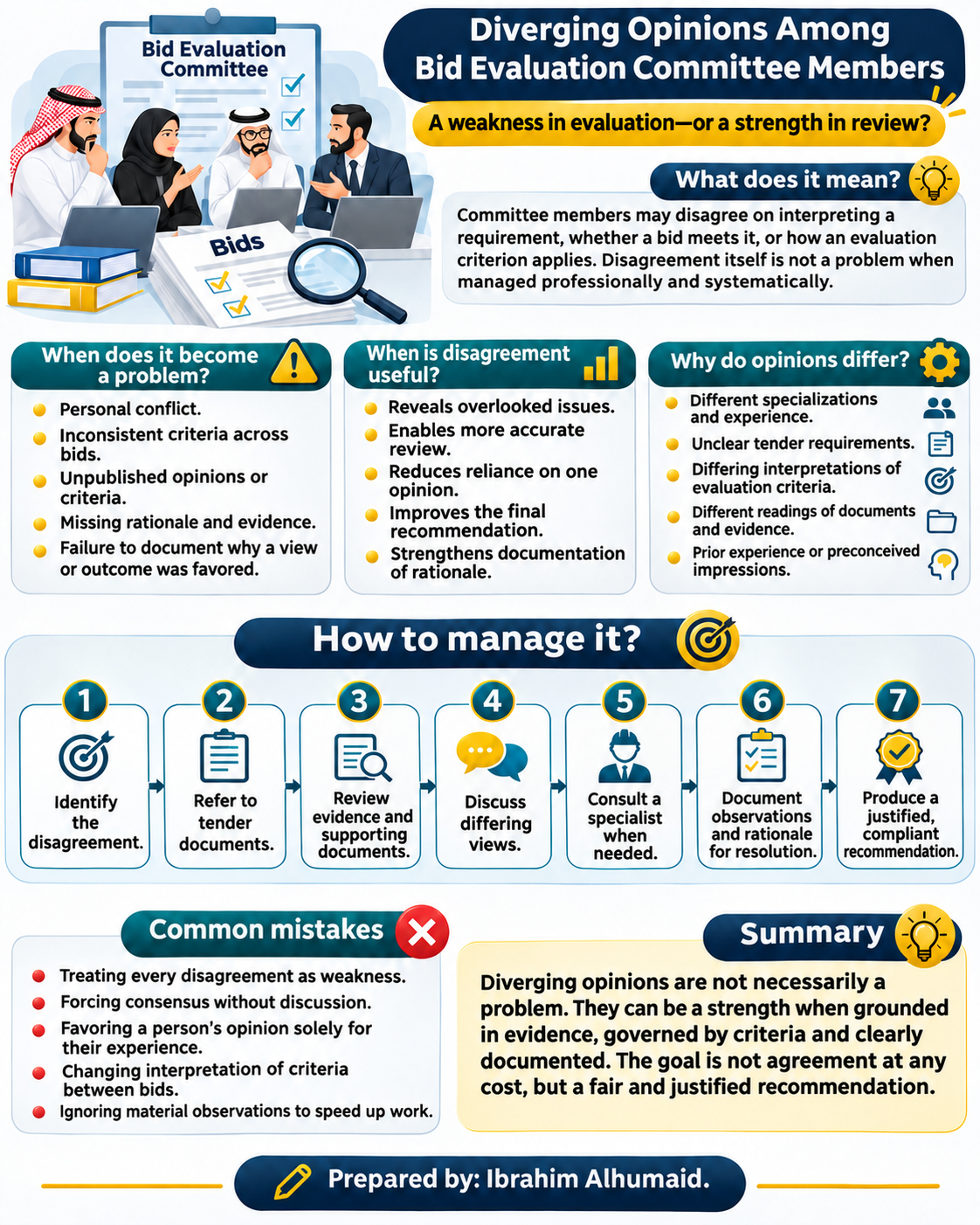
A weakness in evaluation—or a strength in review?
What does it mean?
Bid evaluation committee members may disagree about how to interpret a requirement, whether a particular bid meets it, or how to apply an evaluation criterion. Such disagreement is not a problem in itself if handled professionally and systematically.
Why do opinions differ?
- Different professional specializations and experience.
- Unclear requirements in the tender documents.
- Different understandings of the evaluation criteria.
- Different interpretations of documents and evidence.
- Influence of prior experience or preconceived impressions.
When is disagreement useful?
- Reveals observations that were not apparent to everyone.
- Helps review the decision more accurately.
- Reduces reliance on a single opinion.
- Improves the quality of the final recommendation.
- Strengthens documentation of the rationale.
When does it become a problem?
- When disagreement becomes personal.
- When criteria are applied inconsistently across bids.
- When undisclosed opinions or criteria are introduced.
- When supporting evidence and rationale are absent.
- When the reason for favoring a view or reaching an outcome is not documented.
How should we manage disagreement?
- Identify the specific point of disagreement.
- Refer to the tender documents.
- Review the evidence and supporting documents.
- Discuss the differing views.
- Consult a specialist when necessary.
- Document observations and the rationale for their resolution.
- Reach a justified recommendation that complies with applicable requirements.
Common mistakes
- Treating every disagreement as a weakness.
- Forcing consensus without discussion.
- Favoring an individual's opinion merely because of their experience.
- Changing the interpretation of criteria from one bid to another.
- Ignoring material observations to accelerate work.
Summary
Diverging opinions among committee members are not necessarily a problem. They can be a strength when grounded in evidence, governed by criteria and clearly documented. The goal is not to achieve agreement at any cost, but to reach a fair and justified recommendation.
Prepared by Ibrahim Alhumaid