Category: Tenders
10 Situations That May Change Bidder Eligibility During a Government Tender
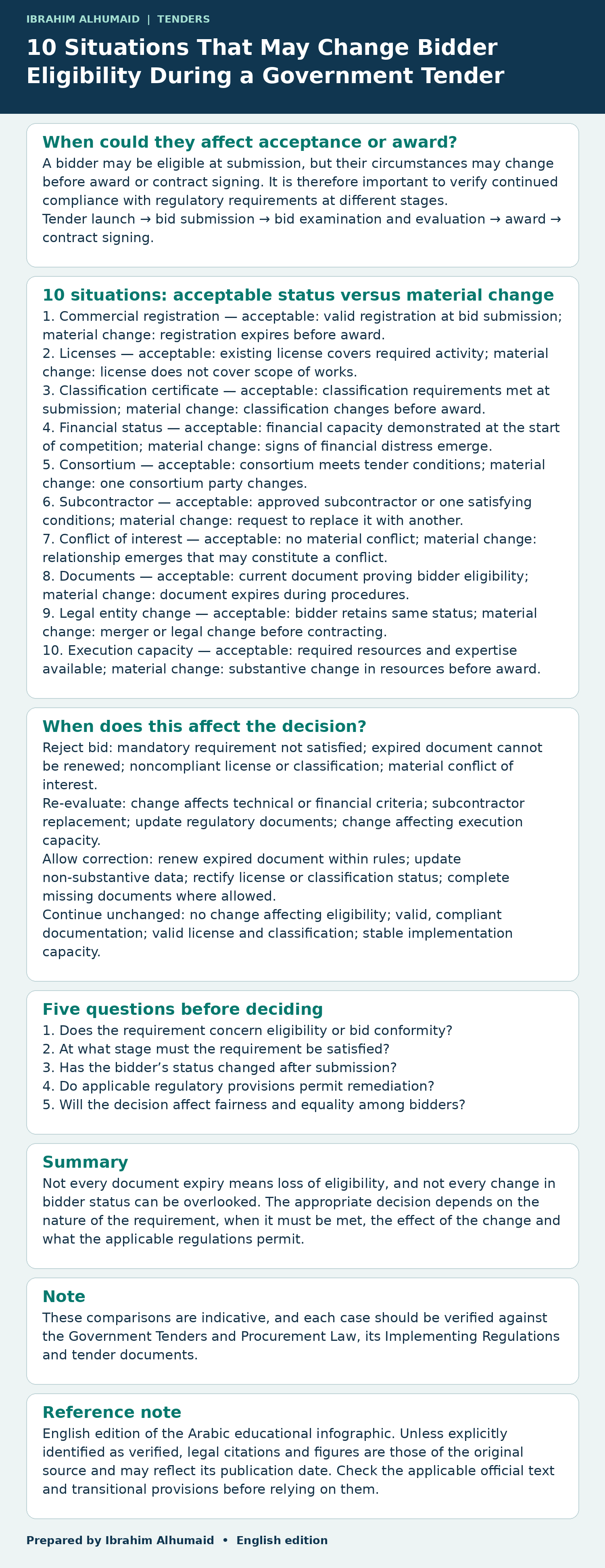
English transcript
When could they affect acceptance or award?
A bidder may be eligible at submission, but their circumstances may change before award or contract signing. It is therefore important to verify continued compliance with regulatory requirements at different stages.
Tender launch → bid submission → bid examination and evaluation → award → contract signing.
10 situations: acceptable status versus material change
1. Commercial registration — acceptable: valid registration at bid submission; material change: registration expires before award.
2. Licenses — acceptable: existing license covers required activity; material change: license does not cover scope of works.
3. Classification certificate — acceptable: classification requirements met at submission; material change: classification changes before award.
4. Financial status — acceptable: financial capacity demonstrated at the start of competition; material change: signs of financial distress emerge.
5. Consortium — acceptable: consortium meets tender conditions; material change: one consortium party changes.
6. Subcontractor — acceptable: approved subcontractor or one satisfying conditions; material change: request to replace it with another.
7. Conflict of interest — acceptable: no material conflict; material change: relationship emerges that may constitute a conflict.
8. Documents — acceptable: current document proving bidder eligibility; material change: document expires during procedures.
9. Legal entity change — acceptable: bidder retains same status; material change: merger or legal change before contracting.
10. Execution capacity — acceptable: required resources and expertise available; material change: substantive change in resources before award.
When does this affect the decision?
Reject bid: mandatory requirement not satisfied; expired document cannot be renewed; noncompliant license or classification; material conflict of interest.
Re-evaluate: change affects technical or financial criteria; subcontractor replacement; update regulatory documents; change affecting execution capacity.
Allow correction: renew expired document within rules; update non-substantive data; rectify license or classification status; complete missing documents where allowed.
Continue unchanged: no change affecting eligibility; valid, compliant documentation; valid license and classification; stable implementation capacity.
Five questions before deciding
1. Does the requirement concern eligibility or bid conformity?
2. At what stage must the requirement be satisfied?
3. Has the bidder’s status changed after submission?
4. Do applicable regulatory provisions permit remediation?
5. Will the decision affect fairness and equality among bidders?
Summary
Not every document expiry means loss of eligibility, and not every change in bidder status can be overlooked. The appropriate decision depends on the nature of the requirement, when it must be met, the effect of the change and what the applicable regulations permit.
Note
These comparisons are indicative, and each case should be verified against the Government Tenders and Procurement Law, its Implementing Regulations and tender documents.
Reference note
English edition of the Arabic educational infographic. Unless explicitly identified as verified, legal citations and figures are those of the original source and may reflect its publication date. Check the applicable official text and transitional provisions before relying on them.