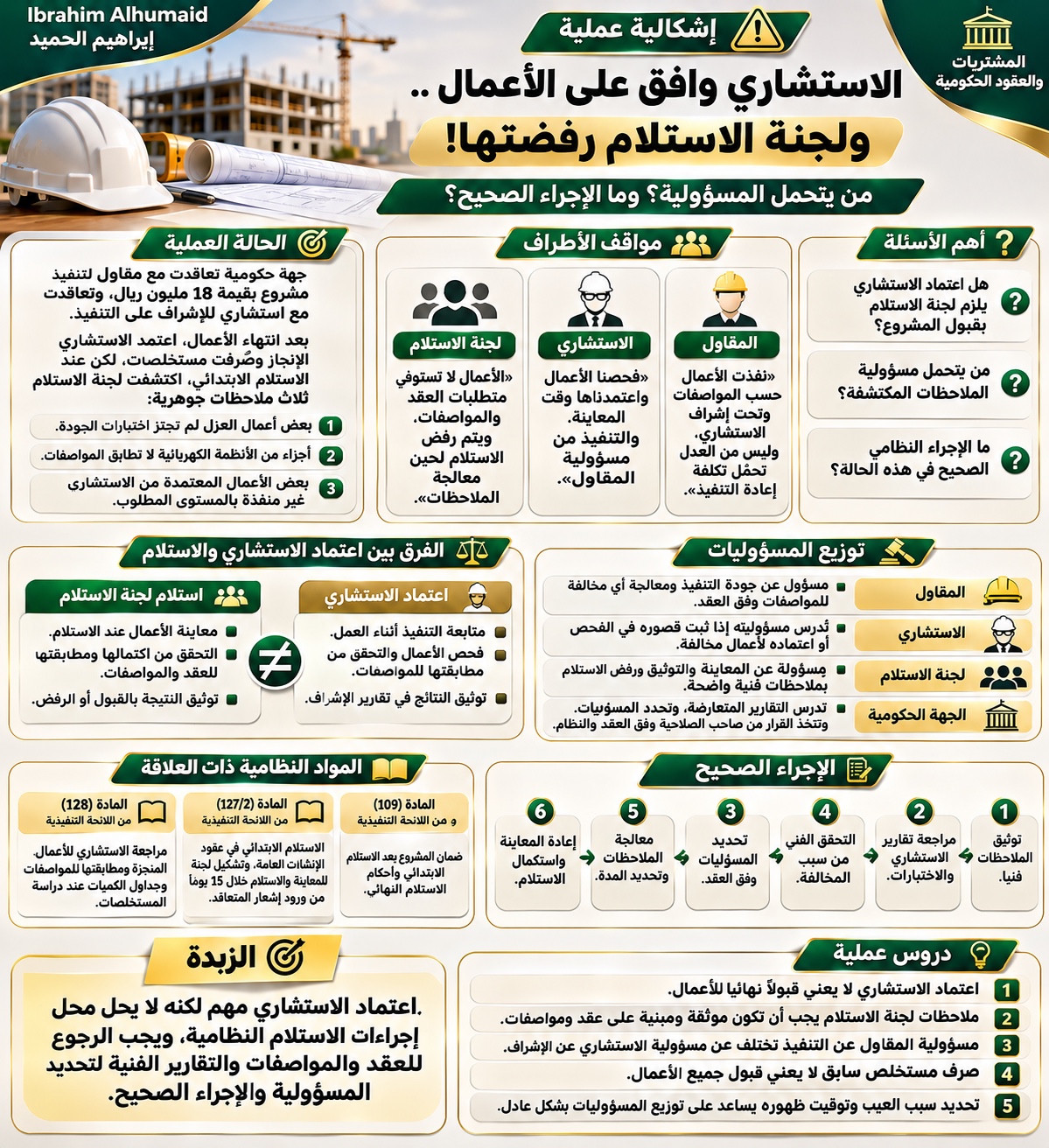
The Consultant Approved the Works, but the Acceptance Committee Rejected Them
Who is responsible, and what should the government entity do?
The case
A government entity awarded a SAR 18 million construction contract and engaged a consultant to supervise the work. After completion, the consultant certified progress and interim payments were made. At preliminary acceptance, the committee identified three material deficiencies:
- Some waterproofing work failed quality tests.
- Parts of the electrical systems did not meet the specifications.
- Some work the consultant had approved did not meet the required standard.
Key questions
- Does the consultant’s approval bind the committee to accept the project?
- Who is responsible for the defects?
- What procedure should the entity follow?
In brief: The consultant’s approval does not replace formal acceptance. Document the nonconformities, establish their cause and timing, and assess each party’s obligations under its contract.
What each party says
Contractor
“We worked to the specifications under the consultant’s supervision. It would be unfair to make us pay to redo the work.”
Supervising consultant
“We inspected and approved the work at the time. The contractor is responsible for execution.”
Acceptance committee
“The works do not meet the contract requirements and specifications. We will not accept them until the issues are addressed.”
Consultant approval is not committee acceptance
Consultant approval
- Monitor work as it proceeds.
- Inspect completed work and check it against the specifications.
- Record findings in supervision reports.
Committee acceptance
- Inspect the works at handover.
- Verify completeness and conformity with the contract and specifications.
- Record acceptance or the reasons for not accepting the works.
Who is responsible for what?
- Contractor: Deliver conforming work and correct deficiencies it is responsible for under the contract.
- Supervising consultant: Its contractual responsibility should be assessed if it failed to carry out required inspections or approved nonconforming work.
- Acceptance committee: Inspect and document the work, and give clear technical reasons for withholding acceptance.
- Government entity: Review the conflicting reports, establish responsibilities, and have the authorized official decide under the contract and applicable rules.
Recommended procedure
- Record each deficiency and the evidence supporting it.
- Review the consultant’s reports and test records.
- Determine the technical cause of the nonconformity.
- Allocate responsibilities under the relevant contracts.
- Specify the required corrective work and a deadline.
- Reinspect and complete the acceptance procedure when the requirements are met.
Relevant Saudi implementing regulations
The original graphic transposes the descriptions for Articles 109 and 128. The references below are corrected.
- Article 109: Progress payment certificates. The project consultant inspects completed works and checks them against the contractual specifications and bills of quantities.
- Article 127(2), as amended: Preliminary acceptance in public construction contracts. The entity forms a committee to begin inspection and acceptance within 15 days of receiving the contractor’s notice of completion. A special procedure applies where acceptance is prevented by a cause unrelated to the contractor.
- Article 128: The warranty for public construction works following preliminary acceptance, the contractor’s obligations during warranty, and the conditions for final acceptance.
Ministry of Finance: Law and Implementing Regulations · Official Gazette: amendment to Article 127
Practical lessons
- Consultant approval does not constitute final acceptance.
- The committee’s findings must be documented and tied to the contract and specifications.
- The contractor’s responsibility for execution differs from the consultant’s responsibility for supervision.
- A previous interim payment does not establish acceptance of all the work.
- Identifying the cause of a defect and when it arose helps allocate responsibility fairly.
Bottom line
Consultant approval matters, but it is not a substitute for formal acceptance. Use the contract, specifications, tests and technical reports to determine responsibility and the correct next step.
View the original Arabic infographic