Category: Contracts
A Government Contract Expires in One Month and the New Tender Has Not Yet Been Launched: How Can We Prevent Service Interruptions?
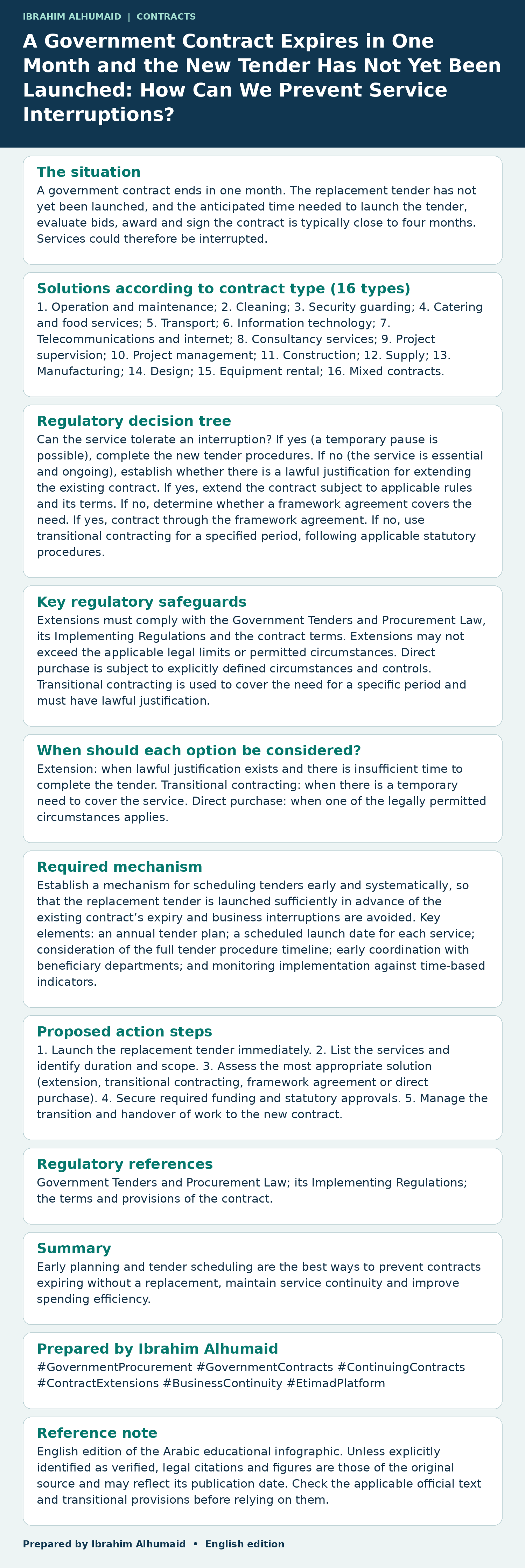
English transcript
The situation
A government contract ends in one month. The replacement tender has not yet been launched, and the anticipated time needed to launch the tender, evaluate bids, award and sign the contract is typically close to four months. Services could therefore be interrupted.
Solutions according to contract type (16 types)
1. Operation and maintenance; 2. Cleaning; 3. Security guarding; 4. Catering and food services; 5. Transport; 6. Information technology; 7. Telecommunications and internet; 8. Consultancy services; 9. Project supervision; 10. Project management; 11. Construction; 12. Supply; 13. Manufacturing; 14. Design; 15. Equipment rental; 16. Mixed contracts.
Regulatory decision tree
Can the service tolerate an interruption? If yes (a temporary pause is possible), complete the new tender procedures. If no (the service is essential and ongoing), establish whether there is a lawful justification for extending the existing contract. If yes, extend the contract subject to applicable rules and its terms. If no, determine whether a framework agreement covers the need. If yes, contract through the framework agreement. If no, use transitional contracting for a specified period, following applicable statutory procedures.
Key regulatory safeguards
Extensions must comply with the Government Tenders and Procurement Law, its Implementing Regulations and the contract terms. Extensions may not exceed the applicable legal limits or permitted circumstances. Direct purchase is subject to explicitly defined circumstances and controls. Transitional contracting is used to cover the need for a specific period and must have lawful justification.
When should each option be considered?
Extension: when lawful justification exists and there is insufficient time to complete the tender. Transitional contracting: when there is a temporary need to cover the service. Direct purchase: when one of the legally permitted circumstances applies.
Required mechanism
Establish a mechanism for scheduling tenders early and systematically, so that the replacement tender is launched sufficiently in advance of the existing contract’s expiry and business interruptions are avoided. Key elements: an annual tender plan; a scheduled launch date for each service; consideration of the full tender procedure timeline; early coordination with beneficiary departments; and monitoring implementation against time-based indicators.
Proposed action steps
1. Launch the replacement tender immediately. 2. List the services and identify duration and scope. 3. Assess the most appropriate solution (extension, transitional contracting, framework agreement or direct purchase). 4. Secure required funding and statutory approvals. 5. Manage the transition and handover of work to the new contract.
Regulatory references
Government Tenders and Procurement Law; its Implementing Regulations; the terms and provisions of the contract.
Summary
Early planning and tender scheduling are the best ways to prevent contracts expiring without a replacement, maintain service continuity and improve spending efficiency.
Prepared by Ibrahim Alhumaid
#GovernmentProcurement #GovernmentContracts #ContinuingContracts #ContractExtensions #BusinessContinuity #EtimadPlatform
Reference note
English edition of the Arabic educational infographic. Unless explicitly identified as verified, legal citations and figures are those of the original source and may reflect its publication date. Check the applicable official text and transitional provisions before relying on them.