Category: Contracts New
What Is Contract Knowledge Management, and How Can It Help Procurement and Contracts?
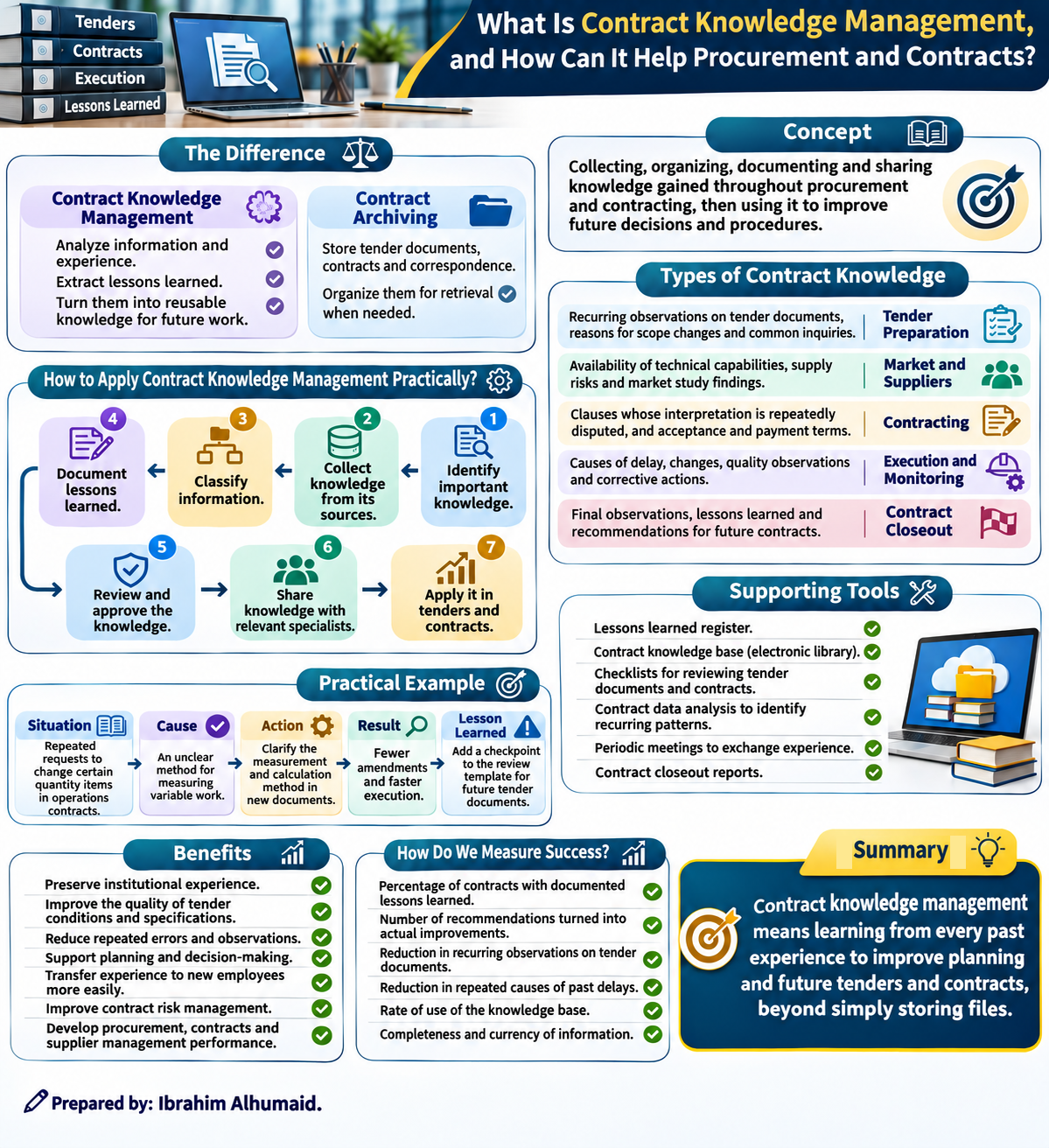
Concept: Collecting, organizing, documenting and sharing knowledge gained throughout procurement and contracting, then using it to improve future decisions and procedures.
Contract archiving: Store tender documents, contracts and correspondence. Organize them for retrieval when needed. Contract knowledge management: Analyze information and experience; extract lessons learned; turn them into reusable knowledge for future work.
Types of contract knowledge: Tender preparation: Recurring observations on tender documents, reasons for scope changes and common inquiries. Market and suppliers: Availability of technical capabilities, supply risks and market study findings. Contracting: Clauses whose interpretation is repeatedly disputed, and acceptance and payment terms. Execution and monitoring: Causes of delay, changes, quality observations and corrective actions. Contract closeout: Final observations, lessons learned and recommendations for future contracts.
Practical application: 1 Identify important knowledge. 2 Collect knowledge from its sources. 3 Classify information. 4 Document lessons learned. 5 Review and approve the knowledge. 6 Share knowledge with relevant specialists. 7 Apply it in tenders and contracts.
Supporting tools: Lessons learned register. Contract knowledge base (electronic library). Checklists for reviewing tender documents and contracts. Contract data analysis to identify recurring patterns. Periodic meetings to exchange experience. Contract closeout reports.
Practical example: Situation: Repeated requests to change certain quantity items in operations contracts. Cause: An unclear method for measuring variable work. Action: Clarify the measurement and calculation method in new documents. Result: Fewer amendments and faster execution. Lesson learned: Add a checkpoint to the review template for future tender documents.
Benefits: Preserve institutional experience. Improve the quality of tender conditions and specifications. Reduce repeated errors and observations. Support planning and decision-making. Transfer experience to new employees more easily. Improve contract risk management. Develop procurement, contracts and supplier management performance.
How do we measure success? Percentage of contracts with documented lessons learned. Number of recommendations turned into actual improvements. Reduction in recurring observations on tender documents. Reduction in repeated causes of past delays. Rate of use of the knowledge base. Completeness and currency of information.
Summary: Contract knowledge management means learning from every past experience to improve planning and future tenders and contracts, beyond simply storing files.
Prepared by: Ibrahim Alhumaid.