Can a government entity deduct amounts from payments due to a contractor without notice?
When may a deduction be made, and when must the contractor be notified?
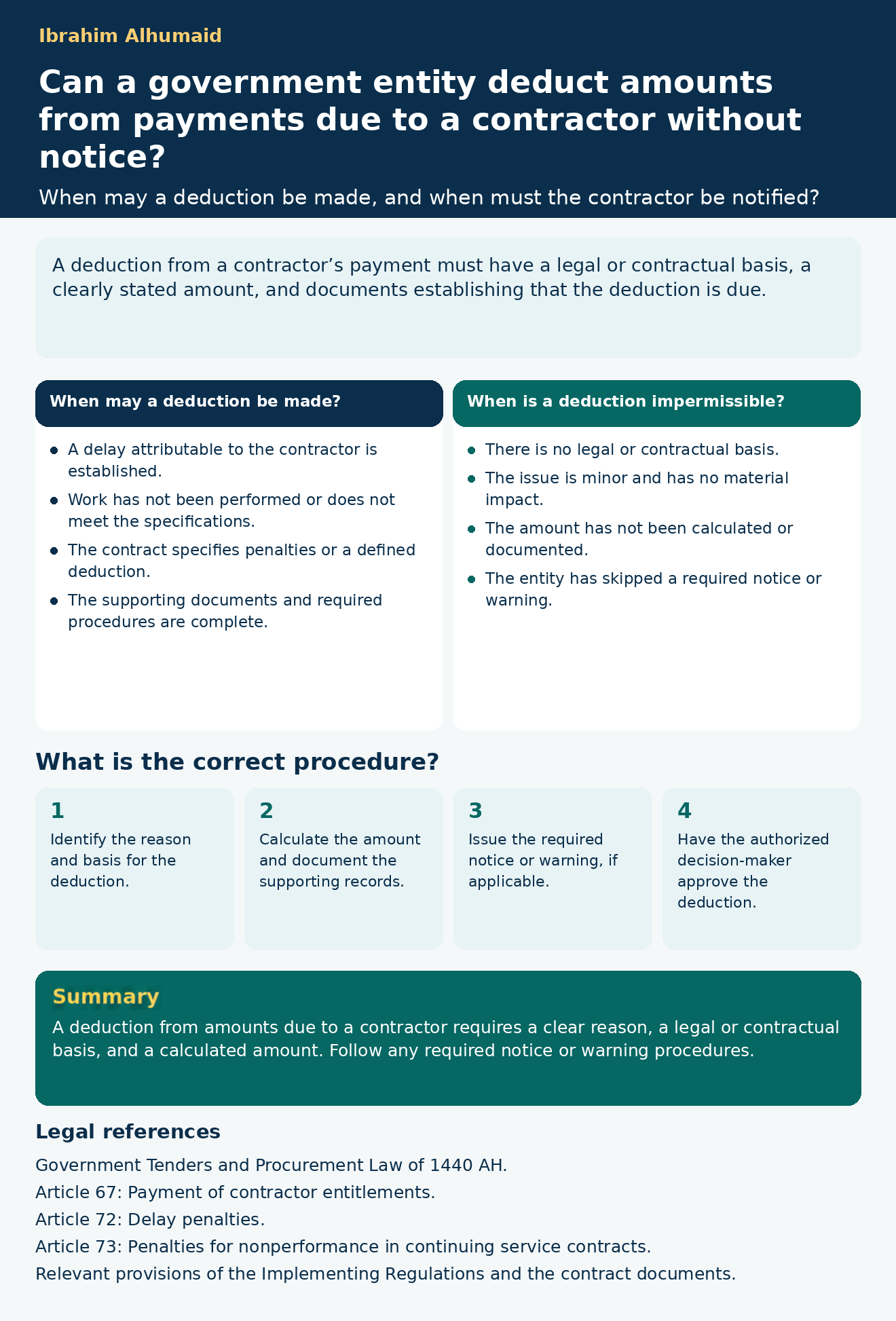
A deduction from a contractor’s payment must have a legal or contractual basis, a clearly stated amount, and documents establishing that the deduction is due.
When may a deduction be made?
- A delay attributable to the contractor is established.
- Work has not been performed or does not meet the specifications.
- The contract specifies penalties or a defined deduction.
- The supporting documents and required procedures are complete.
When is a deduction impermissible?
- There is no legal or contractual basis.
- The issue is minor and has no material impact.
- The amount has not been calculated or documented.
- The entity has skipped a required notice or warning.
What is the correct procedure?
- Identify the reason and basis for the deduction.
- Calculate the amount and document the supporting records.
- Issue the required notice or warning, if applicable.
- Have the authorized decision-maker approve the deduction.
Summary
A deduction from amounts due to a contractor requires a clear reason, a legal or contractual basis, and a calculated amount. Follow any required notice or warning procedures.
Legal references
- Government Tenders and Procurement Law of 1440 AH.
- Article 67: Payment of contractor entitlements.
- Article 72: Delay penalties.
- Article 73: Penalties for nonperformance in continuing service contracts.
- Relevant provisions of the Implementing Regulations and the contract documents.