Category: Contracts
Does Transferring Risk to a Contractor Eliminate It?
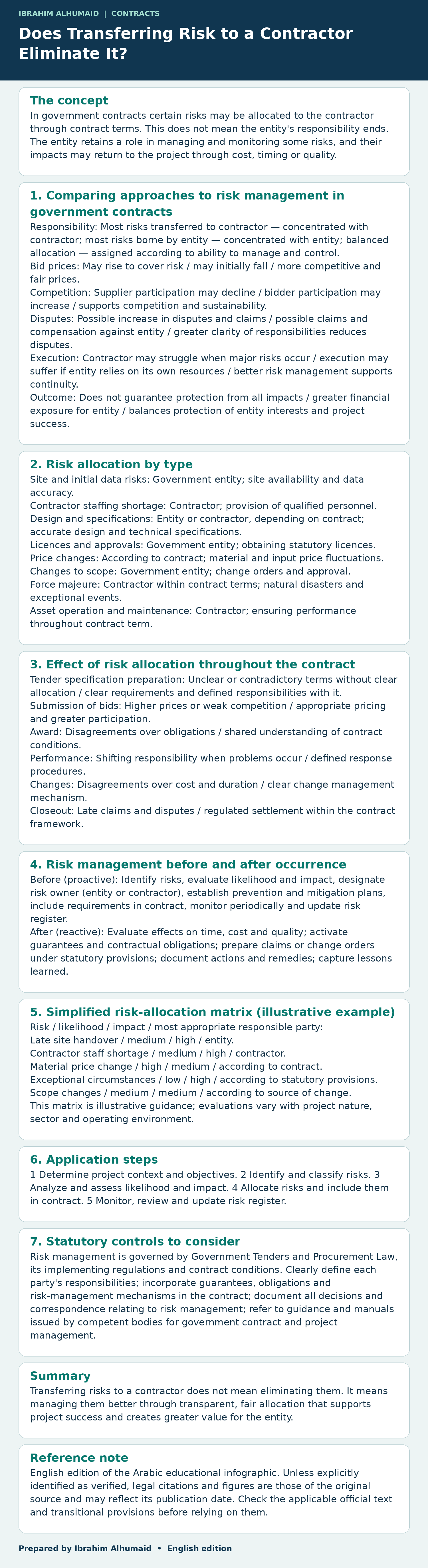
English transcript
The concept
In government contracts certain risks may be allocated to the contractor through contract terms. This does not mean the entity's responsibility ends. The entity retains a role in managing and monitoring some risks, and their impacts may return to the project through cost, timing or quality.
1. Comparing approaches to risk management in government contracts
Responsibility: Most risks transferred to contractor — concentrated with contractor; most risks borne by entity — concentrated with entity; balanced allocation — assigned according to ability to manage and control.
Bid prices: May rise to cover risk / may initially fall / more competitive and fair prices.
Competition: Supplier participation may decline / bidder participation may increase / supports competition and sustainability.
Disputes: Possible increase in disputes and claims / possible claims and compensation against entity / greater clarity of responsibilities reduces disputes.
Execution: Contractor may struggle when major risks occur / execution may suffer if entity relies on its own resources / better risk management supports continuity.
Outcome: Does not guarantee protection from all impacts / greater financial exposure for entity / balances protection of entity interests and project success.
2. Risk allocation by type
Site and initial data risks: Government entity; site availability and data accuracy.
Contractor staffing shortage: Contractor; provision of qualified personnel.
Design and specifications: Entity or contractor, depending on contract; accurate design and technical specifications.
Licences and approvals: Government entity; obtaining statutory licences.
Price changes: According to contract; material and input price fluctuations.
Changes to scope: Government entity; change orders and approval.
Force majeure: Contractor within contract terms; natural disasters and exceptional events.
Asset operation and maintenance: Contractor; ensuring performance throughout contract term.
3. Effect of risk allocation throughout the contract
Tender specification preparation: Unclear or contradictory terms without clear allocation / clear requirements and defined responsibilities with it.
Submission of bids: Higher prices or weak competition / appropriate pricing and greater participation.
Award: Disagreements over obligations / shared understanding of contract conditions.
Performance: Shifting responsibility when problems occur / defined response procedures.
Changes: Disagreements over cost and duration / clear change management mechanism.
Closeout: Late claims and disputes / regulated settlement within the contract framework.
4. Risk management before and after occurrence
Before (proactive): Identify risks, evaluate likelihood and impact, designate risk owner (entity or contractor), establish prevention and mitigation plans, include requirements in contract, monitor periodically and update risk register.
After (reactive): Evaluate effects on time, cost and quality; activate guarantees and contractual obligations; prepare claims or change orders under statutory provisions; document actions and remedies; capture lessons learned.
5. Simplified risk-allocation matrix (illustrative example)
Risk / likelihood / impact / most appropriate responsible party:
Late site handover / medium / high / entity.
Contractor staff shortage / medium / high / contractor.
Material price change / high / medium / according to contract.
Exceptional circumstances / low / high / according to statutory provisions.
Scope changes / medium / medium / according to source of change.
This matrix is illustrative guidance; evaluations vary with project nature, sector and operating environment.
6. Application steps
1 Determine project context and objectives. 2 Identify and classify risks. 3 Analyze and assess likelihood and impact. 4 Allocate risks and include them in contract. 5 Monitor, review and update risk register.
7. Statutory controls to consider
Risk management is governed by Government Tenders and Procurement Law, its implementing regulations and contract conditions. Clearly define each party's responsibilities; incorporate guarantees, obligations and risk-management mechanisms in the contract; document all decisions and correspondence relating to risk management; refer to guidance and manuals issued by competent bodies for government contract and project management.
Summary
Transferring risks to a contractor does not mean eliminating them. It means managing them better through transparent, fair allocation that supports project success and creates greater value for the entity.
Reference note
English edition of the Arabic educational infographic. Unless explicitly identified as verified, legal citations and figures are those of the original source and may reflect its publication date. Check the applicable official text and transitional provisions before relying on them.