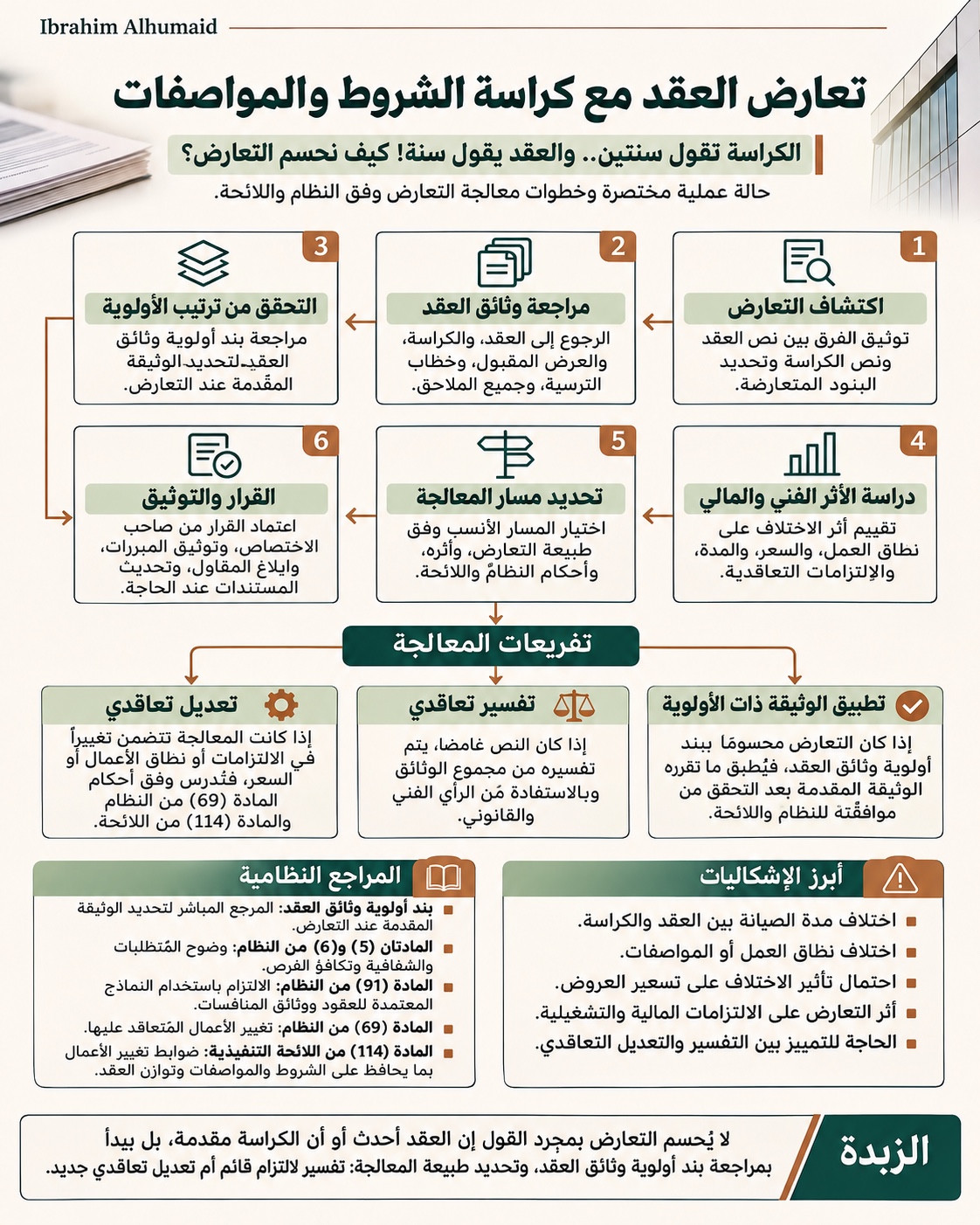
When the Contract Conflicts with the Tender Specifications
The tender says two years; the contract says one. How do you resolve it?
Practical case
The tender specifies two years of maintenance, but the signed contract says one year. Neither the date of the contract nor the fact that a requirement was in the tender settles the conflict on its own.
Six steps for resolving the conflict
- Identify the conflict. Record the exact contract and tender clauses that differ.
- Review the contract documents. Check the signed contract, tender specifications, accepted bid, award letter and all annexes.
- Check the order of precedence. Use the contractual clause to identify which incorporated document takes priority.
- Assess technical and financial impact. Review how the difference affects the scope, price, duration and obligations.
- Identify the right remedy. Consider the nature and effect of the conflict under the applicable law and regulations.
- Decide and document. Obtain the decision from the competent authority, record the reasons, notify the contractor and update the documents if required.
Three possible routes
Apply the document that takes precedence
Where the precedence clause resolves the inconsistency, apply the controlling document after checking conformity with the applicable law and regulations.
Interpret an existing obligation
If the language is ambiguous, read the relevant documents together and seek technical and legal input. Do not use interpretation to add a new obligation.
Amend the contract where permitted
If the proposed solution changes the work, scope, obligations or price, identify the specific authority and approvals required. For changes to contracted works, check Law Article 69 and amended Regulation Article 114 where applicable. A price adjustment is not automatically a change order.
What can be affected?
- The maintenance period, scope or technical specifications.
- How bidders priced their offers.
- Financial and operational obligations.
- Whether the proposed remedy is an interpretation or a contractual amendment.
Regulatory references
These citations concern the Saudi Government Tenders and Procurement Law under Royal Decree M/128 and its implementing regulations. Apply the relevant transitional rules.
- Contract order-of-precedence clause: The starting point for determining which incorporated document controls when terms conflict.
- Law Articles 5 and 6: Clear procurement information and the principles of fairness, transparency and equal opportunity in public tenders.
- Law Article 91: Use of approved standard forms for contracts, tender documents and other specified documents.
- Law Article 69 and amended Regulation Article 114: Change orders and their controls. Neither sets a universal order of document precedence.
Law and implementing regulations · Article 114 amendment · Transitional provisions
Bottom line
Start with document precedence and the actual wording. Then decide whether you are clarifying an existing obligation or proposing a new contractual change.
View the signed Arabic infographic