Category: Contracts
Ownership Rights or Use Rights? Comparing Acquired, Restricted and Surviving Contractual Rights
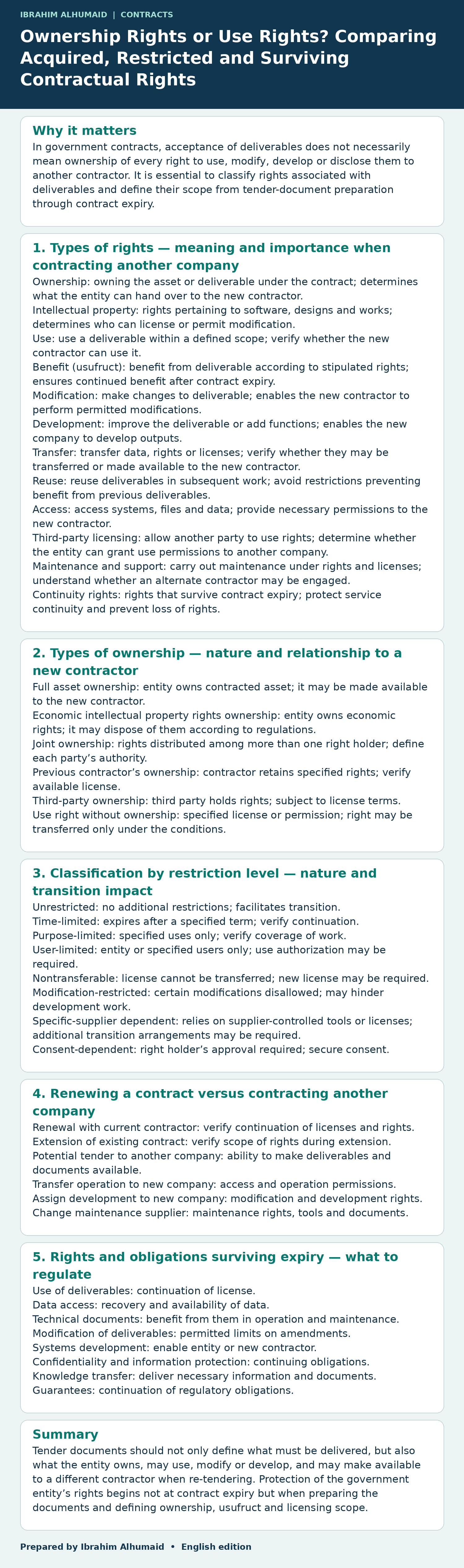
English transcript
Why it matters
In government contracts, acceptance of deliverables does not necessarily mean ownership of every right to use, modify, develop or disclose them to another contractor. It is essential to classify rights associated with deliverables and define their scope from tender-document preparation through contract expiry.
1. Types of rights — meaning and importance when contracting another company
Ownership: owning the asset or deliverable under the contract; determines what the entity can hand over to the new contractor.
Intellectual property: rights pertaining to software, designs and works; determines who can license or permit modification.
Use: use a deliverable within a defined scope; verify whether the new contractor can use it.
Benefit (usufruct): benefit from deliverable according to stipulated rights; ensures continued benefit after contract expiry.
Modification: make changes to deliverable; enables the new contractor to perform permitted modifications.
Development: improve the deliverable or add functions; enables the new company to develop outputs.
Transfer: transfer data, rights or licenses; verify whether they may be transferred or made available to the new contractor.
Reuse: reuse deliverables in subsequent work; avoid restrictions preventing benefit from previous deliverables.
Access: access systems, files and data; provide necessary permissions to the new contractor.
Third-party licensing: allow another party to use rights; determine whether the entity can grant use permissions to another company.
Maintenance and support: carry out maintenance under rights and licenses; understand whether an alternate contractor may be engaged.
Continuity rights: rights that survive contract expiry; protect service continuity and prevent loss of rights.
2. Types of ownership — nature and relationship to a new contractor
Full asset ownership: entity owns contracted asset; it may be made available to the new contractor.
Economic intellectual property rights ownership: entity owns economic rights; it may dispose of them according to regulations.
Joint ownership: rights distributed among more than one right holder; define each party’s authority.
Previous contractor’s ownership: contractor retains specified rights; verify available license.
Third-party ownership: third party holds rights; subject to license terms.
Use right without ownership: specified license or permission; right may be transferred only under the conditions.
3. Classification by restriction level — nature and transition impact
Unrestricted: no additional restrictions; facilitates transition.
Time-limited: expires after a specified term; verify continuation.
Purpose-limited: specified uses only; verify coverage of work.
User-limited: entity or specified users only; use authorization may be required.
Nontransferable: license cannot be transferred; new license may be required.
Modification-restricted: certain modifications disallowed; may hinder development work.
Specific-supplier dependent: relies on supplier-controlled tools or licenses; additional transition arrangements may be required.
Consent-dependent: right holder’s approval required; secure consent.
4. Renewing a contract versus contracting another company
Renewal with current contractor: verify continuation of licenses and rights.
Extension of existing contract: verify scope of rights during extension.
Potential tender to another company: ability to make deliverables and documents available.
Transfer operation to new company: access and operation permissions.
Assign development to new company: modification and development rights.
Change maintenance supplier: maintenance rights, tools and documents.
5. Rights and obligations surviving expiry — what to regulate
Use of deliverables: continuation of license.
Data access: recovery and availability of data.
Technical documents: benefit from them in operation and maintenance.
Modification of deliverables: permitted limits on amendments.
Systems development: enable entity or new contractor.
Confidentiality and information protection: continuing obligations.
Knowledge transfer: deliver necessary information and documents.
Guarantees: continuation of regulatory obligations.
Summary
Tender documents should not only define what must be delivered, but also what the entity owns, may use, modify or develop, and may make available to a different contractor when re-tendering. Protection of the government entity’s rights begins not at contract expiry but when preparing the documents and defining ownership, usufruct and licensing scope.