Category: Tenders
How Can a Government Entity Verify that a Project or Service Is Exclusive Before Direct Contracting?
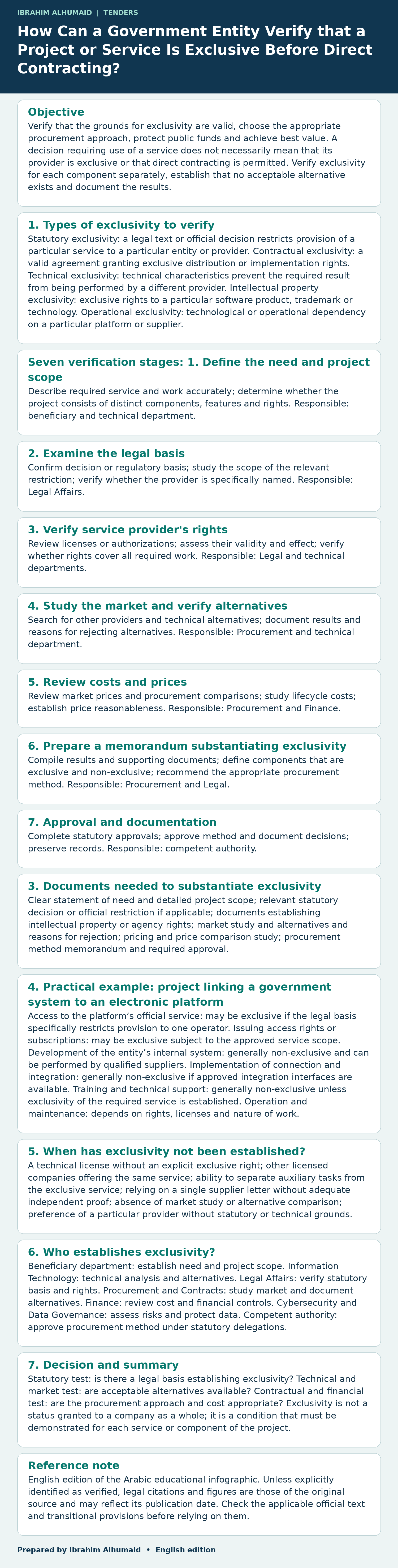
English transcript
Objective
Verify that the grounds for exclusivity are valid, choose the appropriate procurement approach, protect public funds and achieve best value. A decision requiring use of a service does not necessarily mean that its provider is exclusive or that direct contracting is permitted. Verify exclusivity for each component separately, establish that no acceptable alternative exists and document the results.
1. Types of exclusivity to verify
Statutory exclusivity: a legal text or official decision restricts provision of a particular service to a particular entity or provider. Contractual exclusivity: a valid agreement granting exclusive distribution or implementation rights. Technical exclusivity: technical characteristics prevent the required result from being performed by a different provider. Intellectual property exclusivity: exclusive rights to a particular software product, trademark or technology. Operational exclusivity: technological or operational dependency on a particular platform or supplier.
Seven verification stages: 1. Define the need and project scope
Describe required service and work accurately; determine whether the project consists of distinct components, features and rights. Responsible: beneficiary and technical department.
2. Examine the legal basis
Confirm decision or regulatory basis; study the scope of the relevant restriction; verify whether the provider is specifically named. Responsible: Legal Affairs.
3. Verify service provider's rights
Review licenses or authorizations; assess their validity and effect; verify whether rights cover all required work. Responsible: Legal and technical departments.
4. Study the market and verify alternatives
Search for other providers and technical alternatives; document results and reasons for rejecting alternatives. Responsible: Procurement and technical department.
5. Review costs and prices
Review market prices and procurement comparisons; study lifecycle costs; establish price reasonableness. Responsible: Procurement and Finance.
6. Prepare a memorandum substantiating exclusivity
Compile results and supporting documents; define components that are exclusive and non-exclusive; recommend the appropriate procurement method. Responsible: Procurement and Legal.
7. Approval and documentation
Complete statutory approvals; approve method and document decisions; preserve records. Responsible: competent authority.
3. Documents needed to substantiate exclusivity
Clear statement of need and detailed project scope; relevant statutory decision or official restriction if applicable; documents establishing intellectual property or agency rights; market study and alternatives and reasons for rejection; pricing and price comparison study; procurement method memorandum and required approval.
4. Practical example: project linking a government system to an electronic platform
Access to the platform’s official service: may be exclusive if the legal basis specifically restricts provision to one operator. Issuing access rights or subscriptions: may be exclusive subject to the approved service scope. Development of the entity’s internal system: generally non-exclusive and can be performed by qualified suppliers. Implementation of connection and integration: generally non-exclusive if approved integration interfaces are available. Training and technical support: generally non-exclusive unless exclusivity of the required service is established. Operation and maintenance: depends on rights, licenses and nature of work.
5. When has exclusivity not been established?
A technical license without an explicit exclusive right; other licensed companies offering the same service; ability to separate auxiliary tasks from the exclusive service; relying on a single supplier letter without adequate independent proof; absence of market study or alternative comparison; preference of a particular provider without statutory or technical grounds.
6. Who establishes exclusivity?
Beneficiary department: establish need and project scope. Information Technology: technical analysis and alternatives. Legal Affairs: verify statutory basis and rights. Procurement and Contracts: study market and document alternatives. Finance: review cost and financial controls. Cybersecurity and Data Governance: assess risks and protect data. Competent authority: approve procurement method under statutory delegations.
7. Decision and summary
Statutory test: is there a legal basis establishing exclusivity? Technical and market test: are acceptable alternatives available? Contractual and financial test: are the procurement approach and cost appropriate? Exclusivity is not a status granted to a company as a whole; it is a condition that must be demonstrated for each service or component of the project.
Reference note
English edition of the Arabic educational infographic. Unless explicitly identified as verified, legal citations and figures are those of the original source and may reflect its publication date. Check the applicable official text and transitional provisions before relying on them.