Category: Tenders
Direct Purchasing in Government Procurement
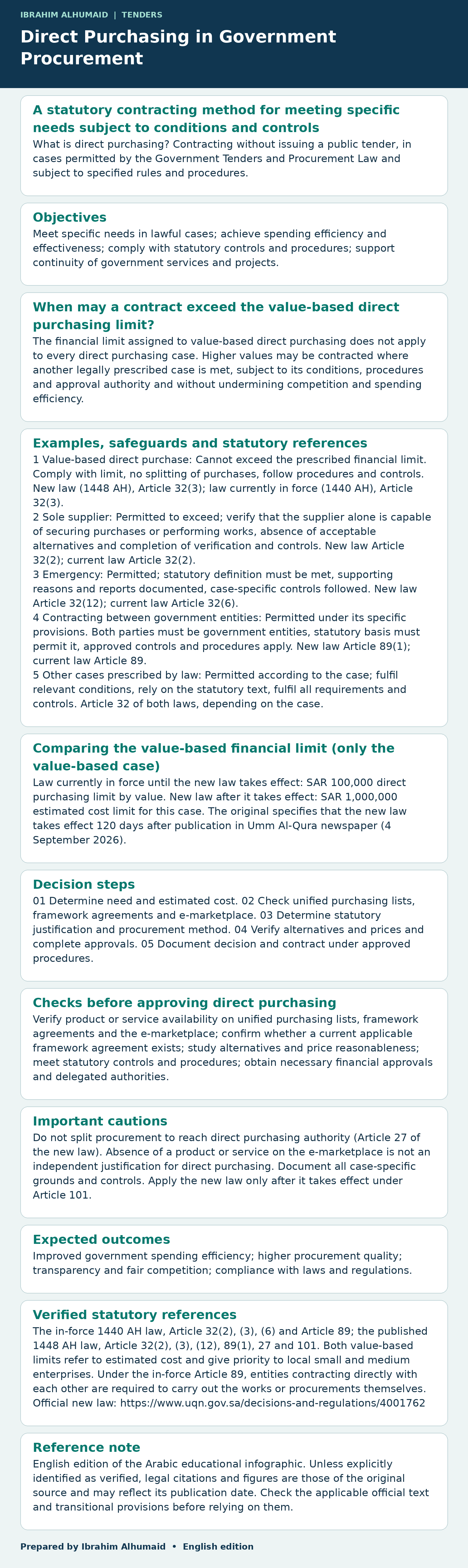
English transcript
A statutory contracting method for meeting specific needs subject to conditions and controls
What is direct purchasing? Contracting without issuing a public tender, in cases permitted by the Government Tenders and Procurement Law and subject to specified rules and procedures.
Objectives
Meet specific needs in lawful cases; achieve spending efficiency and effectiveness; comply with statutory controls and procedures; support continuity of government services and projects.
When may a contract exceed the value-based direct purchasing limit?
The financial limit assigned to value-based direct purchasing does not apply to every direct purchasing case. Higher values may be contracted where another legally prescribed case is met, subject to its conditions, procedures and approval authority and without undermining competition and spending efficiency.
Examples, safeguards and statutory references
1 Value-based direct purchase: Cannot exceed the prescribed financial limit. Comply with limit, no splitting of purchases, follow procedures and controls. New law (1448 AH), Article 32(3); law currently in force (1440 AH), Article 32(3).
2 Sole supplier: Permitted to exceed; verify that the supplier alone is capable of securing purchases or performing works, absence of acceptable alternatives and completion of verification and controls. New law Article 32(2); current law Article 32(2).
3 Emergency: Permitted; statutory definition must be met, supporting reasons and reports documented, case-specific controls followed. New law Article 32(12); current law Article 32(6).
4 Contracting between government entities: Permitted under its specific provisions. Both parties must be government entities, statutory basis must permit it, approved controls and procedures apply. New law Article 89(1); current law Article 89.
5 Other cases prescribed by law: Permitted according to the case; fulfil relevant conditions, rely on the statutory text, fulfil all requirements and controls. Article 32 of both laws, depending on the case.
Comparing the value-based financial limit (only the value-based case)
Law currently in force until the new law takes effect: SAR 100,000 direct purchasing limit by value. New law after it takes effect: SAR 1,000,000 estimated cost limit for this case. The original specifies that the new law takes effect 120 days after publication in Umm Al-Qura newspaper (4 September 2026).
Decision steps
01 Determine need and estimated cost. 02 Check unified purchasing lists, framework agreements and e-marketplace. 03 Determine statutory justification and procurement method. 04 Verify alternatives and prices and complete approvals. 05 Document decision and contract under approved procedures.
Checks before approving direct purchasing
Verify product or service availability on unified purchasing lists, framework agreements and the e-marketplace; confirm whether a current applicable framework agreement exists; study alternatives and price reasonableness; meet statutory controls and procedures; obtain necessary financial approvals and delegated authorities.
Important cautions
Do not split procurement to reach direct purchasing authority (Article 27 of the new law). Absence of a product or service on the e-marketplace is not an independent justification for direct purchasing. Document all case-specific grounds and controls. Apply the new law only after it takes effect under Article 101.
Expected outcomes
Improved government spending efficiency; higher procurement quality; transparency and fair competition; compliance with laws and regulations.
Verified statutory references
The in-force 1440 AH law, Article 32(2), (3), (6) and Article 89; the published 1448 AH law, Article 32(2), (3), (12), 89(1), 27 and 101. Both value-based limits refer to estimated cost and give priority to local small and medium enterprises. Under the in-force Article 89, entities contracting directly with each other are required to carry out the works or procurements themselves. Official new law: https://www.uqn.gov.sa/decisions-and-regulations/4001762
Reference note
English edition of the Arabic educational infographic. Unless explicitly identified as verified, legal citations and figures are those of the original source and may reflect its publication date. Check the applicable official text and transitional provisions before relying on them.