Category: Tenders
Estimated Cost in Government Tenders: Standards, Methodologies and Quality Measurement
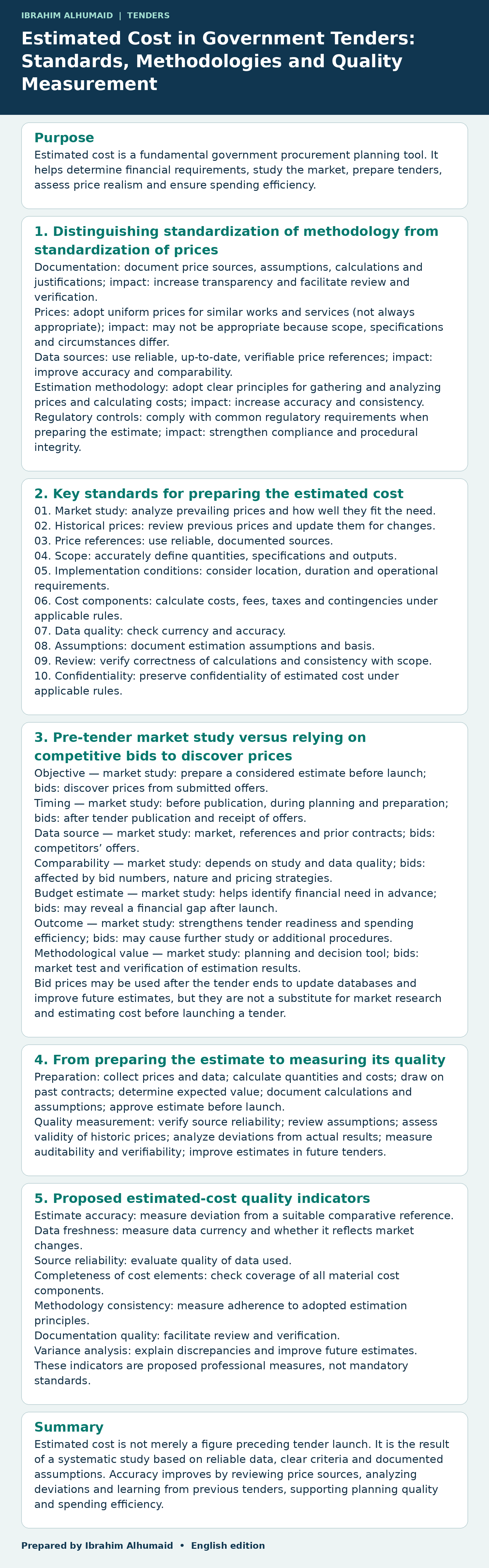
English transcript
Purpose
Estimated cost is a fundamental government procurement planning tool. It helps determine financial requirements, study the market, prepare tenders, assess price realism and ensure spending efficiency.
1. Distinguishing standardization of methodology from standardization of prices
Documentation: document price sources, assumptions, calculations and justifications; impact: increase transparency and facilitate review and verification.
Prices: adopt uniform prices for similar works and services (not always appropriate); impact: may not be appropriate because scope, specifications and circumstances differ.
Data sources: use reliable, up-to-date, verifiable price references; impact: improve accuracy and comparability.
Estimation methodology: adopt clear principles for gathering and analyzing prices and calculating costs; impact: increase accuracy and consistency.
Regulatory controls: comply with common regulatory requirements when preparing the estimate; impact: strengthen compliance and procedural integrity.
2. Key standards for preparing the estimated cost
01. Market study: analyze prevailing prices and how well they fit the need.
02. Historical prices: review previous prices and update them for changes.
03. Price references: use reliable, documented sources.
04. Scope: accurately define quantities, specifications and outputs.
05. Implementation conditions: consider location, duration and operational requirements.
06. Cost components: calculate costs, fees, taxes and contingencies under applicable rules.
07. Data quality: check currency and accuracy.
08. Assumptions: document estimation assumptions and basis.
09. Review: verify correctness of calculations and consistency with scope.
10. Confidentiality: preserve confidentiality of estimated cost under applicable rules.
3. Pre-tender market study versus relying on competitive bids to discover prices
Objective — market study: prepare a considered estimate before launch; bids: discover prices from submitted offers.
Timing — market study: before publication, during planning and preparation; bids: after tender publication and receipt of offers.
Data source — market study: market, references and prior contracts; bids: competitors’ offers.
Comparability — market study: depends on study and data quality; bids: affected by bid numbers, nature and pricing strategies.
Budget estimate — market study: helps identify financial need in advance; bids: may reveal a financial gap after launch.
Outcome — market study: strengthens tender readiness and spending efficiency; bids: may cause further study or additional procedures.
Methodological value — market study: planning and decision tool; bids: market test and verification of estimation results.
Bid prices may be used after the tender ends to update databases and improve future estimates, but they are not a substitute for market research and estimating cost before launching a tender.
4. From preparing the estimate to measuring its quality
Preparation: collect prices and data; calculate quantities and costs; draw on past contracts; determine expected value; document calculations and assumptions; approve estimate before launch.
Quality measurement: verify source reliability; review assumptions; assess validity of historic prices; analyze deviations from actual results; measure auditability and verifiability; improve estimates in future tenders.
5. Proposed estimated-cost quality indicators
Estimate accuracy: measure deviation from a suitable comparative reference.
Data freshness: measure data currency and whether it reflects market changes.
Source reliability: evaluate quality of data used.
Completeness of cost elements: check coverage of all material cost components.
Methodology consistency: measure adherence to adopted estimation principles.
Documentation quality: facilitate review and verification.
Variance analysis: explain discrepancies and improve future estimates.
These indicators are proposed professional measures, not mandatory standards.
Summary
Estimated cost is not merely a figure preceding tender launch. It is the result of a systematic study based on reliable data, clear criteria and documented assumptions. Accuracy improves by reviewing price sources, analyzing deviations and learning from previous tenders, supporting planning quality and spending efficiency.