Category: Tenders
Review of Government Tenders by the Expenditure and Projects Efficiency Authority (EXPRO)
English transcript
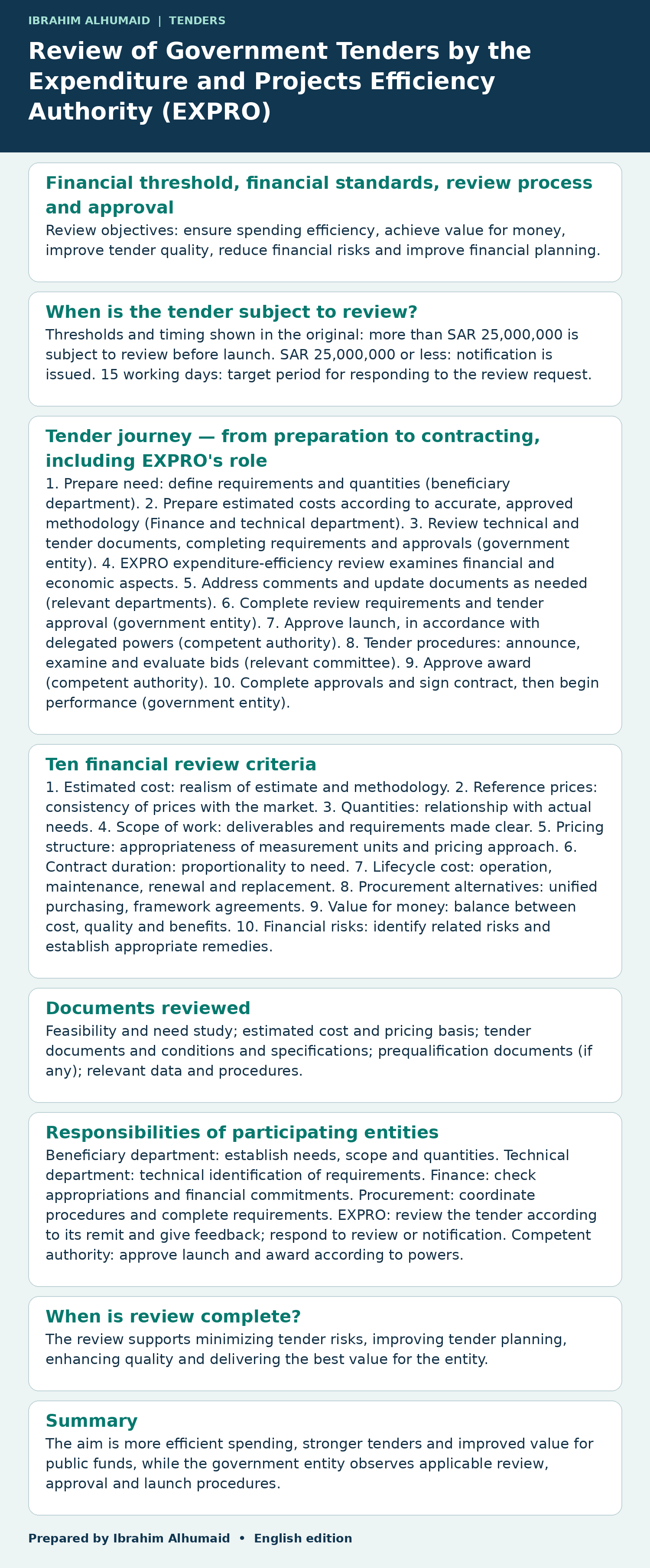
Financial threshold, financial standards, review process and approval
Review objectives: ensure spending efficiency, achieve value for money, improve tender quality, reduce financial risks and improve financial planning.
When is the tender subject to review?
Thresholds and timing shown in the original: more than SAR 25,000,000 is subject to review before launch. SAR 25,000,000 or less: notification is issued. 15 working days: target period for responding to the review request.
Tender journey — from preparation to contracting, including EXPRO's role
1. Prepare need: define requirements and quantities (beneficiary department). 2. Prepare estimated costs according to accurate, approved methodology (Finance and technical department). 3. Review technical and tender documents, completing requirements and approvals (government entity). 4. EXPRO expenditure-efficiency review examines financial and economic aspects. 5. Address comments and update documents as needed (relevant departments). 6. Complete review requirements and tender approval (government entity). 7. Approve launch, in accordance with delegated powers (competent authority). 8. Tender procedures: announce, examine and evaluate bids (relevant committee). 9. Approve award (competent authority). 10. Complete approvals and sign contract, then begin performance (government entity).
Ten financial review criteria
1. Estimated cost: realism of estimate and methodology. 2. Reference prices: consistency of prices with the market. 3. Quantities: relationship with actual needs. 4. Scope of work: deliverables and requirements made clear. 5. Pricing structure: appropriateness of measurement units and pricing approach. 6. Contract duration: proportionality to need. 7. Lifecycle cost: operation, maintenance, renewal and replacement. 8. Procurement alternatives: unified purchasing, framework agreements. 9. Value for money: balance between cost, quality and benefits. 10. Financial risks: identify related risks and establish appropriate remedies.
Documents reviewed
Feasibility and need study; estimated cost and pricing basis; tender documents and conditions and specifications; prequalification documents (if any); relevant data and procedures.
Responsibilities of participating entities
Beneficiary department: establish needs, scope and quantities. Technical department: technical identification of requirements. Finance: check appropriations and financial commitments. Procurement: coordinate procedures and complete requirements. EXPRO: review the tender according to its remit and give feedback; respond to review or notification. Competent authority: approve launch and award according to powers.
When is review complete?
The review supports minimizing tender risks, improving tender planning, enhancing quality and delivering the best value for the entity.
Summary
The aim is more efficient spending, stronger tenders and improved value for public funds, while the government entity observes applicable review, approval and launch procedures.