Fixed-Term or Completion-Based Contracts?
Glossary · Fixed-Term Contract and Completion-Based Contract
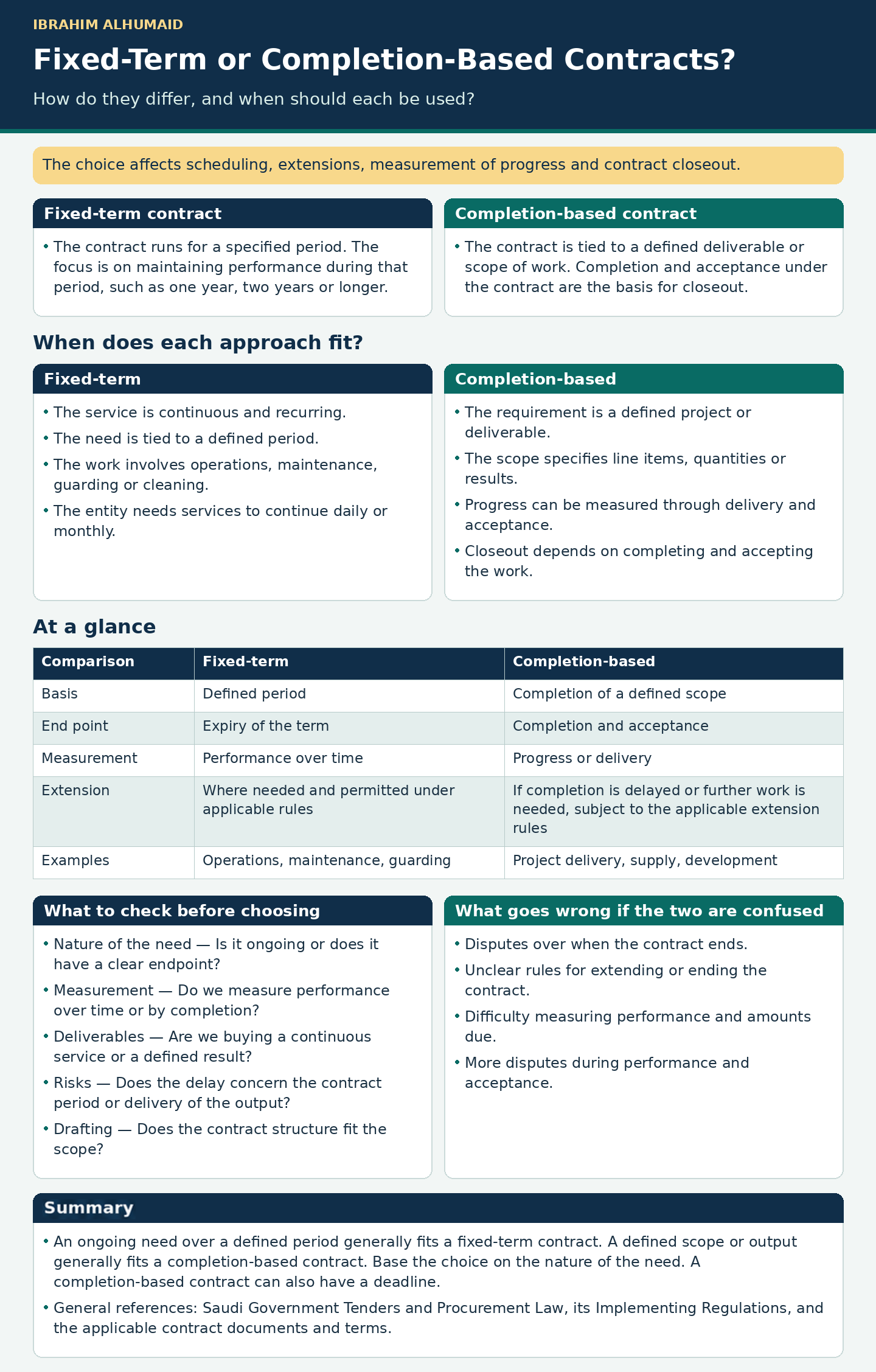
How do they differ, and when should each be used? The choice affects scheduling, extensions, measurement of progress and contract closeout.
Fixed-term contract
The contract runs for a specified period. The focus is on maintaining performance during that period, such as one year, two years or longer.
Completion-based contract
The contract is tied to a defined deliverable or scope of work. Completion and acceptance under the contract are the basis for closeout.
When to use fixed-term contracts
- The service is continuous and recurring.
- The need is tied to a defined period.
- The work involves operations, maintenance, guarding or cleaning.
- The entity needs services to continue daily or monthly.
When to use completion-based contracts
- The requirement is a defined project or deliverable.
- The scope specifies line items, quantities or results.
- Progress can be measured through delivery and acceptance.
- Closeout depends on completing and accepting the work.
At a glance
- Basis. Fixed-term: Defined period. Completion-based: Completion of a defined scope.
- End point. Fixed-term: Expiry of the term. Completion-based: Completion and acceptance.
- Measurement. Fixed-term: Performance over time. Completion-based: Progress or delivery.
- Extension. Fixed-term: Where needed and permitted under applicable rules. Completion-based: If completion is delayed or further work is needed, subject to the applicable extension rules.
- Examples. Fixed-term: Operations, maintenance, guarding. Completion-based: Project delivery, supply, development.
Checks before choosing
- Nature of the need — Is it ongoing or does it have a clear endpoint?
- Measurement — Do we measure performance over time or by completion?
- Deliverables — Are we buying a continuous service or a defined result?
- Risks — Does the delay concern the contract period or delivery of the output?
- Drafting — Does the contract structure fit the scope?
Risks
- Disputes over when the contract ends.
- Unclear rules for extending or ending the contract.
- Difficulty measuring performance and amounts due.
- More disputes during performance and acceptance.
Summary
An ongoing need over a defined period generally fits a fixed-term contract. A defined scope or output generally fits a completion-based contract. Base the choice on the nature of the need. A completion-based contract can also have a deadline.
General references: Saudi Government Tenders and Procurement Law, its Implementing Regulations, and the applicable contract documents and terms.