Category: Contracts
When May Government Entities Contract with Foreign Companies?
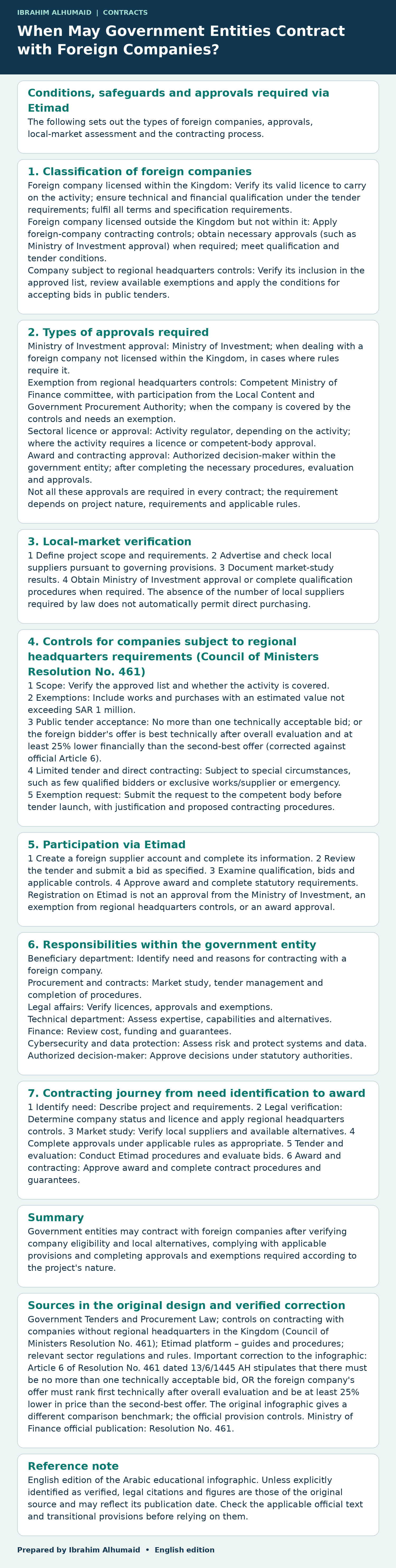
English transcript
Conditions, safeguards and approvals required via Etimad
The following sets out the types of foreign companies, approvals, local-market assessment and the contracting process.
1. Classification of foreign companies
Foreign company licensed within the Kingdom: Verify its valid licence to carry on the activity; ensure technical and financial qualification under the tender requirements; fulfil all terms and specification requirements.
Foreign company licensed outside the Kingdom but not within it: Apply foreign-company contracting controls; obtain necessary approvals (such as Ministry of Investment approval) when required; meet qualification and tender conditions.
Company subject to regional headquarters controls: Verify its inclusion in the approved list, review available exemptions and apply the conditions for accepting bids in public tenders.
2. Types of approvals required
Ministry of Investment approval: Ministry of Investment; when dealing with a foreign company not licensed within the Kingdom, in cases where rules require it.
Exemption from regional headquarters controls: Competent Ministry of Finance committee, with participation from the Local Content and Government Procurement Authority; when the company is covered by the controls and needs an exemption.
Sectoral licence or approval: Activity regulator, depending on the activity; where the activity requires a licence or competent-body approval.
Award and contracting approval: Authorized decision-maker within the government entity; after completing the necessary procedures, evaluation and approvals.
Not all these approvals are required in every contract; the requirement depends on project nature, requirements and applicable rules.
3. Local-market verification
1 Define project scope and requirements. 2 Advertise and check local suppliers pursuant to governing provisions. 3 Document market-study results. 4 Obtain Ministry of Investment approval or complete qualification procedures when required. The absence of the number of local suppliers required by law does not automatically permit direct purchasing.
4. Controls for companies subject to regional headquarters requirements (Council of Ministers Resolution No. 461)
1 Scope: Verify the approved list and whether the activity is covered.
2 Exemptions: Include works and purchases with an estimated value not exceeding SAR 1 million.
3 Public tender acceptance: No more than one technically acceptable bid; or the foreign bidder's offer is best technically after overall evaluation and at least 25% lower financially than the second-best offer (corrected against official Article 6).
4 Limited tender and direct contracting: Subject to special circumstances, such as few qualified bidders or exclusive works/supplier or emergency.
5 Exemption request: Submit the request to the competent body before tender launch, with justification and proposed contracting procedures.
5. Participation via Etimad
1 Create a foreign supplier account and complete its information. 2 Review the tender and submit a bid as specified. 3 Examine qualification, bids and applicable controls. 4 Approve award and complete statutory requirements. Registration on Etimad is not an approval from the Ministry of Investment, an exemption from regional headquarters controls, or an award approval.
6. Responsibilities within the government entity
Beneficiary department: Identify need and reasons for contracting with a foreign company.
Procurement and contracts: Market study, tender management and completion of procedures.
Legal affairs: Verify licences, approvals and exemptions.
Technical department: Assess expertise, capabilities and alternatives.
Finance: Review cost, funding and guarantees.
Cybersecurity and data protection: Assess risk and protect systems and data.
Authorized decision-maker: Approve decisions under statutory authorities.
7. Contracting journey from need identification to award
1 Identify need: Describe project and requirements. 2 Legal verification: Determine company status and licence and apply regional headquarters controls. 3 Market study: Verify local suppliers and available alternatives. 4 Complete approvals under applicable rules as appropriate. 5 Tender and evaluation: Conduct Etimad procedures and evaluate bids. 6 Award and contracting: Approve award and complete contract procedures and guarantees.
Summary
Government entities may contract with foreign companies after verifying company eligibility and local alternatives, complying with applicable provisions and completing approvals and exemptions required according to the project's nature.
Sources in the original design and verified correction
Government Tenders and Procurement Law; controls on contracting with companies without regional headquarters in the Kingdom (Council of Ministers Resolution No. 461); Etimad platform – guides and procedures; relevant sector regulations and rules. Important correction to the infographic: Article 6 of Resolution No. 461 dated 13/6/1445 AH stipulates that there must be no more than one technically acceptable bid, OR the foreign company's offer must rank first technically after overall evaluation and be at least 25% lower in price than the second-best offer. The original infographic gives a different comparison benchmark; the official provision controls. Ministry of Finance official publication: Resolution No. 461.
Reference note
English edition of the Arabic educational infographic. Unless explicitly identified as verified, legal citations and figures are those of the original source and may reflect its publication date. Check the applicable official text and transitional provisions before relying on them.