Category: Contracts
Change Requests in Government Contracts
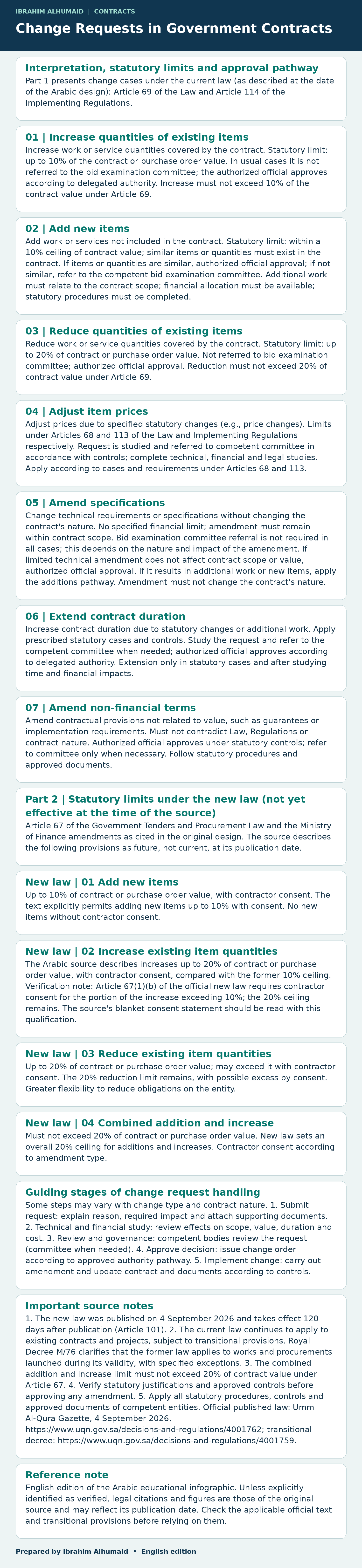
English transcript
Interpretation, statutory limits and approval pathway
Part 1 presents change cases under the current law (as described at the date of the Arabic design): Article 69 of the Law and Article 114 of the Implementing Regulations.
01 | Increase quantities of existing items
Increase work or service quantities covered by the contract. Statutory limit: up to 10% of the contract or purchase order value. In usual cases it is not referred to the bid examination committee; the authorized official approves according to delegated authority. Increase must not exceed 10% of the contract value under Article 69.
02 | Add new items
Add work or services not included in the contract. Statutory limit: within a 10% ceiling of contract value; similar items or quantities must exist in the contract. If items or quantities are similar, authorized official approval; if not similar, refer to the competent bid examination committee. Additional work must relate to the contract scope; financial allocation must be available; statutory procedures must be completed.
03 | Reduce quantities of existing items
Reduce work or service quantities covered by the contract. Statutory limit: up to 20% of contract or purchase order value. Not referred to bid examination committee; authorized official approval. Reduction must not exceed 20% of contract value under Article 69.
04 | Adjust item prices
Adjust prices due to specified statutory changes (e.g., price changes). Limits under Articles 68 and 113 of the Law and Implementing Regulations respectively. Request is studied and referred to competent committee in accordance with controls; complete technical, financial and legal studies. Apply according to cases and requirements under Articles 68 and 113.
05 | Amend specifications
Change technical requirements or specifications without changing the contract's nature. No specified financial limit; amendment must remain within contract scope. Bid examination committee referral is not required in all cases; this depends on the nature and impact of the amendment. If limited technical amendment does not affect contract scope or value, authorized official approval. If it results in additional work or new items, apply the additions pathway. Amendment must not change the contract's nature.
06 | Extend contract duration
Increase contract duration due to statutory changes or additional work. Apply prescribed statutory cases and controls. Study the request and refer to the competent committee when needed; authorized official approves according to delegated authority. Extension only in statutory cases and after studying time and financial impacts.
07 | Amend non-financial terms
Amend contractual provisions not related to value, such as guarantees or implementation requirements. Must not contradict Law, Regulations or contract nature. Authorized official approves under statutory controls; refer to committee only when necessary. Follow statutory procedures and approved documents.
Part 2 | Statutory limits under the new law (not yet effective at the time of the source)
Article 67 of the Government Tenders and Procurement Law and the Ministry of Finance amendments as cited in the original design. The source describes the following provisions as future, not current, at its publication date.
New law | 01 Add new items
Up to 10% of contract or purchase order value, with contractor consent. The text explicitly permits adding new items up to 10% with consent. No new items without contractor consent.
New law | 02 Increase existing item quantities
The Arabic source describes increases up to 20% of contract or purchase order value, with contractor consent, compared with the former 10% ceiling. Verification note: Article 67(1)(b) of the official new law requires contractor consent for the portion of the increase exceeding 10%; the 20% ceiling remains. The source's blanket consent statement should be read with this qualification.
New law | 03 Reduce existing item quantities
Up to 20% of contract or purchase order value; may exceed it with contractor consent. The 20% reduction limit remains, with possible excess by consent. Greater flexibility to reduce obligations on the entity.
New law | 04 Combined addition and increase
Must not exceed 20% of contract or purchase order value. New law sets an overall 20% ceiling for additions and increases. Contractor consent according to amendment type.
Guiding stages of change request handling
Some steps may vary with change type and contract nature. 1. Submit request: explain reason, required impact and attach supporting documents. 2. Technical and financial study: review effects on scope, value, duration and cost. 3. Review and governance: competent bodies review the request (committee when needed). 4. Approve decision: issue change order according to approved authority pathway. 5. Implement change: carry out amendment and update contract and documents according to controls.
Important source notes
1. The new law was published on 4 September 2026 and takes effect 120 days after publication (Article 101). 2. The current law continues to apply to existing contracts and projects, subject to transitional provisions. Royal Decree M/76 clarifies that the former law applies to works and procurements launched during its validity, with specified exceptions. 3. The combined addition and increase limit must not exceed 20% of contract value under Article 67. 4. Verify statutory justifications and approved controls before approving any amendment. 5. Apply all statutory procedures, controls and approved documents of competent entities. Official published law: Umm Al-Qura Gazette, 4 September 2026, https://www.uqn.gov.sa/decisions-and-regulations/4001762; transitional decree: https://www.uqn.gov.sa/decisions-and-regulations/4001759.
Reference note
English edition of the Arabic educational infographic. Unless explicitly identified as verified, legal citations and figures are those of the original source and may reflect its publication date. Check the applicable official text and transitional provisions before relying on them.