Category: Contracts
Government Contract Endings: Different Cases, Procedures and Effects
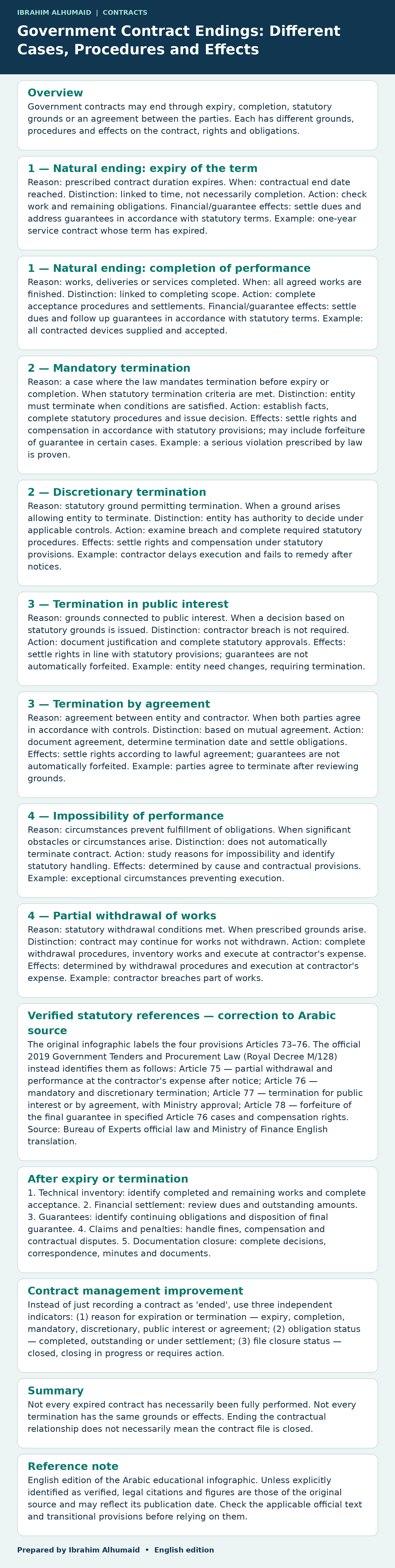
English transcript
Overview
Government contracts may end through expiry, completion, statutory grounds or an agreement between the parties. Each has different grounds, procedures and effects on the contract, rights and obligations.
1 — Natural ending: expiry of the term
Reason: prescribed contract duration expires. When: contractual end date reached. Distinction: linked to time, not necessarily completion. Action: check work and remaining obligations. Financial/guarantee effects: settle dues and address guarantees in accordance with statutory terms. Example: one-year service contract whose term has expired.
1 — Natural ending: completion of performance
Reason: works, deliveries or services completed. When: all agreed works are finished. Distinction: linked to completing scope. Action: complete acceptance procedures and settlements. Financial/guarantee effects: settle dues and follow up guarantees in accordance with statutory terms. Example: all contracted devices supplied and accepted.
2 — Mandatory termination
Reason: a case where the law mandates termination before expiry or completion. When statutory termination criteria are met. Distinction: entity must terminate when conditions are satisfied. Action: establish facts, complete statutory procedures and issue decision. Effects: settle rights and compensation in accordance with statutory provisions; may include forfeiture of guarantee in certain cases. Example: a serious violation prescribed by law is proven.
2 — Discretionary termination
Reason: statutory ground permitting termination. When a ground arises allowing entity to terminate. Distinction: entity has authority to decide under applicable controls. Action: examine breach and complete required statutory procedures. Effects: settle rights and compensation under statutory provisions. Example: contractor delays execution and fails to remedy after notices.
3 — Termination in public interest
Reason: grounds connected to public interest. When a decision based on statutory grounds is issued. Distinction: contractor breach is not required. Action: document justification and complete statutory approvals. Effects: settle rights in line with statutory provisions; guarantees are not automatically forfeited. Example: entity need changes, requiring termination.
3 — Termination by agreement
Reason: agreement between entity and contractor. When both parties agree in accordance with controls. Distinction: based on mutual agreement. Action: document agreement, determine termination date and settle obligations. Effects: settle rights according to lawful agreement; guarantees are not automatically forfeited. Example: parties agree to terminate after reviewing grounds.
4 — Impossibility of performance
Reason: circumstances prevent fulfillment of obligations. When significant obstacles or circumstances arise. Distinction: does not automatically terminate contract. Action: study reasons for impossibility and identify statutory handling. Effects: determined by cause and contractual provisions. Example: exceptional circumstances preventing execution.
4 — Partial withdrawal of works
Reason: statutory withdrawal conditions met. When prescribed grounds arise. Distinction: contract may continue for works not withdrawn. Action: complete withdrawal procedures, inventory works and execute at contractor's expense. Effects: determined by withdrawal procedures and execution at contractor's expense. Example: contractor breaches part of works.
Verified statutory references — correction to Arabic source
The original infographic labels the four provisions Articles 73–76. The official 2019 Government Tenders and Procurement Law (Royal Decree M/128) instead identifies them as follows: Article 75 — partial withdrawal and performance at the contractor's expense after notice; Article 76 — mandatory and discretionary termination; Article 77 — termination for public interest or by agreement, with Ministry approval; Article 78 — forfeiture of the final guarantee in specified Article 76 cases and compensation rights. Source: Bureau of Experts official law and Ministry of Finance English translation.
After expiry or termination
1. Technical inventory: identify completed and remaining works and complete acceptance. 2. Financial settlement: review dues and outstanding amounts. 3. Guarantees: identify continuing obligations and disposition of final guarantee. 4. Claims and penalties: handle fines, compensation and contractual disputes. 5. Documentation closure: complete decisions, correspondence, minutes and documents.
Contract management improvement
Instead of just recording a contract as 'ended', use three independent indicators: (1) reason for expiration or termination — expiry, completion, mandatory, discretionary, public interest or agreement; (2) obligation status — completed, outstanding or under settlement; (3) file closure status — closed, closing in progress or requires action.
Summary
Not every expired contract has necessarily been fully performed. Not every termination has the same grounds or effects. Ending the contractual relationship does not necessarily mean the contract file is closed.
Reference note
English edition of the Arabic educational infographic. Unless explicitly identified as verified, legal citations and figures are those of the original source and may reflect its publication date. Check the applicable official text and transitional provisions before relying on them.