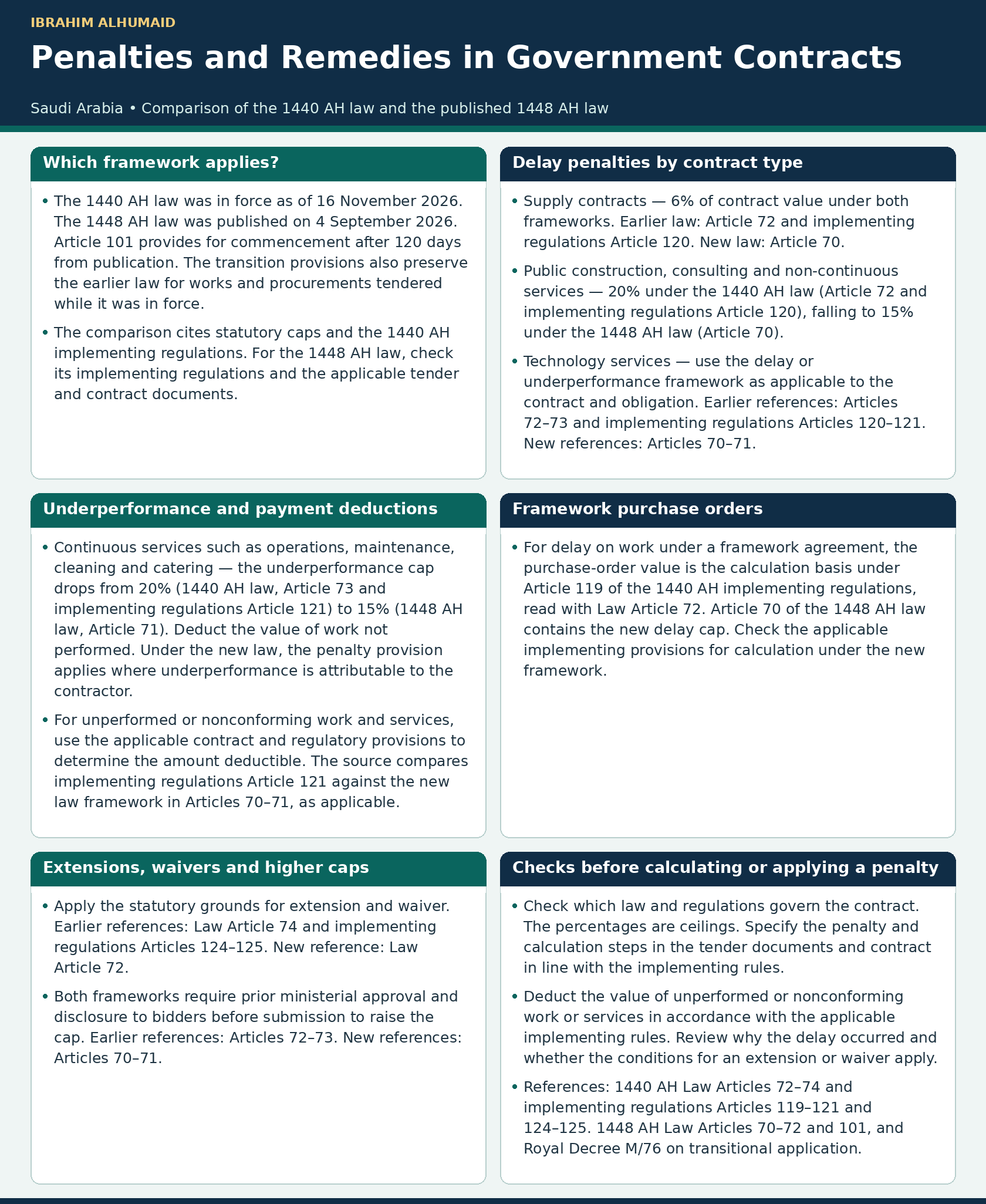
Penalties and Remedies in Government Contracts
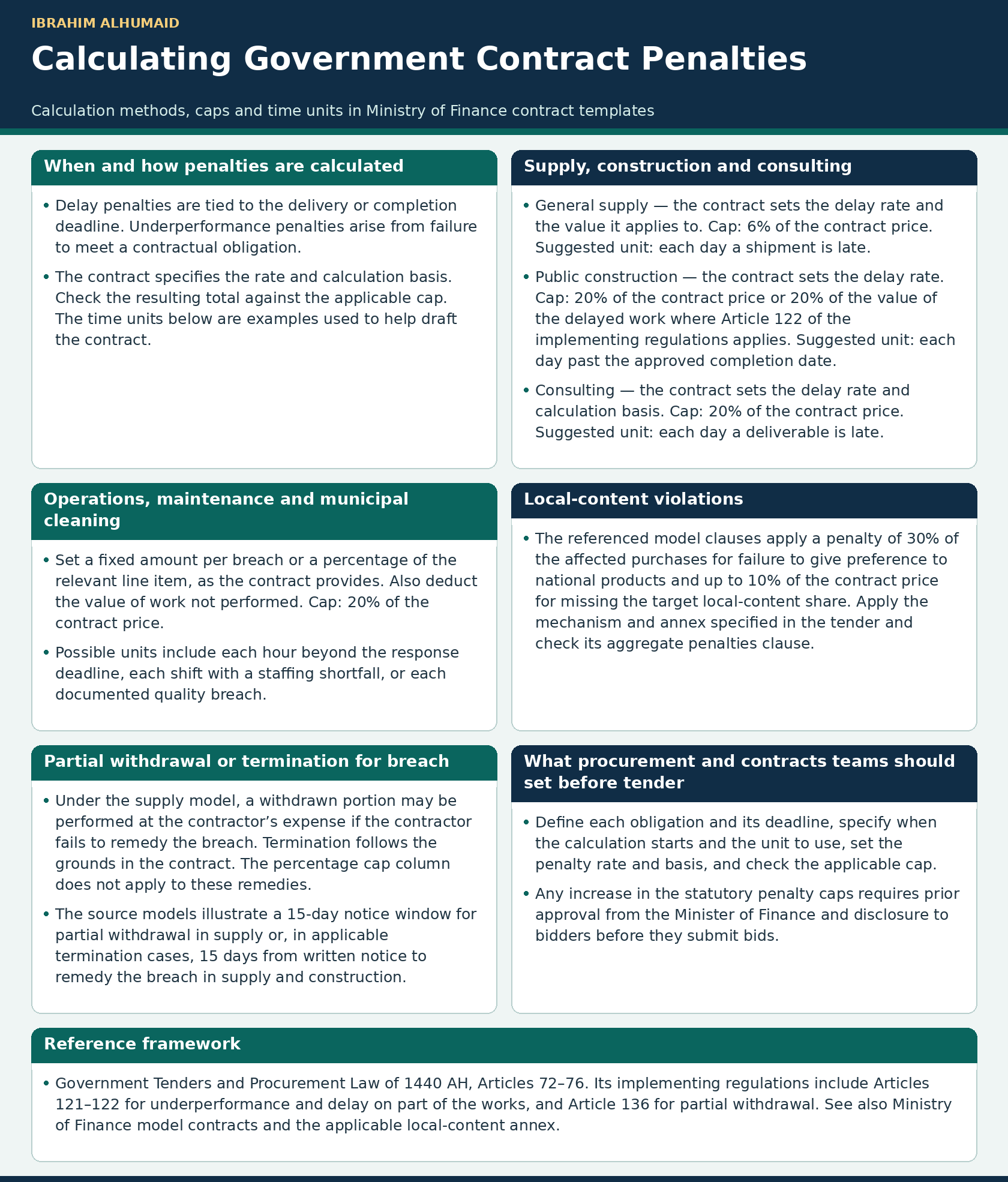
Calculating Government Contract Penalties
Penalties and Remedies in Government Contracts
Calculating Government Contract Penalties
Calculation methods, caps and time units in Ministry of Finance contract templates
When and how penalties are calculated
- Delay penalties are tied to the delivery or completion deadline. Underperformance penalties arise from failure to meet a contractual obligation.
- The contract specifies the rate and calculation basis. Check the resulting total against the applicable cap. The time units below are examples used to help draft the contract.
Supply, construction and consulting
- General supply — the contract sets the delay rate and the value it applies to. Cap: 6% of the contract price. Suggested unit: each day a shipment is late.
- Public construction — the contract sets the delay rate. Cap: 20% of the contract price or 20% of the value of the delayed work where Article 122 of the implementing regulations applies. Suggested unit: each day past the approved completion date.
- Consulting — the contract sets the delay rate and calculation basis. Cap: 20% of the contract price. Suggested unit: each day a deliverable is late.
Operations, maintenance and municipal cleaning
- Set a fixed amount per breach or a percentage of the relevant line item, as the contract provides. Also deduct the value of work not performed. Cap: 20% of the contract price.
- Possible units include each hour beyond the response deadline, each shift with a staffing shortfall, or each documented quality breach.
Local-content violations
- The referenced model clauses apply a penalty of 30% of the affected purchases for failure to give preference to national products and up to 10% of the contract price for missing the target local-content share. Apply the mechanism and annex specified in the tender and check its aggregate penalties clause.
Partial withdrawal or termination for breach
- Under the supply model, a withdrawn portion may be performed at the contractor’s expense if the contractor fails to remedy the breach. Termination follows the grounds in the contract. The percentage cap column does not apply to these remedies.
- The source models illustrate a 15-day notice window for partial withdrawal in supply or, in applicable termination cases, 15 days from written notice to remedy the breach in supply and construction.
What procurement and contracts teams should set before tender
- Define each obligation and its deadline, specify when the calculation starts and the unit to use, set the penalty rate and basis, and check the applicable cap.
- Any increase in the statutory penalty caps requires prior approval from the Minister of Finance and disclosure to bidders before they submit bids.
Reference framework
- Government Tenders and Procurement Law of 1440 AH, Articles 72–76. Its implementing regulations include Articles 121–122 for underperformance and delay on part of the works, and Article 136 for partial withdrawal. See also Ministry of Finance model contracts and the applicable local-content annex.
Penalties and Remedies in Government Contracts
Saudi Arabia • Comparison of the 1440 AH law and the published 1448 AH law
Which framework applies?
- The 1440 AH law was in force as of 16 November 2026. The 1448 AH law was published on 4 September 2026. Article 101 provides for commencement after 120 days from publication. The transition provisions also preserve the earlier law for works and procurements tendered while it was in force.
- The comparison cites statutory caps and the 1440 AH implementing regulations. For the 1448 AH law, check its implementing regulations and the applicable tender and contract documents.
Delay penalties by contract type
- Supply contracts — 6% of contract value under both frameworks. Earlier law: Article 72 and implementing regulations Article 120. New law: Article 70.
- Public construction, consulting and non-continuous services — 20% under the 1440 AH law (Article 72 and implementing regulations Article 120), falling to 15% under the 1448 AH law (Article 70).
- Technology services — use the delay or underperformance framework as applicable to the contract and obligation. Earlier references: Articles 72–73 and implementing regulations Articles 120–121. New references: Articles 70–71.
Underperformance and payment deductions
- Continuous services such as operations, maintenance, cleaning and catering — the underperformance cap drops from 20% (1440 AH law, Article 73 and implementing regulations Article 121) to 15% (1448 AH law, Article 71). Deduct the value of work not performed. Under the new law, the penalty provision applies where underperformance is attributable to the contractor.
- For unperformed or nonconforming work and services, use the applicable contract and regulatory provisions to determine the amount deductible. The source compares implementing regulations Article 121 against the new law framework in Articles 70–71, as applicable.
Framework purchase orders
- For delay on work under a framework agreement, the purchase-order value is the calculation basis under Article 119 of the 1440 AH implementing regulations, read with Law Article 72. Article 70 of the 1448 AH law contains the new delay cap. Check the applicable implementing provisions for calculation under the new framework.
Extensions, waivers and higher caps
- Apply the statutory grounds for extension and waiver. Earlier references: Law Article 74 and implementing regulations Articles 124–125. New reference: Law Article 72.
- Both frameworks require prior ministerial approval and disclosure to bidders before submission to raise the cap. Earlier references: Articles 72–73. New references: Articles 70–71.
Checks before calculating or applying a penalty
- Check which law and regulations govern the contract. The percentages are ceilings. Specify the penalty and calculation steps in the tender documents and contract in line with the implementing rules.
- Deduct the value of unperformed or nonconforming work or services in accordance with the applicable implementing rules. Review why the delay occurred and whether the conditions for an extension or waiver apply.
- References: 1440 AH Law Articles 72–74 and implementing regulations Articles 119–121 and 124–125. 1448 AH Law Articles 70–72 and 101, and Royal Decree M/76 on transitional application.