Category: Contracts
Cooperation Memoranda in Government Entities
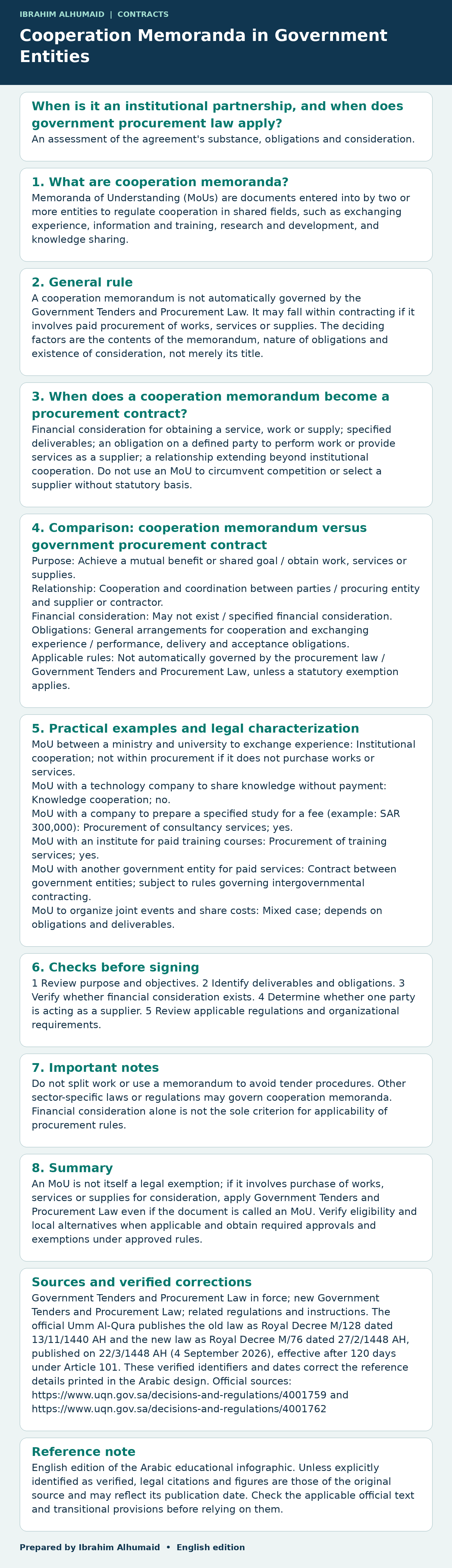
English transcript
When is it an institutional partnership, and when does government procurement law apply?
An assessment of the agreement's substance, obligations and consideration.
1. What are cooperation memoranda?
Memoranda of Understanding (MoUs) are documents entered into by two or more entities to regulate cooperation in shared fields, such as exchanging experience, information and training, research and development, and knowledge sharing.
2. General rule
A cooperation memorandum is not automatically governed by the Government Tenders and Procurement Law. It may fall within contracting if it involves paid procurement of works, services or supplies. The deciding factors are the contents of the memorandum, nature of obligations and existence of consideration, not merely its title.
3. When does a cooperation memorandum become a procurement contract?
Financial consideration for obtaining a service, work or supply; specified deliverables; an obligation on a defined party to perform work or provide services as a supplier; a relationship extending beyond institutional cooperation. Do not use an MoU to circumvent competition or select a supplier without statutory basis.
4. Comparison: cooperation memorandum versus government procurement contract
Purpose: Achieve a mutual benefit or shared goal / obtain work, services or supplies.
Relationship: Cooperation and coordination between parties / procuring entity and supplier or contractor.
Financial consideration: May not exist / specified financial consideration.
Obligations: General arrangements for cooperation and exchanging experience / performance, delivery and acceptance obligations.
Applicable rules: Not automatically governed by the procurement law / Government Tenders and Procurement Law, unless a statutory exemption applies.
5. Practical examples and legal characterization
MoU between a ministry and university to exchange experience: Institutional cooperation; not within procurement if it does not purchase works or services.
MoU with a technology company to share knowledge without payment: Knowledge cooperation; no.
MoU with a company to prepare a specified study for a fee (example: SAR 300,000): Procurement of consultancy services; yes.
MoU with an institute for paid training courses: Procurement of training services; yes.
MoU with another government entity for paid services: Contract between government entities; subject to rules governing intergovernmental contracting.
MoU to organize joint events and share costs: Mixed case; depends on obligations and deliverables.
6. Checks before signing
1 Review purpose and objectives. 2 Identify deliverables and obligations. 3 Verify whether financial consideration exists. 4 Determine whether one party is acting as a supplier. 5 Review applicable regulations and organizational requirements.
7. Important notes
Do not split work or use a memorandum to avoid tender procedures. Other sector-specific laws or regulations may govern cooperation memoranda. Financial consideration alone is not the sole criterion for applicability of procurement rules.
8. Summary
An MoU is not itself a legal exemption; if it involves purchase of works, services or supplies for consideration, apply Government Tenders and Procurement Law even if the document is called an MoU. Verify eligibility and local alternatives when applicable and obtain required approvals and exemptions under approved rules.
Sources and verified corrections
Government Tenders and Procurement Law in force; new Government Tenders and Procurement Law; related regulations and instructions. The official Umm Al-Qura publishes the old law as Royal Decree M/128 dated 13/11/1440 AH and the new law as Royal Decree M/76 dated 27/2/1448 AH, published on 22/3/1448 AH (4 September 2026), effective after 120 days under Article 101. These verified identifiers and dates correct the reference details printed in the Arabic design. Official sources: https://www.uqn.gov.sa/decisions-and-regulations/4001759 and https://www.uqn.gov.sa/decisions-and-regulations/4001762
Reference note
English edition of the Arabic educational infographic. Unless explicitly identified as verified, legal citations and figures are those of the original source and may reflect its publication date. Check the applicable official text and transitional provisions before relying on them.