Category: Contracts
Procedures and Roles in Government Property Leasing
English transcript
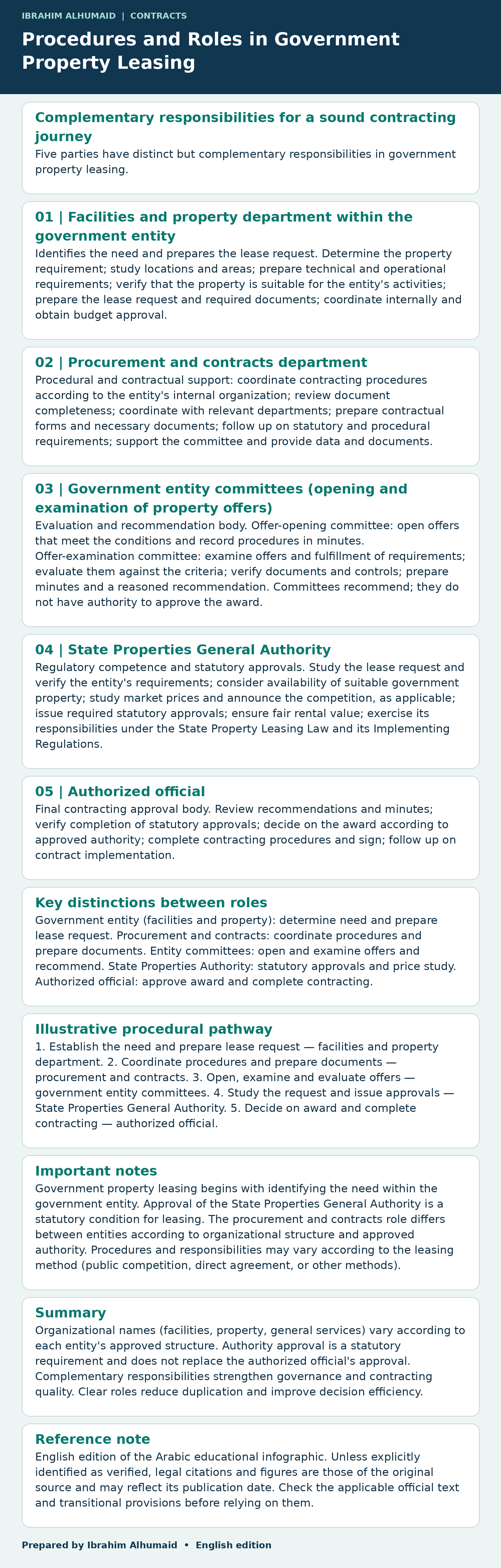
Complementary responsibilities for a sound contracting journey
Five parties have distinct but complementary responsibilities in government property leasing.
01 | Facilities and property department within the government entity
Identifies the need and prepares the lease request. Determine the property requirement; study locations and areas; prepare technical and operational requirements; verify that the property is suitable for the entity's activities; prepare the lease request and required documents; coordinate internally and obtain budget approval.
02 | Procurement and contracts department
Procedural and contractual support: coordinate contracting procedures according to the entity's internal organization; review document completeness; coordinate with relevant departments; prepare contractual forms and necessary documents; follow up on statutory and procedural requirements; support the committee and provide data and documents.
03 | Government entity committees (opening and examination of property offers)
Evaluation and recommendation body. Offer-opening committee: open offers that meet the conditions and record procedures in minutes. Offer-examination committee: examine offers and fulfillment of requirements; evaluate them against the criteria; verify documents and controls; prepare minutes and a reasoned recommendation. Committees recommend; they do not have authority to approve the award.
04 | State Properties General Authority
Regulatory competence and statutory approvals. Study the lease request and verify the entity's requirements; consider availability of suitable government property; study market prices and announce the competition, as applicable; issue required statutory approvals; ensure fair rental value; exercise its responsibilities under the State Property Leasing Law and its Implementing Regulations.
05 | Authorized official
Final contracting approval body. Review recommendations and minutes; verify completion of statutory approvals; decide on the award according to approved authority; complete contracting procedures and sign; follow up on contract implementation.
Key distinctions between roles
Government entity (facilities and property): determine need and prepare lease request. Procurement and contracts: coordinate procedures and prepare documents. Entity committees: open and examine offers and recommend. State Properties Authority: statutory approvals and price study. Authorized official: approve award and complete contracting.
Illustrative procedural pathway
1. Establish the need and prepare lease request — facilities and property department. 2. Coordinate procedures and prepare documents — procurement and contracts. 3. Open, examine and evaluate offers — government entity committees. 4. Study the request and issue approvals — State Properties General Authority. 5. Decide on award and complete contracting — authorized official.
Important notes
Government property leasing begins with identifying the need within the government entity. Approval of the State Properties General Authority is a statutory condition for leasing. The procurement and contracts role differs between entities according to organizational structure and approved authority. Procedures and responsibilities may vary according to the leasing method (public competition, direct agreement, or other methods).
Summary
Organizational names (facilities, property, general services) vary according to each entity's approved structure. Authority approval is a statutory requirement and does not replace the authorized official's approval. Complementary responsibilities strengthen governance and contracting quality. Clear roles reduce duplication and improve decision efficiency.
Reference note
English edition of the Arabic educational infographic. Unless explicitly identified as verified, legal citations and figures are those of the original source and may reflect its publication date. Check the applicable official text and transitional provisions before relying on them.