Government purchase orders (POs): When can a supplier refuse?
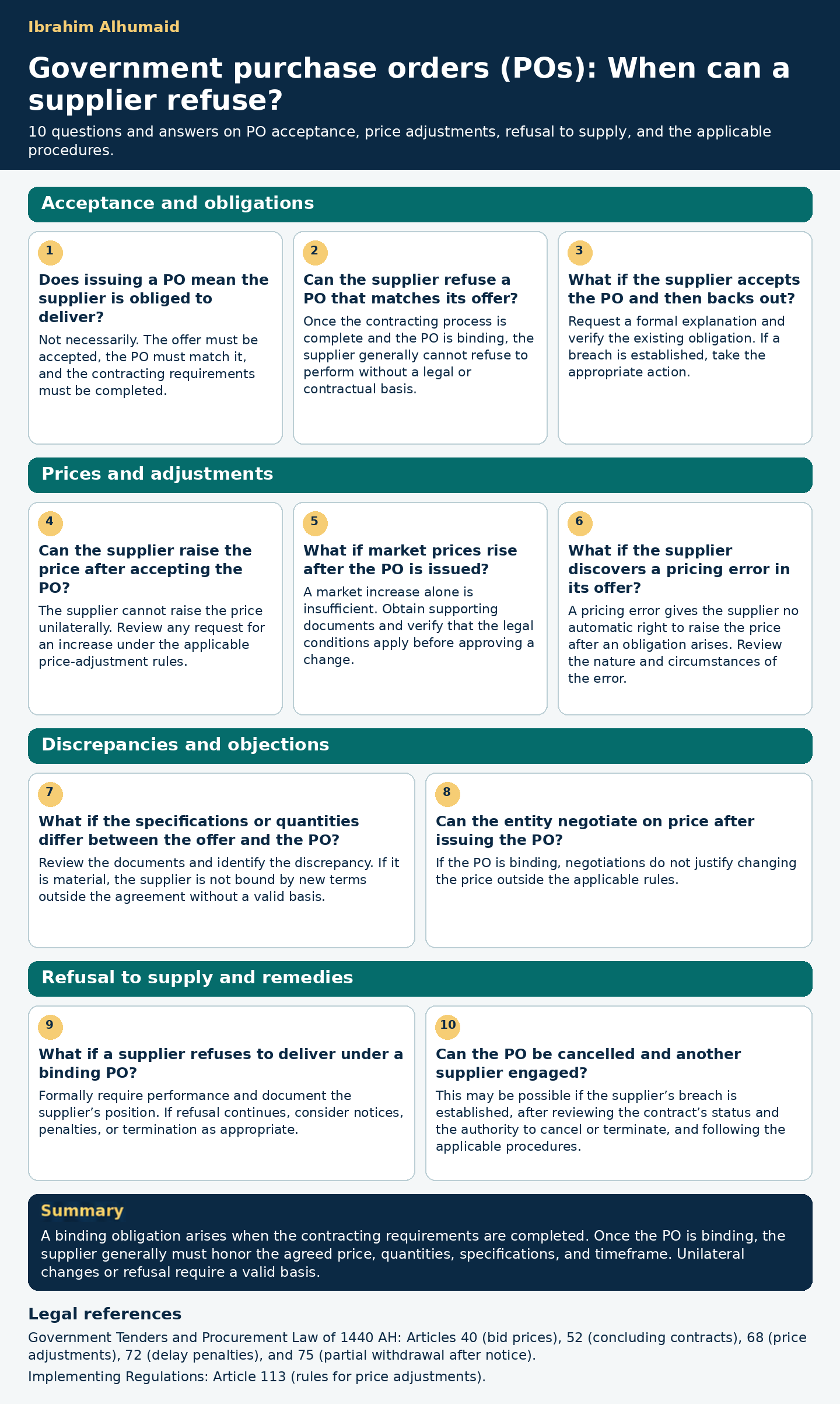
10 questions and answers on PO acceptance, price adjustments, refusal to supply, and the applicable procedures.
Acceptance and obligations
- Does issuing a PO mean the supplier is obliged to deliver?
- Not necessarily. The offer must be accepted, the PO must match it, and the contracting requirements must be completed.
- Can the supplier refuse a PO that matches its offer?
- Once the contracting process is complete and the PO is binding, the supplier generally cannot refuse to perform without a legal or contractual basis.
- What if the supplier accepts the PO and then backs out?
- Request a formal explanation and verify the existing obligation. If a breach is established, take the appropriate action.
Prices and adjustments
- Can the supplier raise the price after accepting the PO?
- The supplier cannot raise the price unilaterally. Review any request for an increase under the applicable price-adjustment rules.
- What if market prices rise after the PO is issued?
- A market increase alone is insufficient. Obtain supporting documents and verify that the legal conditions apply before approving a change.
- What if the supplier discovers a pricing error in its offer?
- A pricing error gives the supplier no automatic right to raise the price after an obligation arises. Review the nature and circumstances of the error.
Discrepancies and objections
- What if the specifications or quantities differ between the offer and the PO?
- Review the documents and identify the discrepancy. If it is material, the supplier is not bound by new terms outside the agreement without a valid basis.
- Can the entity negotiate on price after issuing the PO?
- If the PO is binding, negotiations do not justify changing the price outside the applicable rules.
Refusal to supply and remedies
- What if a supplier refuses to deliver under a binding PO?
- Formally require performance and document the supplier’s position. If refusal continues, consider notices, penalties, or termination as appropriate.
- Can the PO be cancelled and another supplier engaged?
- This may be possible if the supplier’s breach is established, after reviewing the contract’s status and the authority to cancel or terminate, and following the applicable procedures.
Summary
A binding obligation arises when the contracting requirements are completed. Once the PO is binding, the supplier generally must honor the agreed price, quantities, specifications, and timeframe. Unilateral changes or refusal require a valid basis.
Legal references
Government Tenders and Procurement Law of 1440 AH: Articles 40 (bid prices), 52 (concluding contracts), 68 (price adjustments), 72 (delay penalties), and 75 (partial withdrawal after notice).
Implementing Regulations: Article 113 (rules for price adjustments).