Category: Tenders
Government Tender Comparisons: Choosing the Appropriate Regulatory Action
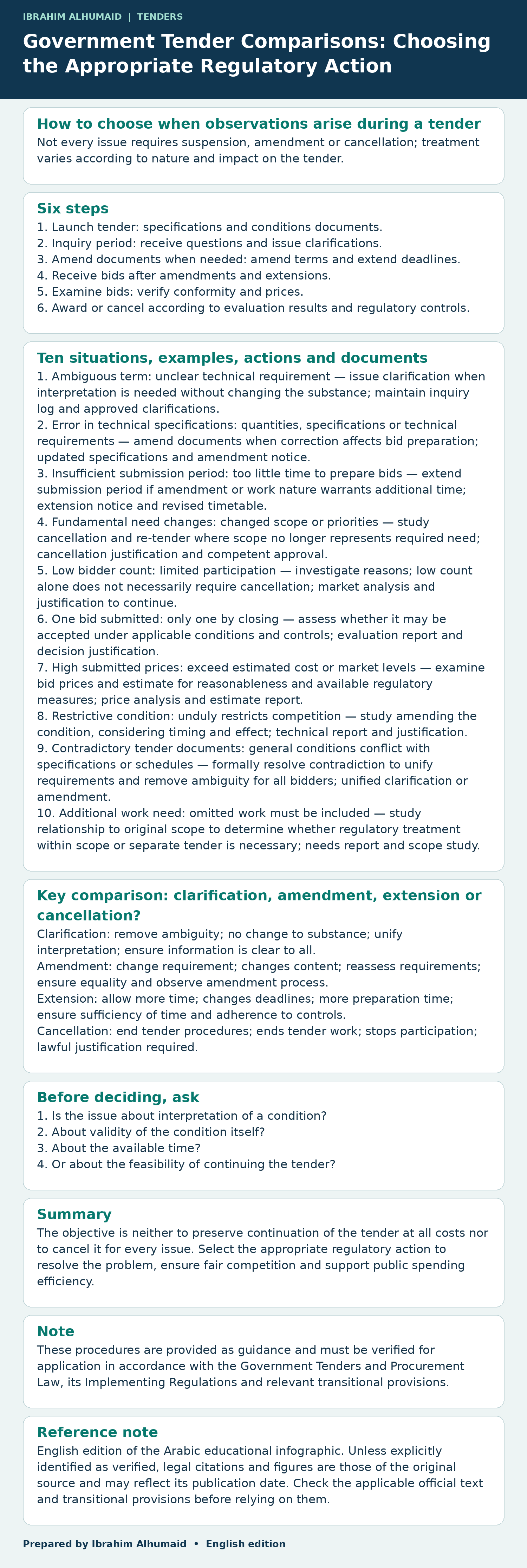
English transcript
How to choose when observations arise during a tender
Not every issue requires suspension, amendment or cancellation; treatment varies according to nature and impact on the tender.
Six steps
1. Launch tender: specifications and conditions documents.
2. Inquiry period: receive questions and issue clarifications.
3. Amend documents when needed: amend terms and extend deadlines.
4. Receive bids after amendments and extensions.
5. Examine bids: verify conformity and prices.
6. Award or cancel according to evaluation results and regulatory controls.
Ten situations, examples, actions and documents
1. Ambiguous term: unclear technical requirement — issue clarification when interpretation is needed without changing the substance; maintain inquiry log and approved clarifications.
2. Error in technical specifications: quantities, specifications or technical requirements — amend documents when correction affects bid preparation; updated specifications and amendment notice.
3. Insufficient submission period: too little time to prepare bids — extend submission period if amendment or work nature warrants additional time; extension notice and revised timetable.
4. Fundamental need changes: changed scope or priorities — study cancellation and re-tender where scope no longer represents required need; cancellation justification and competent approval.
5. Low bidder count: limited participation — investigate reasons; low count alone does not necessarily require cancellation; market analysis and justification to continue.
6. One bid submitted: only one by closing — assess whether it may be accepted under applicable conditions and controls; evaluation report and decision justification.
7. High submitted prices: exceed estimated cost or market levels — examine bid prices and estimate for reasonableness and available regulatory measures; price analysis and estimate report.
8. Restrictive condition: unduly restricts competition — study amending the condition, considering timing and effect; technical report and justification.
9. Contradictory tender documents: general conditions conflict with specifications or schedules — formally resolve contradiction to unify requirements and remove ambiguity for all bidders; unified clarification or amendment.
10. Additional work need: omitted work must be included — study relationship to original scope to determine whether regulatory treatment within scope or separate tender is necessary; needs report and scope study.
Key comparison: clarification, amendment, extension or cancellation?
Clarification: remove ambiguity; no change to substance; unify interpretation; ensure information is clear to all.
Amendment: change requirement; changes content; reassess requirements; ensure equality and observe amendment process.
Extension: allow more time; changes deadlines; more preparation time; ensure sufficiency of time and adherence to controls.
Cancellation: end tender procedures; ends tender work; stops participation; lawful justification required.
Before deciding, ask
1. Is the issue about interpretation of a condition?
2. About validity of the condition itself?
3. About the available time?
4. Or about the feasibility of continuing the tender?
Summary
The objective is neither to preserve continuation of the tender at all costs nor to cancel it for every issue. Select the appropriate regulatory action to resolve the problem, ensure fair competition and support public spending efficiency.
Note
These procedures are provided as guidance and must be verified for application in accordance with the Government Tenders and Procurement Law, its Implementing Regulations and relevant transitional provisions.
Reference note
English edition of the Arabic educational infographic. Unless explicitly identified as verified, legal citations and figures are those of the original source and may reflect its publication date. Check the applicable official text and transitional provisions before relying on them.