Category: Tenders
Hidden Conflicts in Government Procurement and Contracts
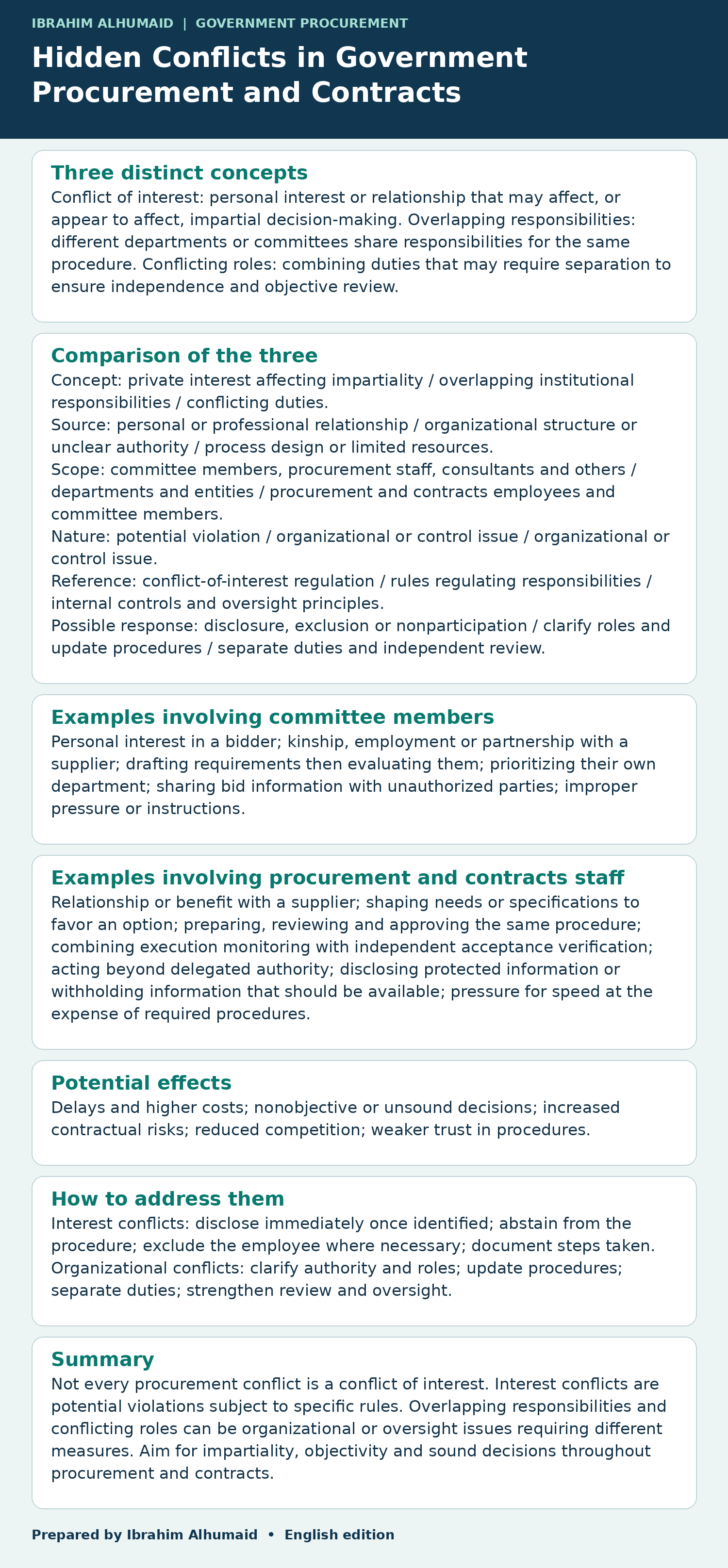
English transcript
Three distinct concepts
Conflict of interest: personal interest or relationship that may affect, or appear to affect, impartial decision-making. Overlapping responsibilities: different departments or committees share responsibilities for the same procedure. Conflicting roles: combining duties that may require separation to ensure independence and objective review.
Comparison of the three
Concept: private interest affecting impartiality / overlapping institutional responsibilities / conflicting duties.
Source: personal or professional relationship / organizational structure or unclear authority / process design or limited resources.
Scope: committee members, procurement staff, consultants and others / departments and entities / procurement and contracts employees and committee members.
Nature: potential violation / organizational or control issue / organizational or control issue.
Reference: conflict-of-interest regulation / rules regulating responsibilities / internal controls and oversight principles.
Possible response: disclosure, exclusion or nonparticipation / clarify roles and update procedures / separate duties and independent review.
Examples involving committee members
Personal interest in a bidder; kinship, employment or partnership with a supplier; drafting requirements then evaluating them; prioritizing their own department; sharing bid information with unauthorized parties; improper pressure or instructions.
Examples involving procurement and contracts staff
Relationship or benefit with a supplier; shaping needs or specifications to favor an option; preparing, reviewing and approving the same procedure; combining execution monitoring with independent acceptance verification; acting beyond delegated authority; disclosing protected information or withholding information that should be available; pressure for speed at the expense of required procedures.
Potential effects
Delays and higher costs; nonobjective or unsound decisions; increased contractual risks; reduced competition; weaker trust in procedures.
How to address them
Interest conflicts: disclose immediately once identified; abstain from the procedure; exclude the employee where necessary; document steps taken. Organizational conflicts: clarify authority and roles; update procedures; separate duties; strengthen review and oversight.
Summary
Not every procurement conflict is a conflict of interest. Interest conflicts are potential violations subject to specific rules. Overlapping responsibilities and conflicting roles can be organizational or oversight issues requiring different measures. Aim for impartiality, objectivity and sound decisions throughout procurement and contracts.