Tenders
How Do We Measure the Internal Cost of a Tender?
What counts as an internal cost?
From tender preparation through contract award, the procuring entity commits staff time and administrative resources to meetings, reviews and repeated work. These resources make up the internal cost of running the tender.
Cost components
- Staff hours
- Meetings
- Legal and technical reviews
- Rework
- Publication and follow-up
- Evaluation and committee work
How to measure the effort
- 1. Identify the stages of the tender.
- 2. List the people involved.
- 3. Estimate the time spent at each stage.
- 4. Include repeated tasks and rework.
- 5. Add up the total effort.
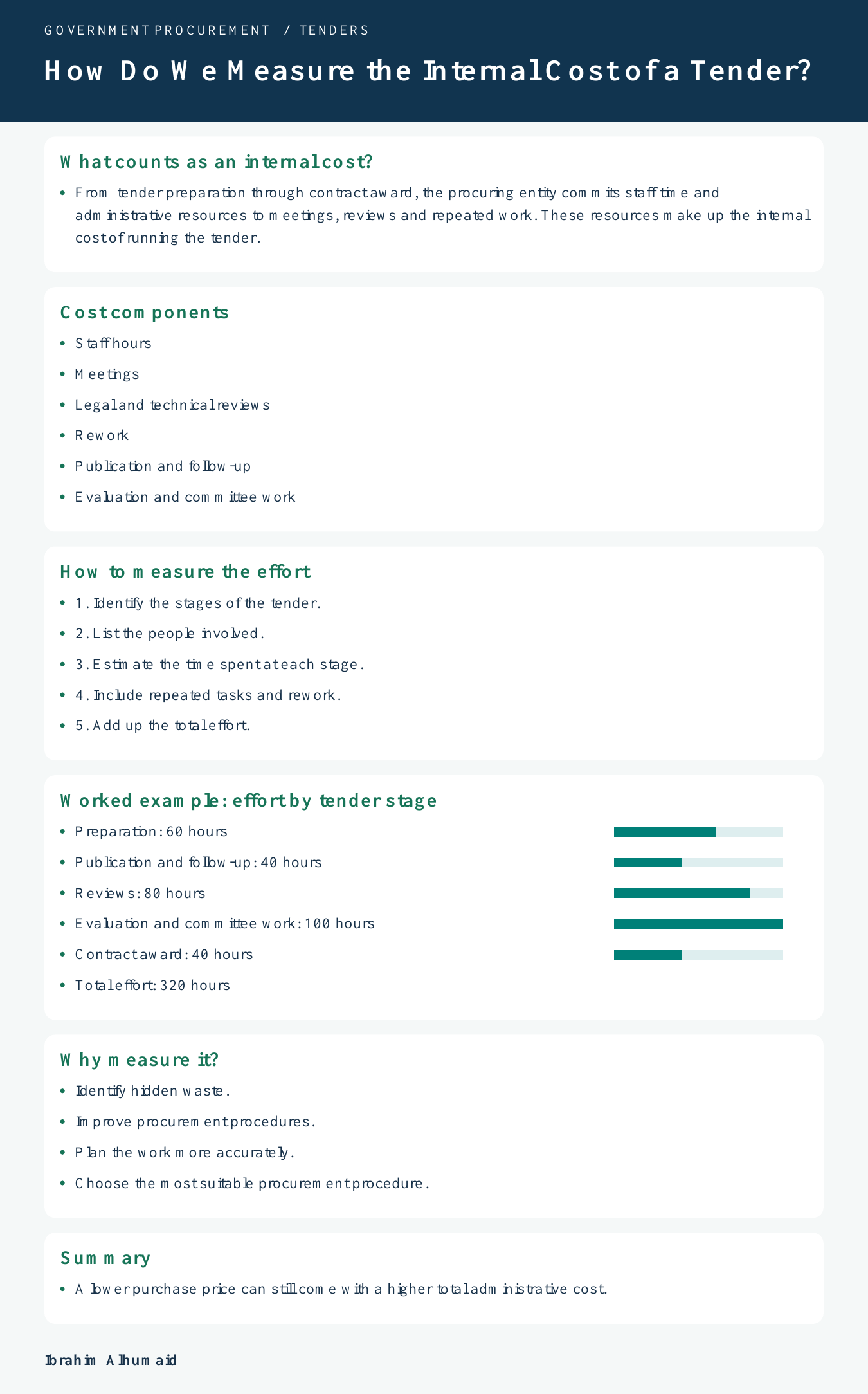
Worked example: effort by tender stage
- Preparation: 60 hours
- Publication and follow-up: 40 hours
- Reviews: 80 hours
- Evaluation and committee work: 100 hours
- Contract award: 40 hours
- Total effort: 320 hours
Why measure it?
- Identify hidden waste.
- Improve procurement procedures.
- Plan the work more accurately.
- Choose the most suitable procurement procedure.
Summary
A lower purchase price can still come with a higher total administrative cost.