Internal systems for managing procurement, contracts, and suppliers in government entities
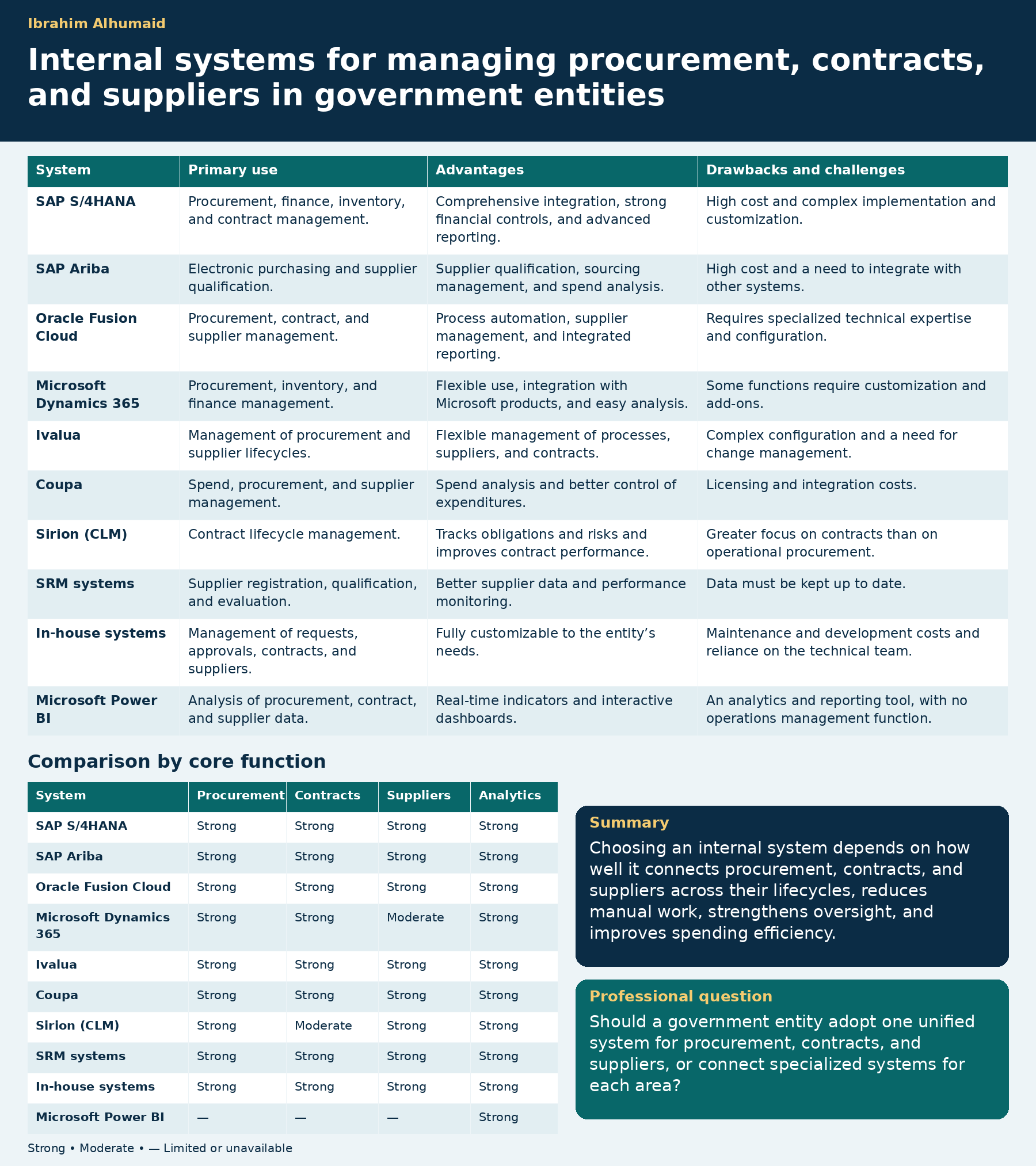
Systems overview
| System | Primary use | Advantages | Drawbacks and challenges |
|---|---|---|---|
| SAP S/4HANA | Procurement, finance, inventory, and contract management. | Comprehensive integration, strong financial controls, and advanced reporting. | High cost and complex implementation and customization. |
| SAP Ariba | Electronic purchasing and supplier qualification. | Supplier qualification, sourcing management, and spend analysis. | High cost and a need to integrate with other systems. |
| Oracle Fusion Cloud | Procurement, contract, and supplier management. | Process automation, supplier management, and integrated reporting. | Requires specialized technical expertise and configuration. |
| Microsoft Dynamics 365 | Procurement, inventory, and finance management. | Flexible use, integration with Microsoft products, and easy analysis. | Some functions require customization and add-ons. |
| Ivalua | Management of procurement and supplier lifecycles. | Flexible management of processes, suppliers, and contracts. | Complex configuration and a need for change management. |
| Coupa | Spend, procurement, and supplier management. | Spend analysis and better control of expenditures. | Licensing and integration costs. |
| Sirion (CLM) | Contract lifecycle management. | Tracks obligations and risks and improves contract performance. | Greater focus on contracts than on operational procurement. |
| SRM systems | Supplier registration, qualification, and evaluation. | Better supplier data and performance monitoring. | Data must be kept up to date. |
| In-house systems | Management of requests, approvals, contracts, and suppliers. | Fully customizable to the entity’s needs. | Maintenance and development costs and reliance on the technical team. |
| Microsoft Power BI | Analysis of procurement, contract, and supplier data. | Real-time indicators and interactive dashboards. | An analytics and reporting tool, with no operations management function. |
Comparison by core function
| System | Procurement | Contracts | Suppliers | Analytics |
|---|---|---|---|---|
| SAP S/4HANA | Strong | Strong | Strong | Strong |
| SAP Ariba | Strong | Strong | Strong | Strong |
| Oracle Fusion Cloud | Strong | Strong | Strong | Strong |
| Microsoft Dynamics 365 | Strong | Strong | Moderate | Strong |
| Ivalua | Strong | Strong | Strong | Strong |
| Coupa | Strong | Strong | Strong | Strong |
| Sirion (CLM) | Strong | Moderate | Strong | Strong |
| SRM systems | Strong | Strong | Strong | Strong |
| In-house systems | Strong | Strong | Strong | Strong |
| Microsoft Power BI | — | — | — | Strong |
Strong • Moderate • — Limited or unavailable
Summary
Choosing an internal system depends on how well it connects procurement, contracts, and suppliers across their lifecycles, reduces manual work, strengthens oversight, and improves spending efficiency.
Professional question
Should a government entity adopt one unified system for procurement, contracts, and suppliers, or connect specialized systems for each area?