16 Cases for Changing a Government Tender
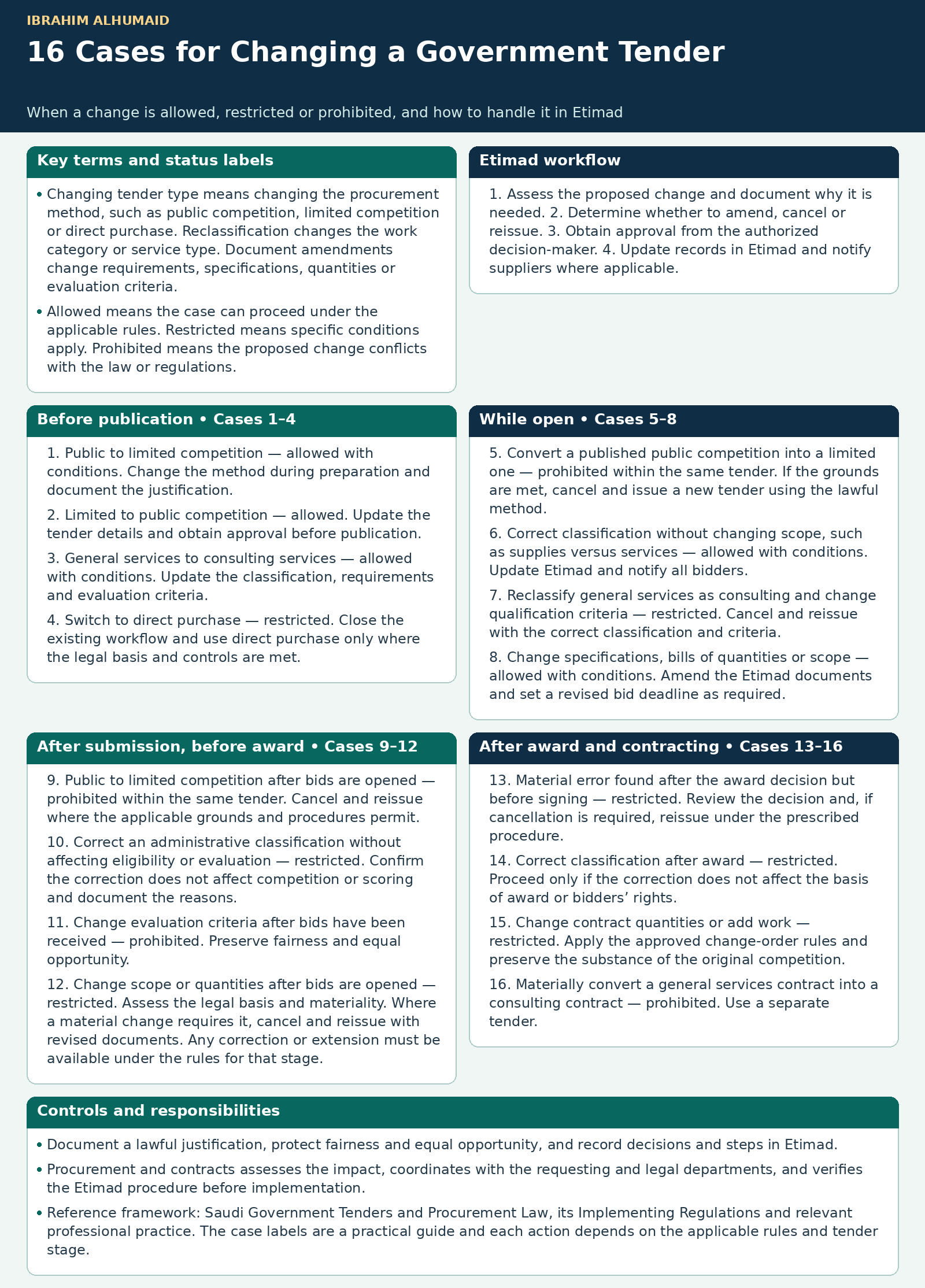
When a change is allowed, restricted or prohibited, and how to handle it in Etimad
Key terms and status labels
- Changing tender type means changing the procurement method, such as public competition, limited competition or direct purchase. Reclassification changes the work category or service type. Document amendments change requirements, specifications, quantities or evaluation criteria.
- Allowed means the case can proceed under the applicable rules. Restricted means specific conditions apply. Prohibited means the proposed change conflicts with the law or regulations.
Etimad workflow
- 1. Assess the proposed change and document why it is needed. 2. Determine whether to amend, cancel or reissue. 3. Obtain approval from the authorized decision-maker. 4. Update records in Etimad and notify suppliers where applicable.
Before publication • Cases 1–4
- 1. Public to limited competition — allowed with conditions. Change the method during preparation and document the justification.
- 2. Limited to public competition — allowed. Update the tender details and obtain approval before publication.
- 3. General services to consulting services — allowed with conditions. Update the classification, requirements and evaluation criteria.
- 4. Switch to direct purchase — restricted. Close the existing workflow and use direct purchase only where the legal basis and controls are met.
While open • Cases 5–8
- 5. Convert a published public competition into a limited one — prohibited within the same tender. If the grounds are met, cancel and issue a new tender using the lawful method.
- 6. Correct classification without changing scope, such as supplies versus services — allowed with conditions. Update Etimad and notify all bidders.
- 7. Reclassify general services as consulting and change qualification criteria — restricted. Cancel and reissue with the correct classification and criteria.
- 8. Change specifications, bills of quantities or scope — allowed with conditions. Amend the Etimad documents and set a revised bid deadline as required.
After submission, before award • Cases 9–12
- 9. Public to limited competition after bids are opened — prohibited within the same tender. Cancel and reissue where the applicable grounds and procedures permit.
- 10. Correct an administrative classification without affecting eligibility or evaluation — restricted. Confirm the correction does not affect competition or scoring and document the reasons.
- 11. Change evaluation criteria after bids have been received — prohibited. Preserve fairness and equal opportunity.
- 12. Change scope or quantities after bids are opened — restricted. Assess the legal basis and materiality. Where a material change requires it, cancel and reissue with revised documents. Any correction or extension must be available under the rules for that stage.
After award and contracting • Cases 13–16
- 13. Material error found after the award decision but before signing — restricted. Review the decision and, if cancellation is required, reissue under the prescribed procedure.
- 14. Correct classification after award — restricted. Proceed only if the correction does not affect the basis of award or bidders’ rights.
- 15. Change contract quantities or add work — restricted. Apply the approved change-order rules and preserve the substance of the original competition.
- 16. Materially convert a general services contract into a consulting contract — prohibited. Use a separate tender.
Controls and responsibilities
- Document a lawful justification, protect fairness and equal opportunity, and record decisions and steps in Etimad.
- Procurement and contracts assesses the impact, coordinates with the requesting and legal departments, and verifies the Etimad procedure before implementation.
- Reference framework: Saudi Government Tenders and Procurement Law, its Implementing Regulations and relevant professional practice. The case labels are a practical guide and each action depends on the applicable rules and tender stage.