Organizational models for government procurement and contracts departments
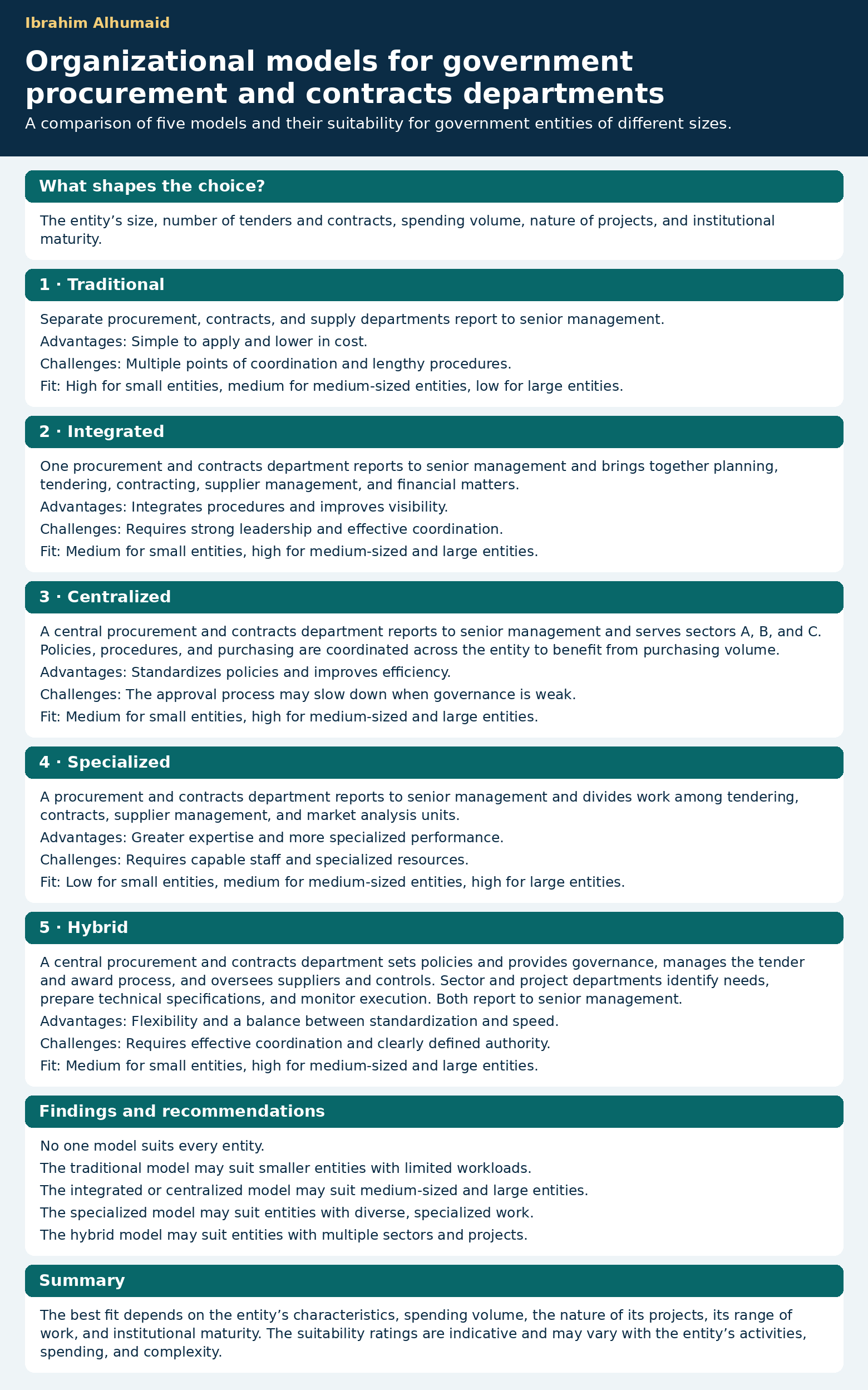
A comparison of five models and their suitability for government entities of different sizes.
What shapes the choice?
- The entity’s size, number of tenders and contracts, spending volume, nature of projects, and institutional maturity.
1 · Traditional
- Separate procurement, contracts, and supply departments report to senior management.
- Advantages: Simple to apply and lower in cost.
- Challenges: Multiple points of coordination and lengthy procedures.
- Fit: High for small entities, medium for medium-sized entities, low for large entities.
2 · Integrated
- One procurement and contracts department reports to senior management and brings together planning, tendering, contracting, supplier management, and financial matters.
- Advantages: Integrates procedures and improves visibility.
- Challenges: Requires strong leadership and effective coordination.
- Fit: Medium for small entities, high for medium-sized and large entities.
3 · Centralized
- A central procurement and contracts department reports to senior management and serves sectors A, B, and C. Policies, procedures, and purchasing are coordinated across the entity to benefit from purchasing volume.
- Advantages: Standardizes policies and improves efficiency.
- Challenges: The approval process may slow down when governance is weak.
- Fit: Medium for small entities, high for medium-sized and large entities.
4 · Specialized
- A procurement and contracts department reports to senior management and divides work among tendering, contracts, supplier management, and market analysis units.
- Advantages: Greater expertise and more specialized performance.
- Challenges: Requires capable staff and specialized resources.
- Fit: Low for small entities, medium for medium-sized entities, high for large entities.
5 · Hybrid
- A central procurement and contracts department sets policies and provides governance, manages the tender and award process, and oversees suppliers and controls. Sector and project departments identify needs, prepare technical specifications, and monitor execution. Both report to senior management.
- Advantages: Flexibility and a balance between standardization and speed.
- Challenges: Requires effective coordination and clearly defined authority.
- Fit: Medium for small entities, high for medium-sized and large entities.
Findings and recommendations
- No one model suits every entity.
- The traditional model may suit smaller entities with limited workloads.
- The integrated or centralized model may suit medium-sized and large entities.
- The specialized model may suit entities with diverse, specialized work.
- The hybrid model may suit entities with multiple sectors and projects.
Summary
- The best fit depends on the entity’s characteristics, spending volume, the nature of its projects, its range of work, and institutional maturity. The suitability ratings are indicative and may vary with the entity’s activities, spending, and complexity.