Category: Contracts
Why Construction and Supervision Usually Have Separate Contracts
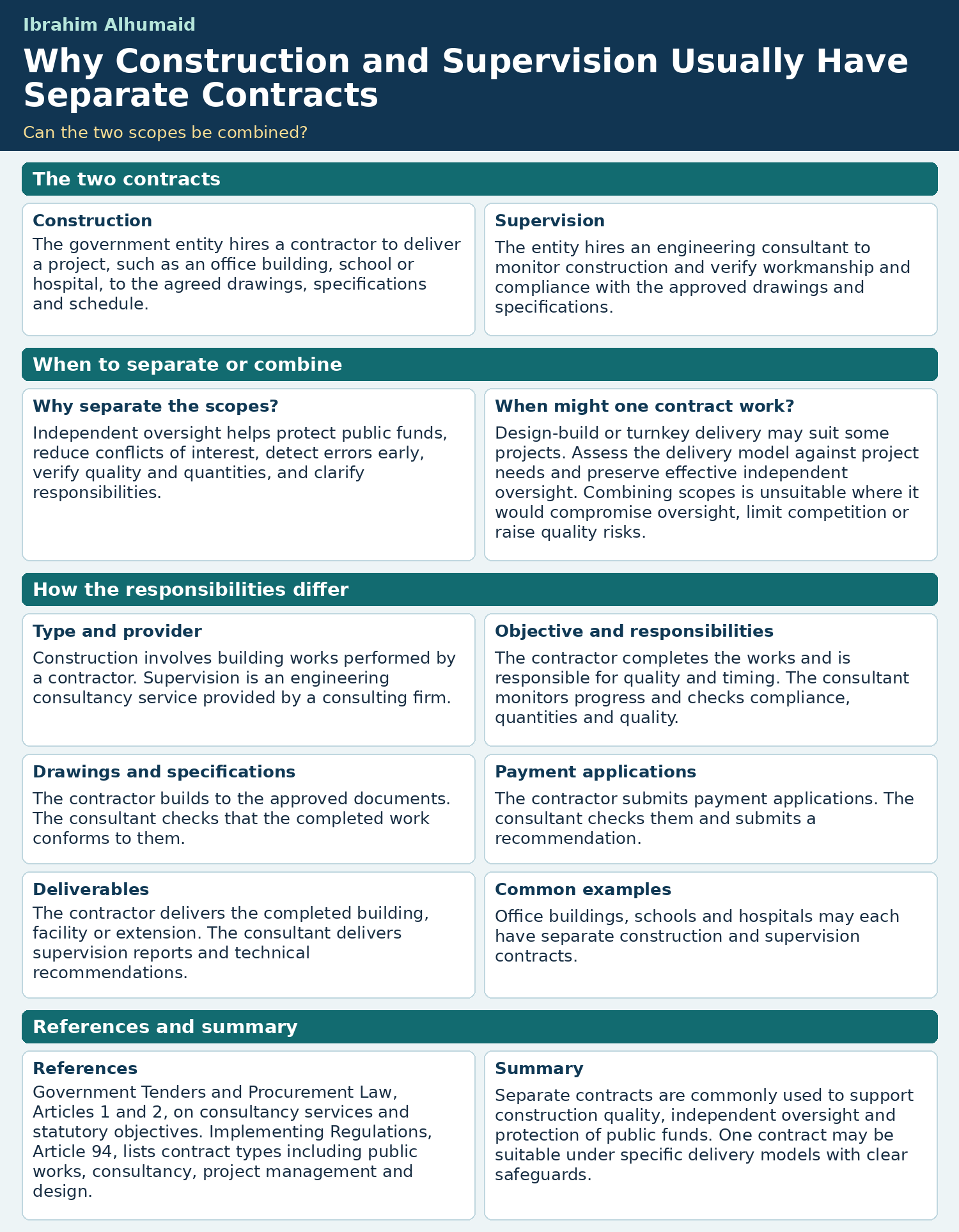
Read the full English text
The two contracts
Construction
The government entity hires a contractor to deliver a project, such as an office building, school or hospital, to the agreed drawings, specifications and schedule.
Supervision
The entity hires an engineering consultant to monitor construction and verify workmanship and compliance with the approved drawings and specifications.
When to separate or combine
Why separate the scopes?
Independent oversight helps protect public funds, reduce conflicts of interest, detect errors early, verify quality and quantities, and clarify responsibilities.
When might one contract work?
Design-build or turnkey delivery may suit some projects. Assess the delivery model against project needs and preserve effective independent oversight. Combining scopes is unsuitable where it would compromise oversight, limit competition or raise quality risks.
How the responsibilities differ
Type and provider
Construction involves building works performed by a contractor. Supervision is an engineering consultancy service provided by a consulting firm.
Objective and responsibilities
The contractor completes the works and is responsible for quality and timing. The consultant monitors progress and checks compliance, quantities and quality.
Drawings and specifications
The contractor builds to the approved documents. The consultant checks that the completed work conforms to them.
Payment applications
The contractor submits payment applications. The consultant checks them and submits a recommendation.
Deliverables
The contractor delivers the completed building, facility or extension. The consultant delivers supervision reports and technical recommendations.
Common examples
Office buildings, schools and hospitals may each have separate construction and supervision contracts.
References and summary
References
Government Tenders and Procurement Law, Articles 1 and 2, on consultancy services and statutory objectives. Implementing Regulations, Article 94, lists contract types including public works, consultancy, project management and design.
Summary
Separate contracts are commonly used to support construction quality, independent oversight and protection of public funds. One contract may be suitable under specific delivery models with clear safeguards.