Category: Tenders
Local Content in Government Tenders: Requirements and Differences Between Mechanisms
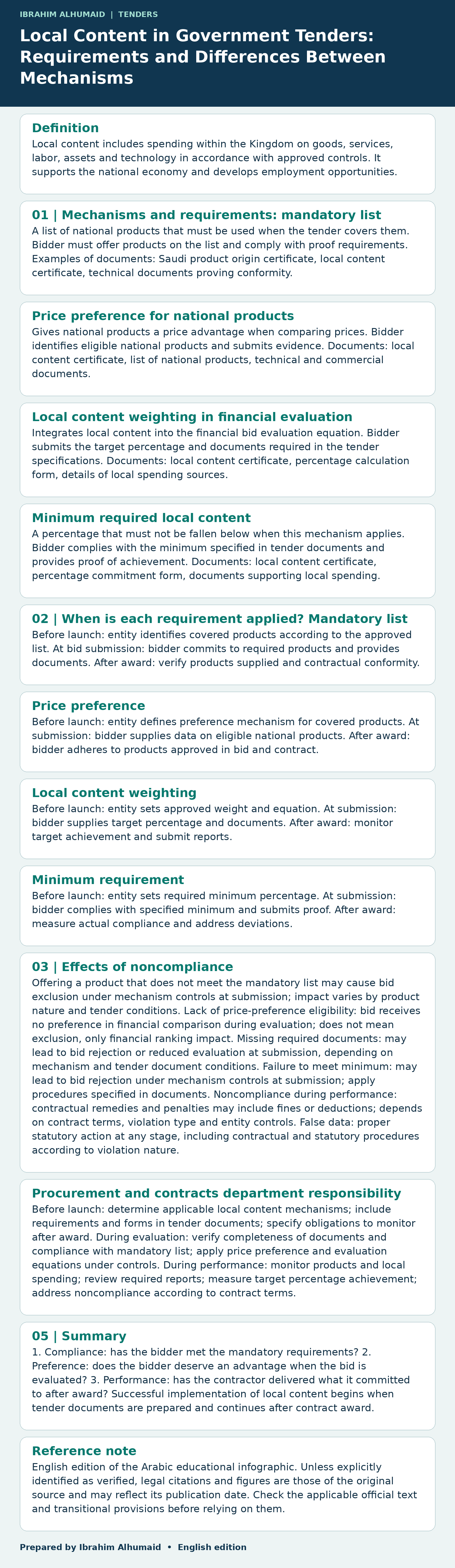
English transcript
Definition
Local content includes spending within the Kingdom on goods, services, labor, assets and technology in accordance with approved controls. It supports the national economy and develops employment opportunities.
01 | Mechanisms and requirements: mandatory list
A list of national products that must be used when the tender covers them. Bidder must offer products on the list and comply with proof requirements. Examples of documents: Saudi product origin certificate, local content certificate, technical documents proving conformity.
Price preference for national products
Gives national products a price advantage when comparing prices. Bidder identifies eligible national products and submits evidence. Documents: local content certificate, list of national products, technical and commercial documents.
Local content weighting in financial evaluation
Integrates local content into the financial bid evaluation equation. Bidder submits the target percentage and documents required in the tender specifications. Documents: local content certificate, percentage calculation form, details of local spending sources.
Minimum required local content
A percentage that must not be fallen below when this mechanism applies. Bidder complies with the minimum specified in tender documents and provides proof of achievement. Documents: local content certificate, percentage commitment form, documents supporting local spending.
02 | When is each requirement applied? Mandatory list
Before launch: entity identifies covered products according to the approved list. At bid submission: bidder commits to required products and provides documents. After award: verify products supplied and contractual conformity.
Price preference
Before launch: entity defines preference mechanism for covered products. At submission: bidder supplies data on eligible national products. After award: bidder adheres to products approved in bid and contract.
Local content weighting
Before launch: entity sets approved weight and equation. At submission: bidder supplies target percentage and documents. After award: monitor target achievement and submit reports.
Minimum requirement
Before launch: entity sets required minimum percentage. At submission: bidder complies with specified minimum and submits proof. After award: measure actual compliance and address deviations.
03 | Effects of noncompliance
Offering a product that does not meet the mandatory list may cause bid exclusion under mechanism controls at submission; impact varies by product nature and tender conditions. Lack of price-preference eligibility: bid receives no preference in financial comparison during evaluation; does not mean exclusion, only financial ranking impact. Missing required documents: may lead to bid rejection or reduced evaluation at submission, depending on mechanism and tender document conditions. Failure to meet minimum: may lead to bid rejection under mechanism controls at submission; apply procedures specified in documents. Noncompliance during performance: contractual remedies and penalties may include fines or deductions; depends on contract terms, violation type and entity controls. False data: proper statutory action at any stage, including contractual and statutory procedures according to violation nature.
Procurement and contracts department responsibility
Before launch: determine applicable local content mechanisms; include requirements and forms in tender documents; specify obligations to monitor after award. During evaluation: verify completeness of documents and compliance with mandatory list; apply price preference and evaluation equations under controls. During performance: monitor products and local spending; review required reports; measure target percentage achievement; address noncompliance according to contract terms.
05 | Summary
1. Compliance: has the bidder met the mandatory requirements? 2. Preference: does the bidder deserve an advantage when the bid is evaluated? 3. Performance: has the contractor delivered what it committed to after award? Successful implementation of local content begins when tender documents are prepared and continues after contract award.
Reference note
English edition of the Arabic educational infographic. Unless explicitly identified as verified, legal citations and figures are those of the original source and may reflect its publication date. Check the applicable official text and transitional provisions before relying on them.