Category: Contracts
A Government Operations and Maintenance Contract Has Ended and the Supplier Has Changed: Who Retains the Employees and Who Bears Responsibility for Their Rights?
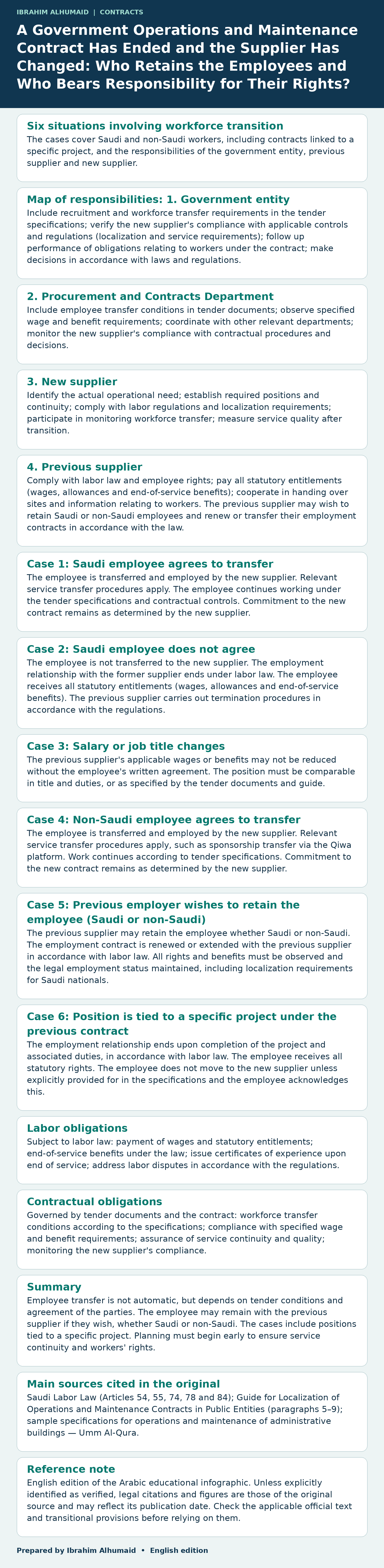
English transcript
Six situations involving workforce transition
The cases cover Saudi and non-Saudi workers, including contracts linked to a specific project, and the responsibilities of the government entity, previous supplier and new supplier.
Map of responsibilities: 1. Government entity
Include recruitment and workforce transfer requirements in the tender specifications; verify the new supplier's compliance with applicable controls and regulations (localization and service requirements); follow up performance of obligations relating to workers under the contract; make decisions in accordance with laws and regulations.
2. Procurement and Contracts Department
Include employee transfer conditions in tender documents; observe specified wage and benefit requirements; coordinate with other relevant departments; monitor the new supplier's compliance with contractual procedures and decisions.
3. New supplier
Identify the actual operational need; establish required positions and continuity; comply with labor regulations and localization requirements; participate in monitoring workforce transfer; measure service quality after transition.
4. Previous supplier
Comply with labor law and employee rights; pay all statutory entitlements (wages, allowances and end-of-service benefits); cooperate in handing over sites and information relating to workers. The previous supplier may wish to retain Saudi or non-Saudi employees and renew or transfer their employment contracts in accordance with the law.
Case 1: Saudi employee agrees to transfer
The employee is transferred and employed by the new supplier. Relevant service transfer procedures apply. The employee continues working under the tender specifications and contractual controls. Commitment to the new contract remains as determined by the new supplier.
Case 2: Saudi employee does not agree
The employee is not transferred to the new supplier. The employment relationship with the former supplier ends under labor law. The employee receives all statutory entitlements (wages, allowances and end-of-service benefits). The previous supplier carries out termination procedures in accordance with the regulations.
Case 3: Salary or job title changes
The previous supplier's applicable wages or benefits may not be reduced without the employee's written agreement. The position must be comparable in title and duties, or as specified by the tender documents and guide.
Case 4: Non-Saudi employee agrees to transfer
The employee is transferred and employed by the new supplier. Relevant service transfer procedures apply, such as sponsorship transfer via the Qiwa platform. Work continues according to tender specifications. Commitment to the new contract remains as determined by the new supplier.
Case 5: Previous employer wishes to retain the employee (Saudi or non-Saudi)
The previous supplier may retain the employee whether Saudi or non-Saudi. The employment contract is renewed or extended with the previous supplier in accordance with labor law. All rights and benefits must be observed and the legal employment status maintained, including localization requirements for Saudi nationals.
Case 6: Position is tied to a specific project under the previous contract
The employment relationship ends upon completion of the project and associated duties, in accordance with labor law. The employee receives all statutory rights. The employee does not move to the new supplier unless explicitly provided for in the specifications and the employee acknowledges this.
Labor obligations
Subject to labor law: payment of wages and statutory entitlements; end-of-service benefits under the law; issue certificates of experience upon end of service; address labor disputes in accordance with the regulations.
Contractual obligations
Governed by tender documents and the contract: workforce transfer conditions according to the specifications; compliance with specified wage and benefit requirements; assurance of service continuity and quality; monitoring the new supplier's compliance.
Summary
Employee transfer is not automatic, but depends on tender conditions and agreement of the parties. The employee may remain with the previous supplier if they wish, whether Saudi or non-Saudi. The cases include positions tied to a specific project. Planning must begin early to ensure service continuity and workers' rights.
Main sources cited in the original
Saudi Labor Law (Articles 54, 55, 74, 78 and 84); Guide for Localization of Operations and Maintenance Contracts in Public Entities (paragraphs 5–9); sample specifications for operations and maintenance of administrative buildings — Umm Al-Qura.
Reference note
English edition of the Arabic educational infographic. Unless explicitly identified as verified, legal citations and figures are those of the original source and may reflect its publication date. Check the applicable official text and transitional provisions before relying on them.