Category: Tenders
Procurement and Supply Chains in Government Entities: What Is the Difference and When Are Both Departments Needed?
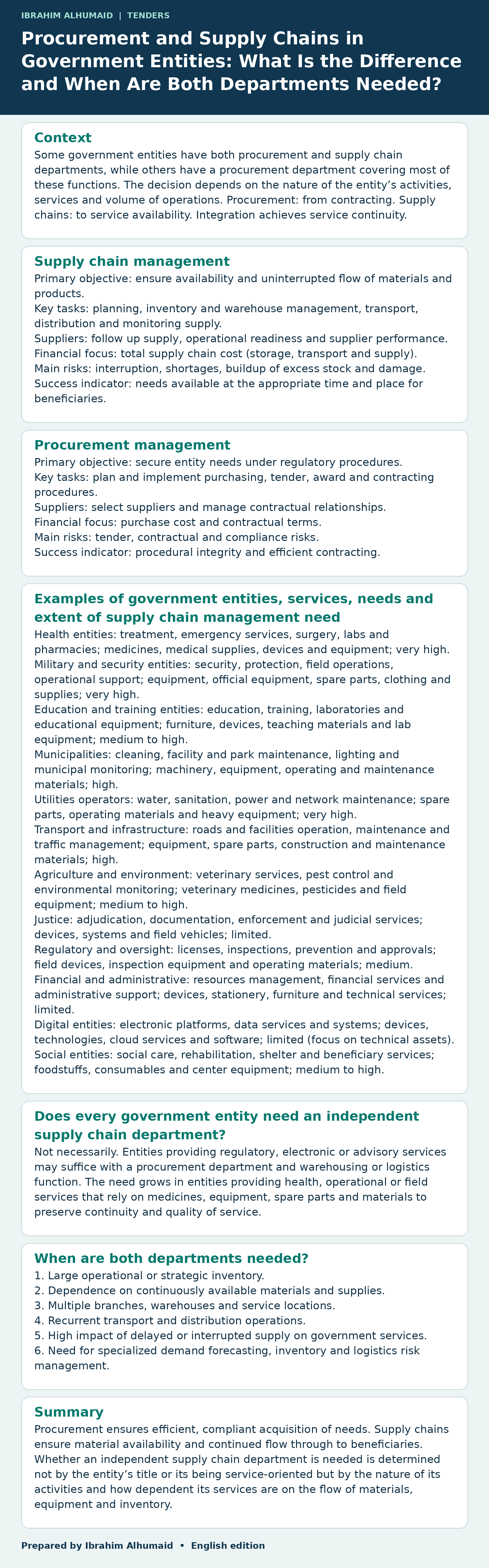
English transcript
Context
Some government entities have both procurement and supply chain departments, while others have a procurement department covering most of these functions. The decision depends on the nature of the entity’s activities, services and volume of operations. Procurement: from contracting. Supply chains: to service availability. Integration achieves service continuity.
Supply chain management
Primary objective: ensure availability and uninterrupted flow of materials and products.
Key tasks: planning, inventory and warehouse management, transport, distribution and monitoring supply.
Suppliers: follow up supply, operational readiness and supplier performance.
Financial focus: total supply chain cost (storage, transport and supply).
Main risks: interruption, shortages, buildup of excess stock and damage.
Success indicator: needs available at the appropriate time and place for beneficiaries.
Procurement management
Primary objective: secure entity needs under regulatory procedures.
Key tasks: plan and implement purchasing, tender, award and contracting procedures.
Suppliers: select suppliers and manage contractual relationships.
Financial focus: purchase cost and contractual terms.
Main risks: tender, contractual and compliance risks.
Success indicator: procedural integrity and efficient contracting.
Examples of government entities, services, needs and extent of supply chain management need
Health entities: treatment, emergency services, surgery, labs and pharmacies; medicines, medical supplies, devices and equipment; very high.
Military and security entities: security, protection, field operations, operational support; equipment, official equipment, spare parts, clothing and supplies; very high.
Education and training entities: education, training, laboratories and educational equipment; furniture, devices, teaching materials and lab equipment; medium to high.
Municipalities: cleaning, facility and park maintenance, lighting and municipal monitoring; machinery, equipment, operating and maintenance materials; high.
Utilities operators: water, sanitation, power and network maintenance; spare parts, operating materials and heavy equipment; very high.
Transport and infrastructure: roads and facilities operation, maintenance and traffic management; equipment, spare parts, construction and maintenance materials; high.
Agriculture and environment: veterinary services, pest control and environmental monitoring; veterinary medicines, pesticides and field equipment; medium to high.
Justice: adjudication, documentation, enforcement and judicial services; devices, systems and field vehicles; limited.
Regulatory and oversight: licenses, inspections, prevention and approvals; field devices, inspection equipment and operating materials; medium.
Financial and administrative: resources management, financial services and administrative support; devices, stationery, furniture and technical services; limited.
Digital entities: electronic platforms, data services and systems; devices, technologies, cloud services and software; limited (focus on technical assets).
Social entities: social care, rehabilitation, shelter and beneficiary services; foodstuffs, consumables and center equipment; medium to high.
Does every government entity need an independent supply chain department?
Not necessarily. Entities providing regulatory, electronic or advisory services may suffice with a procurement department and warehousing or logistics function. The need grows in entities providing health, operational or field services that rely on medicines, equipment, spare parts and materials to preserve continuity and quality of service.
When are both departments needed?
1. Large operational or strategic inventory.
2. Dependence on continuously available materials and supplies.
3. Multiple branches, warehouses and service locations.
4. Recurrent transport and distribution operations.
5. High impact of delayed or interrupted supply on government services.
6. Need for specialized demand forecasting, inventory and logistics risk management.
Summary
Procurement ensures efficient, compliant acquisition of needs. Supply chains ensure material availability and continued flow through to beneficiaries. Whether an independent supply chain department is needed is determined not by the entity’s title or its being service-oriented but by the nature of its activities and how dependent its services are on the flow of materials, equipment and inventory.