Category: Tenders
Leading Professional Certifications in Procurement and Supply Chains
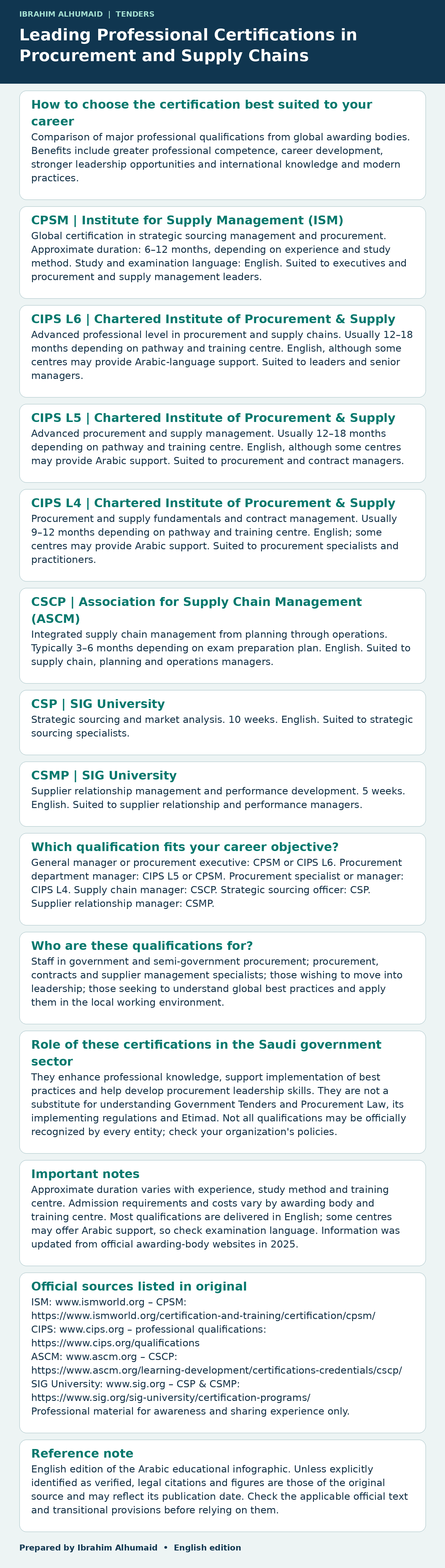
English transcript
How to choose the certification best suited to your career
Comparison of major professional qualifications from global awarding bodies. Benefits include greater professional competence, career development, stronger leadership opportunities and international knowledge and modern practices.
CPSM | Institute for Supply Management (ISM)
Global certification in strategic sourcing management and procurement. Approximate duration: 6–12 months, depending on experience and study method. Study and examination language: English. Suited to executives and procurement and supply management leaders.
CIPS L6 | Chartered Institute of Procurement & Supply
Advanced professional level in procurement and supply chains. Usually 12–18 months depending on pathway and training centre. English, although some centres may provide Arabic-language support. Suited to leaders and senior managers.
CIPS L5 | Chartered Institute of Procurement & Supply
Advanced procurement and supply management. Usually 12–18 months depending on pathway and training centre. English, although some centres may provide Arabic support. Suited to procurement and contract managers.
CIPS L4 | Chartered Institute of Procurement & Supply
Procurement and supply fundamentals and contract management. Usually 9–12 months depending on pathway and training centre. English; some centres may provide Arabic support. Suited to procurement specialists and practitioners.
CSCP | Association for Supply Chain Management (ASCM)
Integrated supply chain management from planning through operations. Typically 3–6 months depending on exam preparation plan. English. Suited to supply chain, planning and operations managers.
CSP | SIG University
Strategic sourcing and market analysis. 10 weeks. English. Suited to strategic sourcing specialists.
CSMP | SIG University
Supplier relationship management and performance development. 5 weeks. English. Suited to supplier relationship and performance managers.
Which qualification fits your career objective?
General manager or procurement executive: CPSM or CIPS L6. Procurement department manager: CIPS L5 or CPSM. Procurement specialist or manager: CIPS L4. Supply chain manager: CSCP. Strategic sourcing officer: CSP. Supplier relationship manager: CSMP.
Who are these qualifications for?
Staff in government and semi-government procurement; procurement, contracts and supplier management specialists; those wishing to move into leadership; those seeking to understand global best practices and apply them in the local working environment.
Role of these certifications in the Saudi government sector
They enhance professional knowledge, support implementation of best practices and help develop procurement leadership skills. They are not a substitute for understanding Government Tenders and Procurement Law, its implementing regulations and Etimad. Not all qualifications may be officially recognized by every entity; check your organization's policies.
Important notes
Approximate duration varies with experience, study method and training centre. Admission requirements and costs vary by awarding body and training centre. Most qualifications are delivered in English; some centres may offer Arabic support, so check examination language. Information was updated from official awarding-body websites in 2025.
Official sources listed in original
ISM: www.ismworld.org – CPSM: https://www.ismworld.org/certification-and-training/certification/cpsm/
CIPS: www.cips.org – professional qualifications: https://www.cips.org/qualifications
ASCM: www.ascm.org – CSCP: https://www.ascm.org/learning-development/certifications-credentials/cscp/
SIG University: www.sig.org – CSP & CSMP: https://www.sig.org/sig-university/certification-programs/
Professional material for awareness and sharing experience only.
Reference note
English edition of the Arabic educational infographic. Unless explicitly identified as verified, legal citations and figures are those of the original source and may reflect its publication date. Check the applicable official text and transitional provisions before relying on them.