Category: Tenders
What Pressures Do Procurement and Contracts Departments Face?
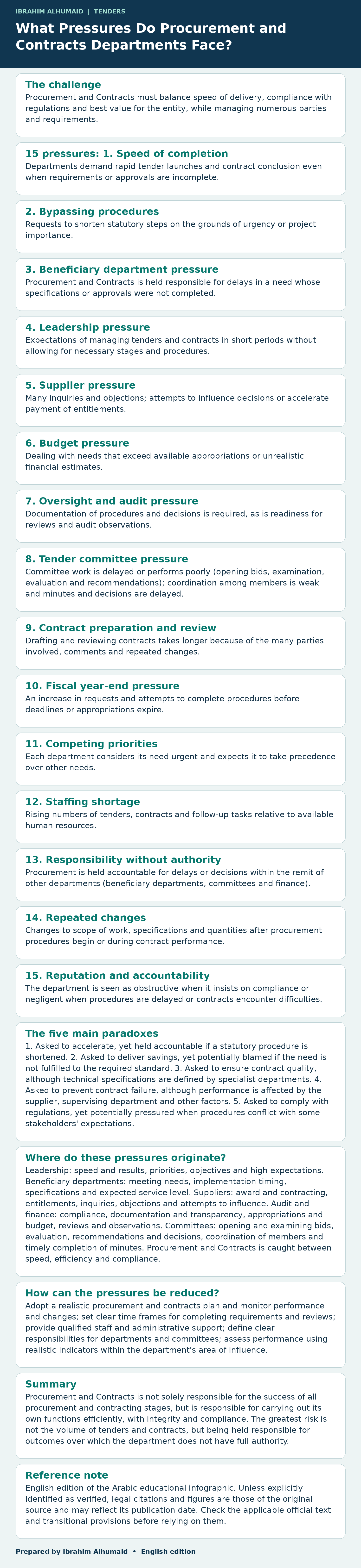
English transcript
The challenge
Procurement and Contracts must balance speed of delivery, compliance with regulations and best value for the entity, while managing numerous parties and requirements.
15 pressures: 1. Speed of completion
Departments demand rapid tender launches and contract conclusion even when requirements or approvals are incomplete.
2. Bypassing procedures
Requests to shorten statutory steps on the grounds of urgency or project importance.
3. Beneficiary department pressure
Procurement and Contracts is held responsible for delays in a need whose specifications or approvals were not completed.
4. Leadership pressure
Expectations of managing tenders and contracts in short periods without allowing for necessary stages and procedures.
5. Supplier pressure
Many inquiries and objections; attempts to influence decisions or accelerate payment of entitlements.
6. Budget pressure
Dealing with needs that exceed available appropriations or unrealistic financial estimates.
7. Oversight and audit pressure
Documentation of procedures and decisions is required, as is readiness for reviews and audit observations.
8. Tender committee pressure
Committee work is delayed or performs poorly (opening bids, examination, evaluation and recommendations); coordination among members is weak and minutes and decisions are delayed.
9. Contract preparation and review
Drafting and reviewing contracts takes longer because of the many parties involved, comments and repeated changes.
10. Fiscal year-end pressure
An increase in requests and attempts to complete procedures before deadlines or appropriations expire.
11. Competing priorities
Each department considers its need urgent and expects it to take precedence over other needs.
12. Staffing shortage
Rising numbers of tenders, contracts and follow-up tasks relative to available human resources.
13. Responsibility without authority
Procurement is held accountable for delays or decisions within the remit of other departments (beneficiary departments, committees and finance).
14. Repeated changes
Changes to scope of work, specifications and quantities after procurement procedures begin or during contract performance.
15. Reputation and accountability
The department is seen as obstructive when it insists on compliance or negligent when procedures are delayed or contracts encounter difficulties.
The five main paradoxes
1. Asked to accelerate, yet held accountable if a statutory procedure is shortened. 2. Asked to deliver savings, yet potentially blamed if the need is not fulfilled to the required standard. 3. Asked to ensure contract quality, although technical specifications are defined by specialist departments. 4. Asked to prevent contract failure, although performance is affected by the supplier, supervising department and other factors. 5. Asked to comply with regulations, yet potentially pressured when procedures conflict with some stakeholders' expectations.
Where do these pressures originate?
Leadership: speed and results, priorities, objectives and high expectations. Beneficiary departments: meeting needs, implementation timing, specifications and expected service level. Suppliers: award and contracting, entitlements, inquiries, objections and attempts to influence. Audit and finance: compliance, documentation and transparency, appropriations and budget, reviews and observations. Committees: opening and examining bids, evaluation, recommendations and decisions, coordination of members and timely completion of minutes. Procurement and Contracts is caught between speed, efficiency and compliance.
How can the pressures be reduced?
Adopt a realistic procurement and contracts plan and monitor performance and changes; set clear time frames for completing requirements and reviews; provide qualified staff and administrative support; define clear responsibilities for departments and committees; assess performance using realistic indicators within the department's area of influence.
Summary
Procurement and Contracts is not solely responsible for the success of all procurement and contracting stages, but is responsible for carrying out its own functions efficiently, with integrity and compliance. The greatest risk is not the volume of tenders and contracts, but being held responsible for outcomes over which the department does not have full authority.
Reference note
English edition of the Arabic educational infographic. Unless explicitly identified as verified, legal citations and figures are those of the original source and may reflect its publication date. Check the applicable official text and transitional provisions before relying on them.