Category: Tenders
Do Performance Indicators Fairly Assess Procurement and Contracts, or Hold It Accountable for Outcomes It Cannot Control?
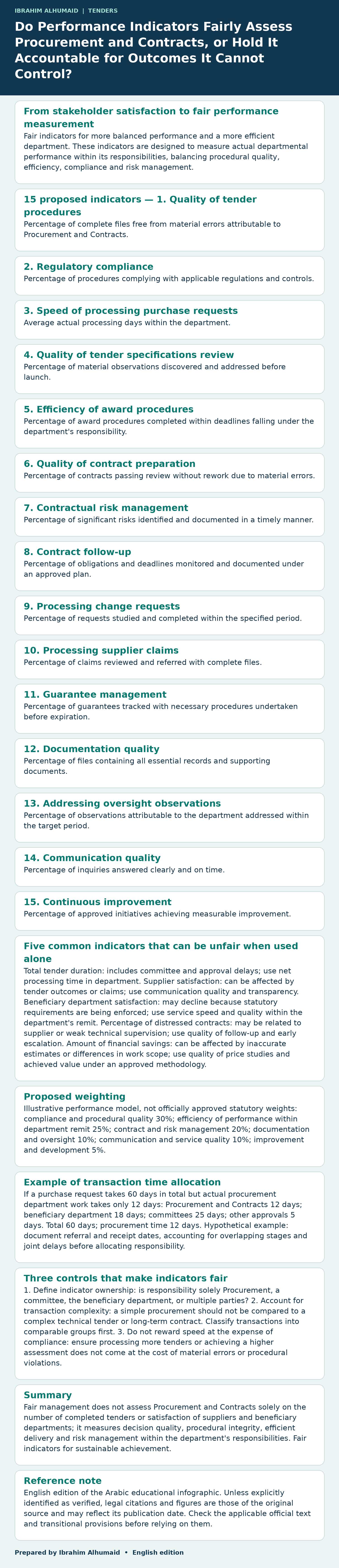
English transcript
From stakeholder satisfaction to fair performance measurement
Fair indicators for more balanced performance and a more efficient department. These indicators are designed to measure actual departmental performance within its responsibilities, balancing procedural quality, efficiency, compliance and risk management.
15 proposed indicators — 1. Quality of tender procedures
Percentage of complete files free from material errors attributable to Procurement and Contracts.
2. Regulatory compliance
Percentage of procedures complying with applicable regulations and controls.
3. Speed of processing purchase requests
Average actual processing days within the department.
4. Quality of tender specifications review
Percentage of material observations discovered and addressed before launch.
5. Efficiency of award procedures
Percentage of award procedures completed within deadlines falling under the department's responsibility.
6. Quality of contract preparation
Percentage of contracts passing review without rework due to material errors.
7. Contractual risk management
Percentage of significant risks identified and documented in a timely manner.
8. Contract follow-up
Percentage of obligations and deadlines monitored and documented under an approved plan.
9. Processing change requests
Percentage of requests studied and completed within the specified period.
10. Processing supplier claims
Percentage of claims reviewed and referred with complete files.
11. Guarantee management
Percentage of guarantees tracked with necessary procedures undertaken before expiration.
12. Documentation quality
Percentage of files containing all essential records and supporting documents.
13. Addressing oversight observations
Percentage of observations attributable to the department addressed within the target period.
14. Communication quality
Percentage of inquiries answered clearly and on time.
15. Continuous improvement
Percentage of approved initiatives achieving measurable improvement.
Five common indicators that can be unfair when used alone
Total tender duration: includes committee and approval delays; use net processing time in department. Supplier satisfaction: can be affected by tender outcomes or claims; use communication quality and transparency. Beneficiary department satisfaction: may decline because statutory requirements are being enforced; use service speed and quality within the department's remit. Percentage of distressed contracts: may be related to supplier or weak technical supervision; use quality of follow-up and early escalation. Amount of financial savings: can be affected by inaccurate estimates or differences in work scope; use quality of price studies and achieved value under an approved methodology.
Proposed weighting
Illustrative performance model, not officially approved statutory weights: compliance and procedural quality 30%; efficiency of performance within department remit 25%; contract and risk management 20%; documentation and oversight 10%; communication and service quality 10%; improvement and development 5%.
Example of transaction time allocation
If a purchase request takes 60 days in total but actual procurement department work takes only 12 days: Procurement and Contracts 12 days; beneficiary department 18 days; committees 25 days; other approvals 5 days. Total 60 days; procurement time 12 days. Hypothetical example: document referral and receipt dates, accounting for overlapping stages and joint delays before allocating responsibility.
Three controls that make indicators fair
1. Define indicator ownership: is responsibility solely Procurement, a committee, the beneficiary department, or multiple parties? 2. Account for transaction complexity: a simple procurement should not be compared to a complex technical tender or long-term contract. Classify transactions into comparable groups first. 3. Do not reward speed at the expense of compliance: ensure processing more tenders or achieving a higher assessment does not come at the cost of material errors or procedural violations.
Summary
Fair management does not assess Procurement and Contracts solely on the number of completed tenders or satisfaction of suppliers and beneficiary departments; it measures decision quality, procedural integrity, efficient delivery and risk management within the department's responsibilities. Fair indicators for sustainable achievement.
Reference note
English edition of the Arabic educational infographic. Unless explicitly identified as verified, legal citations and figures are those of the original source and may reflect its publication date. Check the applicable official text and transitional provisions before relying on them.