Category: Tenders
How to Build a Procurement and Contracts Policy for a Government Entity
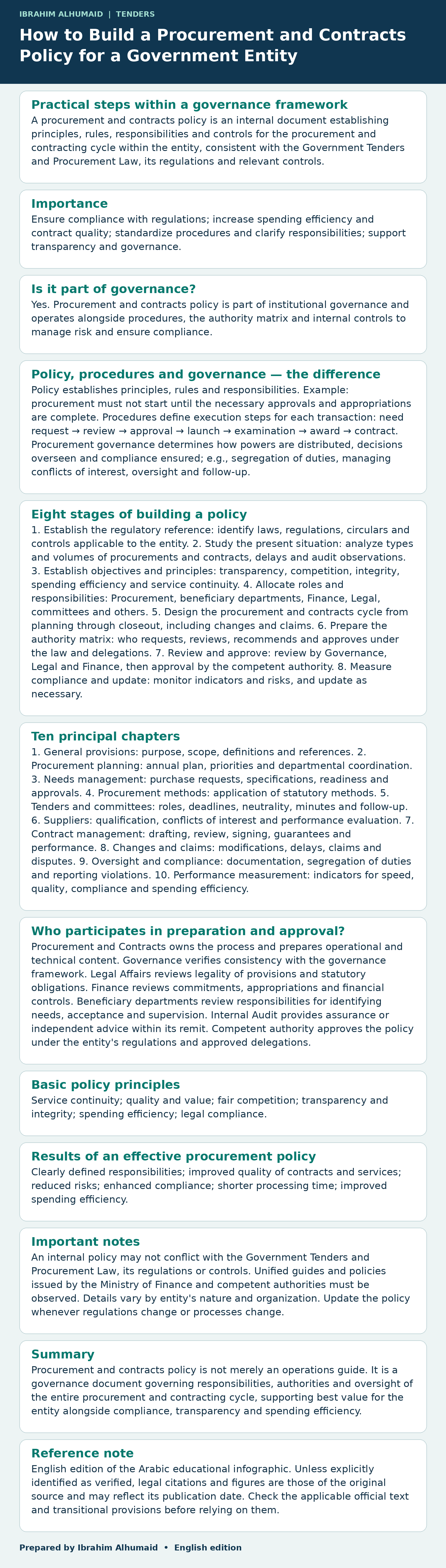
English transcript
Practical steps within a governance framework
A procurement and contracts policy is an internal document establishing principles, rules, responsibilities and controls for the procurement and contracting cycle within the entity, consistent with the Government Tenders and Procurement Law, its regulations and relevant controls.
Importance
Ensure compliance with regulations; increase spending efficiency and contract quality; standardize procedures and clarify responsibilities; support transparency and governance.
Is it part of governance?
Yes. Procurement and contracts policy is part of institutional governance and operates alongside procedures, the authority matrix and internal controls to manage risk and ensure compliance.
Policy, procedures and governance — the difference
Policy establishes principles, rules and responsibilities. Example: procurement must not start until the necessary approvals and appropriations are complete. Procedures define execution steps for each transaction: need request → review → approval → launch → examination → award → contract. Procurement governance determines how powers are distributed, decisions overseen and compliance ensured; e.g., segregation of duties, managing conflicts of interest, oversight and follow-up.
Eight stages of building a policy
1. Establish the regulatory reference: identify laws, regulations, circulars and controls applicable to the entity. 2. Study the present situation: analyze types and volumes of procurements and contracts, delays and audit observations. 3. Establish objectives and principles: transparency, competition, integrity, spending efficiency and service continuity. 4. Allocate roles and responsibilities: Procurement, beneficiary departments, Finance, Legal, committees and others. 5. Design the procurement and contracts cycle from planning through closeout, including changes and claims. 6. Prepare the authority matrix: who requests, reviews, recommends and approves under the law and delegations. 7. Review and approve: review by Governance, Legal and Finance, then approval by the competent authority. 8. Measure compliance and update: monitor indicators and risks, and update as necessary.
Ten principal chapters
1. General provisions: purpose, scope, definitions and references. 2. Procurement planning: annual plan, priorities and departmental coordination. 3. Needs management: purchase requests, specifications, readiness and approvals. 4. Procurement methods: application of statutory methods. 5. Tenders and committees: roles, deadlines, neutrality, minutes and follow-up. 6. Suppliers: qualification, conflicts of interest and performance evaluation. 7. Contract management: drafting, review, signing, guarantees and performance. 8. Changes and claims: modifications, delays, claims and disputes. 9. Oversight and compliance: documentation, segregation of duties and reporting violations. 10. Performance measurement: indicators for speed, quality, compliance and spending efficiency.
Who participates in preparation and approval?
Procurement and Contracts owns the process and prepares operational and technical content. Governance verifies consistency with the governance framework. Legal Affairs reviews legality of provisions and statutory obligations. Finance reviews commitments, appropriations and financial controls. Beneficiary departments review responsibilities for identifying needs, acceptance and supervision. Internal Audit provides assurance or independent advice within its remit. Competent authority approves the policy under the entity's regulations and approved delegations.
Basic policy principles
Service continuity; quality and value; fair competition; transparency and integrity; spending efficiency; legal compliance.
Results of an effective procurement policy
Clearly defined responsibilities; improved quality of contracts and services; reduced risks; enhanced compliance; shorter processing time; improved spending efficiency.
Important notes
An internal policy may not conflict with the Government Tenders and Procurement Law, its regulations or controls. Unified guides and policies issued by the Ministry of Finance and competent authorities must be observed. Details vary by entity's nature and organization. Update the policy whenever regulations change or processes change.
Summary
Procurement and contracts policy is not merely an operations guide. It is a governance document governing responsibilities, authorities and oversight of the entire procurement and contracting cycle, supporting best value for the entity alongside compliance, transparency and spending efficiency.
Reference note
English edition of the Arabic educational infographic. Unless explicitly identified as verified, legal citations and figures are those of the original source and may reflect its publication date. Check the applicable official text and transitional provisions before relying on them.