Category: Tenders
How to Become a Procurement Professional
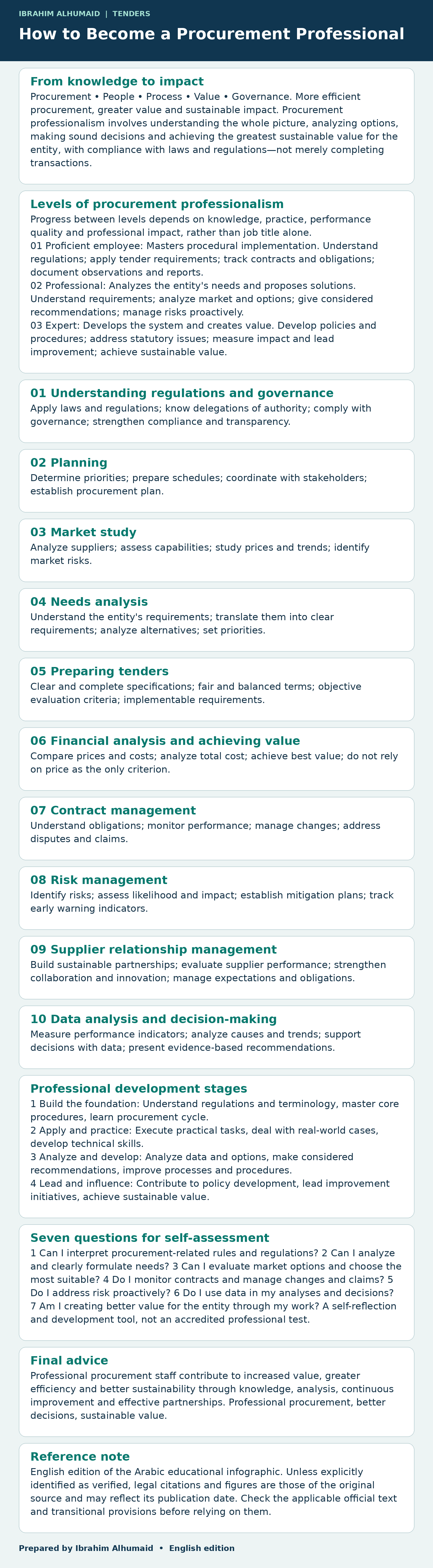
English transcript
From knowledge to impact
Procurement • People • Process • Value • Governance. More efficient procurement, greater value and sustainable impact. Procurement professionalism involves understanding the whole picture, analyzing options, making sound decisions and achieving the greatest sustainable value for the entity, with compliance with laws and regulations—not merely completing transactions.
Levels of procurement professionalism
Progress between levels depends on knowledge, practice, performance quality and professional impact, rather than job title alone.
01 Proficient employee: Masters procedural implementation. Understand regulations; apply tender requirements; track contracts and obligations; document observations and reports.
02 Professional: Analyzes the entity's needs and proposes solutions. Understand requirements; analyze market and options; give considered recommendations; manage risks proactively.
03 Expert: Develops the system and creates value. Develop policies and procedures; address statutory issues; measure impact and lead improvement; achieve sustainable value.
01 Understanding regulations and governance
Apply laws and regulations; know delegations of authority; comply with governance; strengthen compliance and transparency.
02 Planning
Determine priorities; prepare schedules; coordinate with stakeholders; establish procurement plan.
03 Market study
Analyze suppliers; assess capabilities; study prices and trends; identify market risks.
04 Needs analysis
Understand the entity's requirements; translate them into clear requirements; analyze alternatives; set priorities.
05 Preparing tenders
Clear and complete specifications; fair and balanced terms; objective evaluation criteria; implementable requirements.
06 Financial analysis and achieving value
Compare prices and costs; analyze total cost; achieve best value; do not rely on price as the only criterion.
07 Contract management
Understand obligations; monitor performance; manage changes; address disputes and claims.
08 Risk management
Identify risks; assess likelihood and impact; establish mitigation plans; track early warning indicators.
09 Supplier relationship management
Build sustainable partnerships; evaluate supplier performance; strengthen collaboration and innovation; manage expectations and obligations.
10 Data analysis and decision-making
Measure performance indicators; analyze causes and trends; support decisions with data; present evidence-based recommendations.
Professional development stages
1 Build the foundation: Understand regulations and terminology, master core procedures, learn procurement cycle.
2 Apply and practice: Execute practical tasks, deal with real-world cases, develop technical skills.
3 Analyze and develop: Analyze data and options, make considered recommendations, improve processes and procedures.
4 Lead and influence: Contribute to policy development, lead improvement initiatives, achieve sustainable value.
Seven questions for self-assessment
1 Can I interpret procurement-related rules and regulations? 2 Can I analyze and clearly formulate needs? 3 Can I evaluate market options and choose the most suitable? 4 Do I monitor contracts and manage changes and claims? 5 Do I address risk proactively? 6 Do I use data in my analyses and decisions? 7 Am I creating better value for the entity through my work? A self-reflection and development tool, not an accredited professional test.
Final advice
Professional procurement staff contribute to increased value, greater efficiency and better sustainability through knowledge, analysis, continuous improvement and effective partnerships. Professional procurement, better decisions, sustainable value.
Reference note
English edition of the Arabic educational infographic. Unless explicitly identified as verified, legal citations and figures are those of the original source and may reflect its publication date. Check the applicable official text and transitional provisions before relying on them.