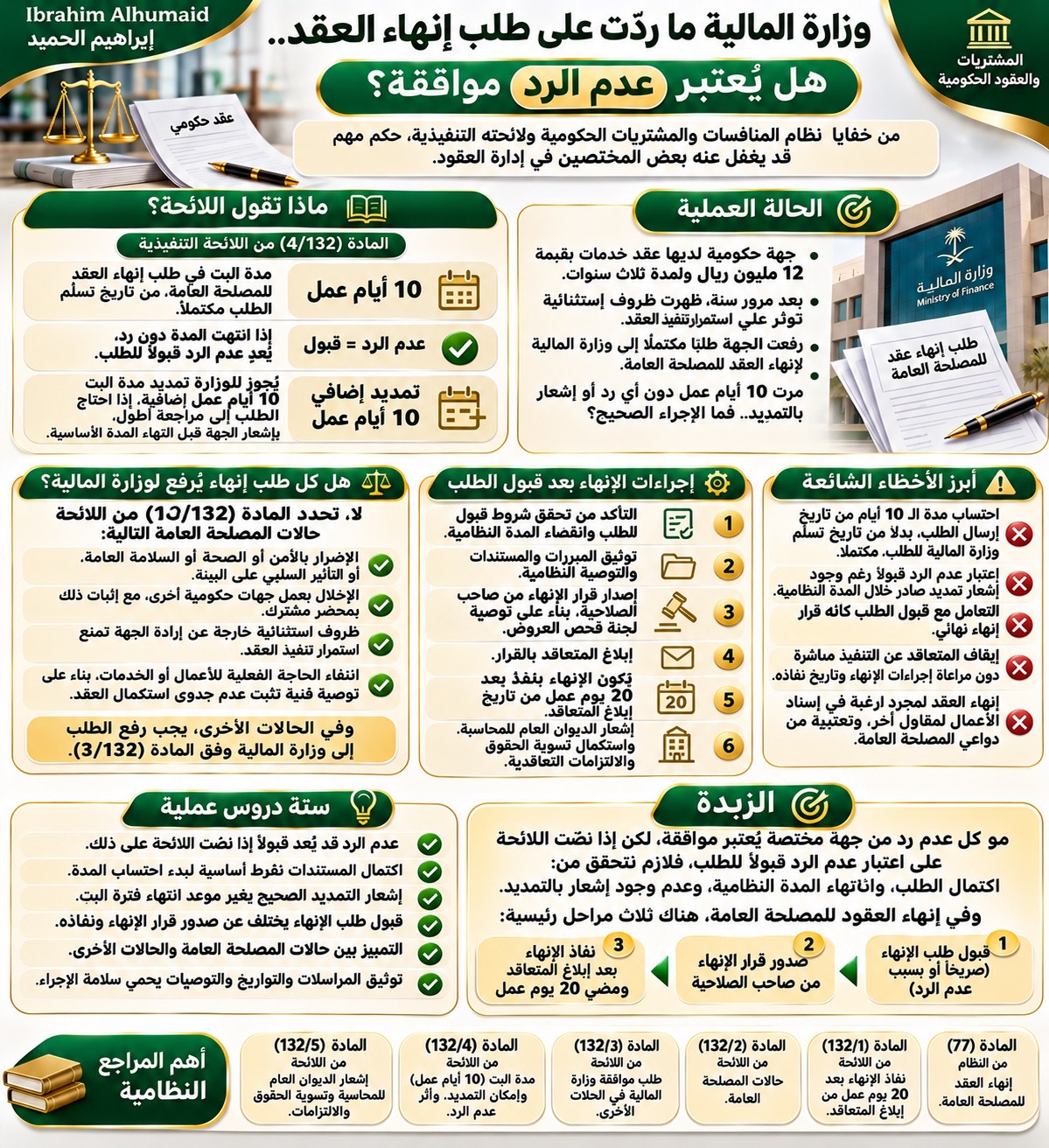
Does Ministry of Finance Silence Mean Approval to Terminate a Contract?
Deemed approval is not the termination decision.
The case
A Saudi government entity has a three-year services contract worth SAR 12 million. After one year, exceptional circumstances affect its ability to continue. The entity sends the Ministry of Finance a complete request to terminate in the public interest. Ten working days pass without a decision or an extension notice. What happens next?
First, check which route applies. If the circumstances are beyond the entity’s control and actually prevent it from continuing, the case falls within Article 132(2)(c). Ministry referral under Article 132(3) is for grounds outside the cases listed in paragraph (2). Merely affecting performance does not establish that paragraph (2)(c) applies.
What the regulations say
Under amended Article 132(4), for a request under paragraph (3), the Ministry has ten working days from receipt of the complete request to decide and notify the government entity. If it does not respond by the applicable deadline, the request is deemed accepted. For cases needing longer review, the Ministry may extend the period by another ten working days by notifying the entity before the original deadline expires. An extension moves the deadline; silence during the original period is then not approval.
Does every public-interest termination go to the Ministry?
No. Article 132(2) lists these grounds:
- Harm to public security, health or safety, or an adverse environmental impact.
- Disruption of another government entity’s work, documented in a record signed with the affected entities.
- Exceptional circumstances beyond the entity’s control that prevent it from continuing with the contract.
- No continuing need for the works or services, supported by a technical recommendation from the Expenditure and Projects Efficiency Authority or the entity showing that continuing the contract is not worthwhile.
For other grounds, paragraph (3) requires a request to the Ministry explaining and documenting why termination is in the public interest. A preference to perform the work in-house or give it to another contractor is not, on its own, a public-interest ground.
What to do after the request is accepted
- Confirm the applicable procedure. Where Ministry approval is required, confirm approval or document that the deadline for the complete request elapsed without a decision or effective extension.
- Record the reasons, supporting documents and bid evaluation committee recommendation.
- Have the authorized official issue the termination decision based on that recommendation.
- Notify the contractor of the decision and record the notification date.
- Apply the termination once twenty working days have elapsed from notification of the contractor.
- Notify the General Court of Audit and complete the applicable contractual and financial settlements.
Common mistakes
- Counting from dispatch rather than the Ministry’s receipt of the complete request.
- Assuming approval at day ten despite a timely extension.
- Treating acceptance of the request as the final termination decision.
- Stopping work immediately without observing the applicable procedure and effective date.
- Invoking the public interest solely to give the work to a different contractor.
Six practical lessons
- Silence counts as acceptance only when the applicable rule says so.
- A complete file starts the review clock.
- A valid extension changes the deadline.
- Request acceptance, a termination decision and the effective date are distinct.
- Distinguish the listed public-interest grounds from other grounds that require Ministry review.
- Keep the correspondence, dates and recommendations on record.
Bottom line
Where the Ministry route applies, check completeness, the review deadline and any extension. Then keep the three stages separate: acceptance of the request, issuance of the decision, and effectiveness after notification and the twenty-working-day period.
Legal references
These references concern the framework under Royal Decree M/128 and its implementing regulations. Check the transitional provisions for an individual case.
- Law Article 77: Public-interest termination and the separate mutual-termination route.
- Amended Regulation Article 132(1)–(5): Effective date, listed grounds, Ministry referral, review deadline and effect of silence, authorized decision and notice to the General Court of Audit. The reference to the list of grounds in the original graphic means paragraph (2).
- Regulation Article 135: Applicable post-termination settlements.
Ministry of Finance Decision 1097: amended Article 132 · Law and implementing regulations · Official Gazette: transitional provisions
View the signed Arabic infographic