Category: Tenders
Purchase Requisition (PR) vs Purchase Order (PO)
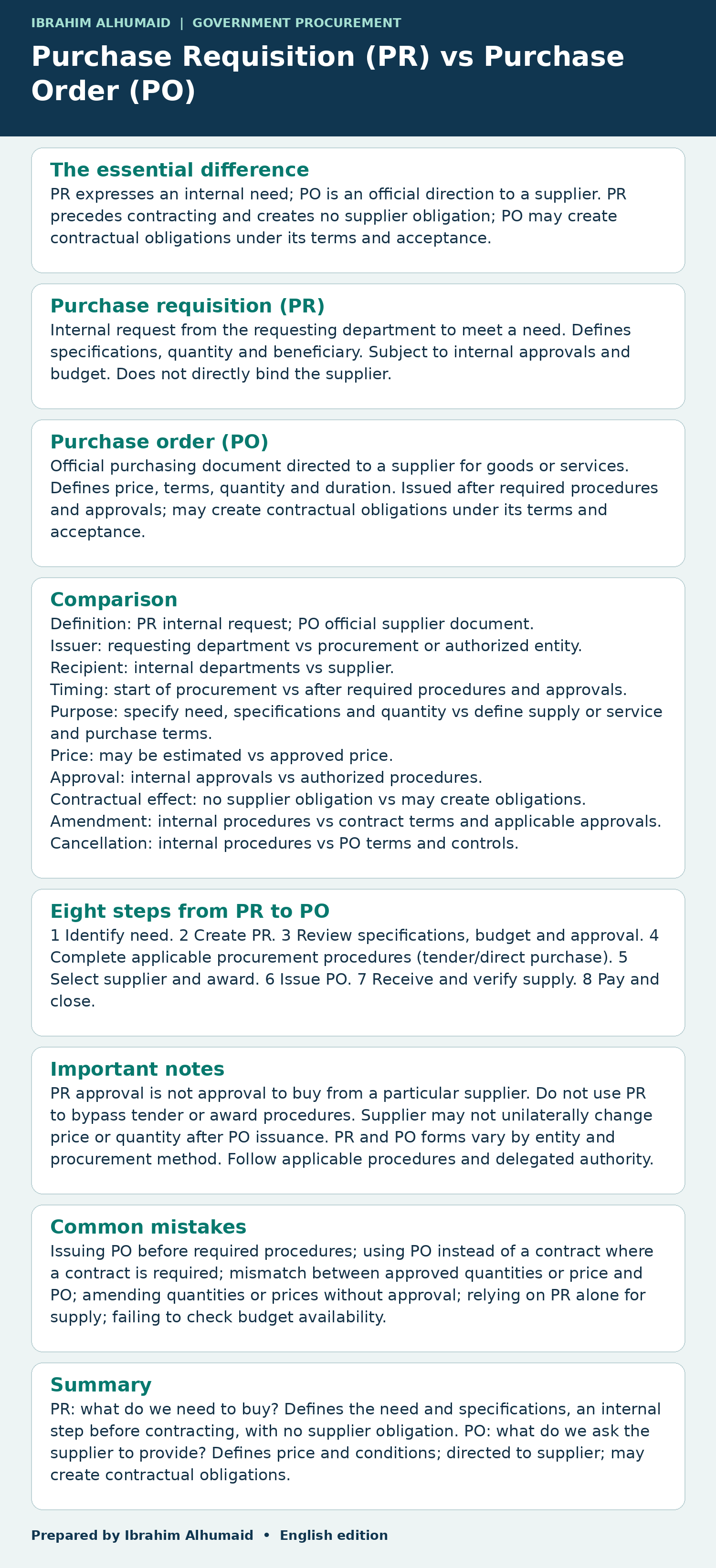
English transcript
The essential difference
PR expresses an internal need; PO is an official direction to a supplier. PR precedes contracting and creates no supplier obligation; PO may create contractual obligations under its terms and acceptance.
Purchase requisition (PR)
Internal request from the requesting department to meet a need. Defines specifications, quantity and beneficiary. Subject to internal approvals and budget. Does not directly bind the supplier.
Purchase order (PO)
Official purchasing document directed to a supplier for goods or services. Defines price, terms, quantity and duration. Issued after required procedures and approvals; may create contractual obligations under its terms and acceptance.
Comparison
Definition: PR internal request; PO official supplier document.
Issuer: requesting department vs procurement or authorized entity.
Recipient: internal departments vs supplier.
Timing: start of procurement vs after required procedures and approvals.
Purpose: specify need, specifications and quantity vs define supply or service and purchase terms.
Price: may be estimated vs approved price.
Approval: internal approvals vs authorized procedures.
Contractual effect: no supplier obligation vs may create obligations.
Amendment: internal procedures vs contract terms and applicable approvals.
Cancellation: internal procedures vs PO terms and controls.
Eight steps from PR to PO
1 Identify need. 2 Create PR. 3 Review specifications, budget and approval. 4 Complete applicable procurement procedures (tender/direct purchase). 5 Select supplier and award. 6 Issue PO. 7 Receive and verify supply. 8 Pay and close.
Important notes
PR approval is not approval to buy from a particular supplier. Do not use PR to bypass tender or award procedures. Supplier may not unilaterally change price or quantity after PO issuance. PR and PO forms vary by entity and procurement method. Follow applicable procedures and delegated authority.
Common mistakes
Issuing PO before required procedures; using PO instead of a contract where a contract is required; mismatch between approved quantities or price and PO; amending quantities or prices without approval; relying on PR alone for supply; failing to check budget availability.
Summary
PR: what do we need to buy? Defines the need and specifications, an internal step before contracting, with no supplier obligation. PO: what do we ask the supplier to provide? Defines price and conditions; directed to supplier; may create contractual obligations.