Committees
Do More Qualification Requirements Improve Tender Quality or Reduce the Number of Bidders?
Meaning
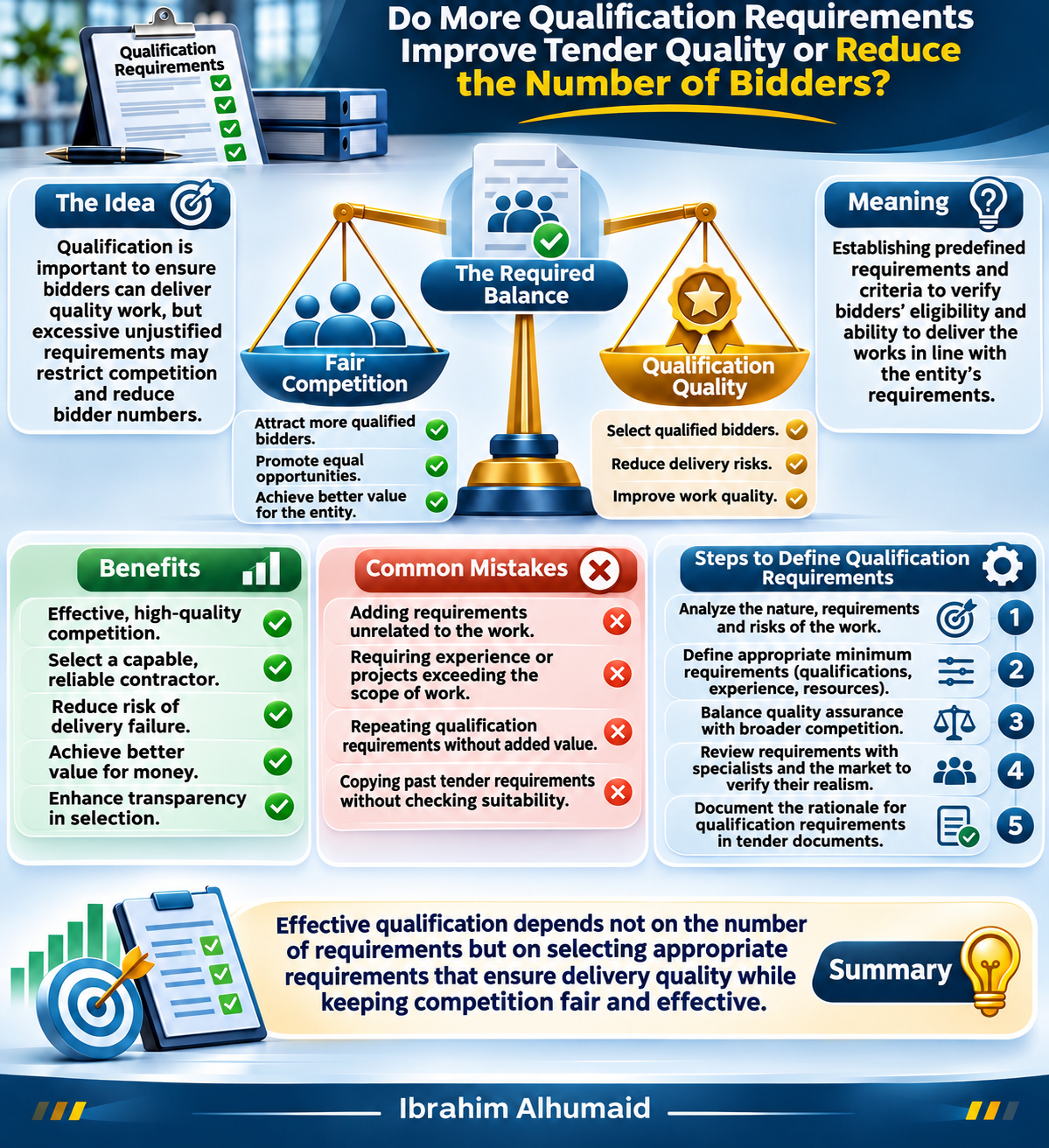
Establishing predefined requirements and criteria to verify bidders’ eligibility and ability to deliver the works in line with the entity’s requirements.
The idea
Qualification is important to ensure bidders can deliver quality work, but excessive unjustified requirements may restrict competition and reduce the number of bidders.
The required balance: qualification quality
- Select qualified bidders.
- Reduce delivery risks.
- Improve the quality of the works.
The required balance: fair competition
- Attract more qualified bidders.
- Promote equal opportunities.
- Achieve better value for the entity.
Steps to define qualification requirements
- Analyze the nature, requirements and risks of the work.
- Define appropriate minimum requirements (qualifications, experience and resources).
- Balance quality assurance with broader competition.
- Review requirements with specialists and the market to verify their realism.
- Document the rationale for qualification requirements in the tender documents.
Common mistakes
- Adding requirements unrelated to the nature of the work.
- Requiring experience or projects exceeding the scope of work.
- Repeating qualification requirements without added value.
- Copying previous tender requirements without checking their suitability.
Benefits
- Effective, high-quality competition.
- Selection of a capable and reliable contractor.
- Reduced risk of delivery failure.
- Better value for money.
- Enhanced transparency in selection.
Summary
Effective qualification depends not on the number of requirements, but on choosing appropriate requirements that ensure delivery quality while keeping competition fair and effective.
Prepared by Ibrahim Alhumaid