Category: Tenders
RFI or RFQ? When to Request Information or Quotations in Government Procurement
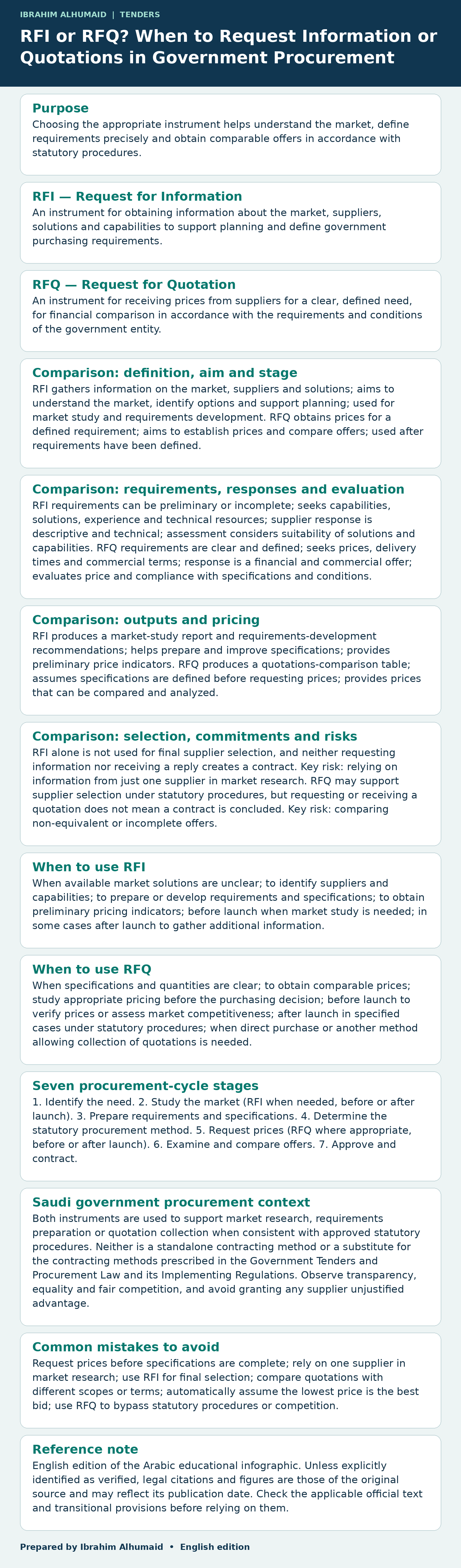
English transcript
Purpose
Choosing the appropriate instrument helps understand the market, define requirements precisely and obtain comparable offers in accordance with statutory procedures.
RFI — Request for Information
An instrument for obtaining information about the market, suppliers, solutions and capabilities to support planning and define government purchasing requirements.
RFQ — Request for Quotation
An instrument for receiving prices from suppliers for a clear, defined need, for financial comparison in accordance with the requirements and conditions of the government entity.
Comparison: definition, aim and stage
RFI gathers information on the market, suppliers and solutions; aims to understand the market, identify options and support planning; used for market study and requirements development. RFQ obtains prices for a defined requirement; aims to establish prices and compare offers; used after requirements have been defined.
Comparison: requirements, responses and evaluation
RFI requirements can be preliminary or incomplete; seeks capabilities, solutions, experience and technical resources; supplier response is descriptive and technical; assessment considers suitability of solutions and capabilities. RFQ requirements are clear and defined; seeks prices, delivery times and commercial terms; response is a financial and commercial offer; evaluates price and compliance with specifications and conditions.
Comparison: outputs and pricing
RFI produces a market-study report and requirements-development recommendations; helps prepare and improve specifications; provides preliminary price indicators. RFQ produces a quotations-comparison table; assumes specifications are defined before requesting prices; provides prices that can be compared and analyzed.
Comparison: selection, commitments and risks
RFI alone is not used for final supplier selection, and neither requesting information nor receiving a reply creates a contract. Key risk: relying on information from just one supplier in market research. RFQ may support supplier selection under statutory procedures, but requesting or receiving a quotation does not mean a contract is concluded. Key risk: comparing non-equivalent or incomplete offers.
When to use RFI
When available market solutions are unclear; to identify suppliers and capabilities; to prepare or develop requirements and specifications; to obtain preliminary pricing indicators; before launch when market study is needed; in some cases after launch to gather additional information.
When to use RFQ
When specifications and quantities are clear; to obtain comparable prices; study appropriate pricing before the purchasing decision; before launch to verify prices or assess market competitiveness; after launch in specified cases under statutory procedures; when direct purchase or another method allowing collection of quotations is needed.
Seven procurement-cycle stages
1. Identify the need. 2. Study the market (RFI when needed, before or after launch). 3. Prepare requirements and specifications. 4. Determine the statutory procurement method. 5. Request prices (RFQ where appropriate, before or after launch). 6. Examine and compare offers. 7. Approve and contract.
Saudi government procurement context
Both instruments are used to support market research, requirements preparation or quotation collection when consistent with approved statutory procedures. Neither is a standalone contracting method or a substitute for the contracting methods prescribed in the Government Tenders and Procurement Law and its Implementing Regulations. Observe transparency, equality and fair competition, and avoid granting any supplier unjustified advantage.
Common mistakes to avoid
Request prices before specifications are complete; rely on one supplier in market research; use RFI for final selection; compare quotations with different scopes or terms; automatically assume the lowest price is the best bid; use RFQ to bypass statutory procedures or competition.
Reference note
English edition of the Arabic educational infographic. Unless explicitly identified as verified, legal citations and figures are those of the original source and may reflect its publication date. Check the applicable official text and transitional provisions before relying on them.