Category: Tenders
Stakeholder Analysis in Tender Preparation
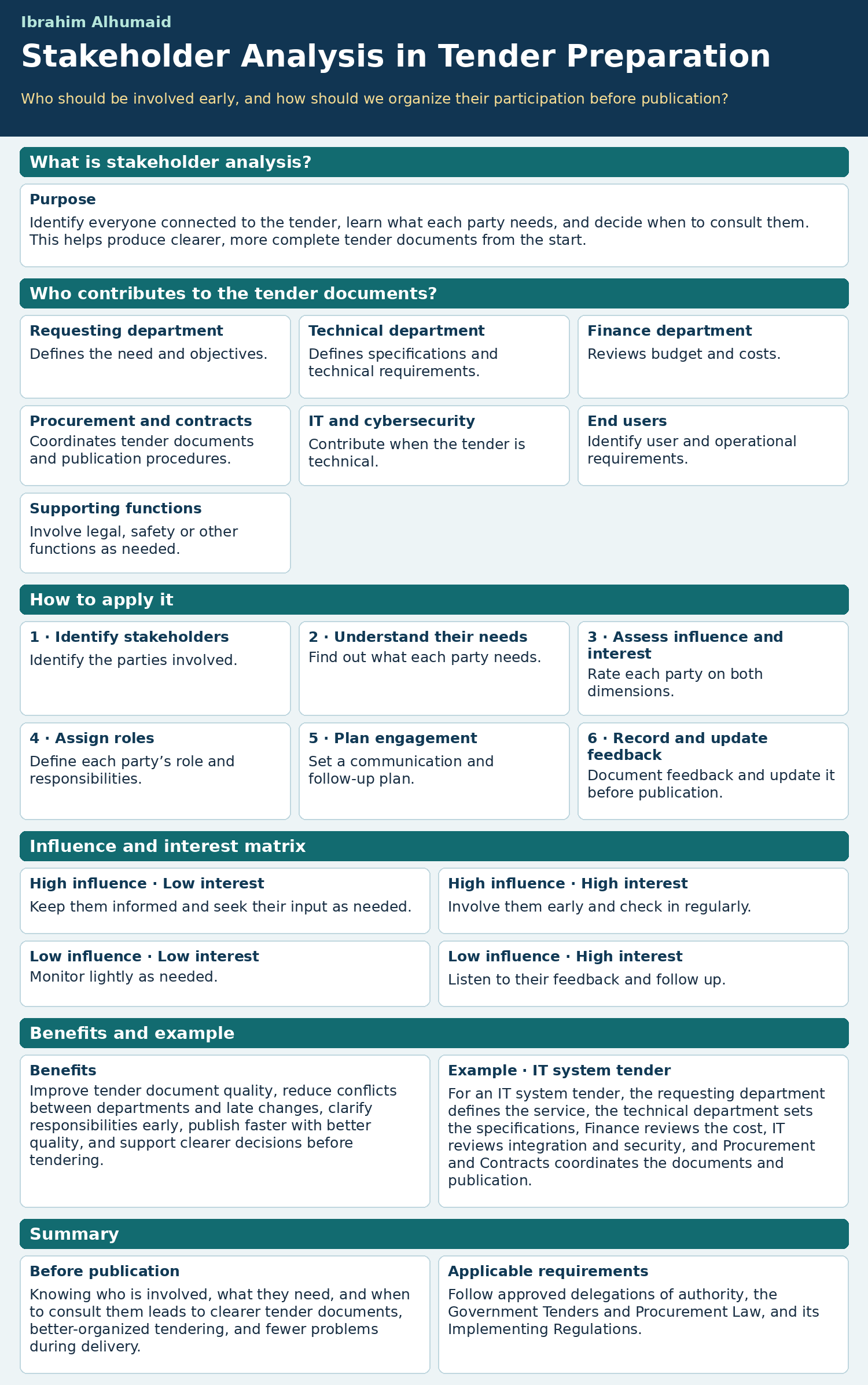
Read the full English text
What is stakeholder analysis?
Purpose
Identify everyone connected to the tender, learn what each party needs, and decide when to consult them. This helps produce clearer, more complete tender documents from the start.
Who contributes to the tender documents?
Requesting department
Defines the need and objectives.
Technical department
Defines specifications and technical requirements.
Finance department
Reviews budget and costs.
Procurement and contracts
Coordinates tender documents and publication procedures.
IT and cybersecurity
Contribute when the tender is technical.
End users
Identify user and operational requirements.
Supporting functions
Involve legal, safety or other functions as needed.
How to apply it
1 · Identify stakeholders
Identify the parties involved.
2 · Understand their needs
Find out what each party needs.
3 · Assess influence and interest
Rate each party on both dimensions.
4 · Assign roles
Define each party’s role and responsibilities.
5 · Plan engagement
Set a communication and follow-up plan.
6 · Record and update feedback
Document feedback and update it before publication.
Influence and interest matrix
High influence · Low interest
Keep them informed and seek their input as needed.
High influence · High interest
Involve them early and check in regularly.
Low influence · Low interest
Monitor lightly as needed.
Low influence · High interest
Listen to their feedback and follow up.
Benefits and example
Benefits
Improve tender document quality, reduce conflicts between departments and late changes, clarify responsibilities early, publish faster with better quality, and support clearer decisions before tendering.
Example · IT system tender
For an IT system tender, the requesting department defines the service, the technical department sets the specifications, Finance reviews the cost, IT reviews integration and security, and Procurement and Contracts coordinates the documents and publication.
Summary
Before publication
Knowing who is involved, what they need, and when to consult them leads to clearer tender documents, better-organized tendering, and fewer problems during delivery.
Applicable requirements
Follow approved delegations of authority, the Government Tenders and Procurement Law, and its Implementing Regulations.