Contracts
Subcontracting or contract assignment? When is the procedure compliant and when does it become a violation?
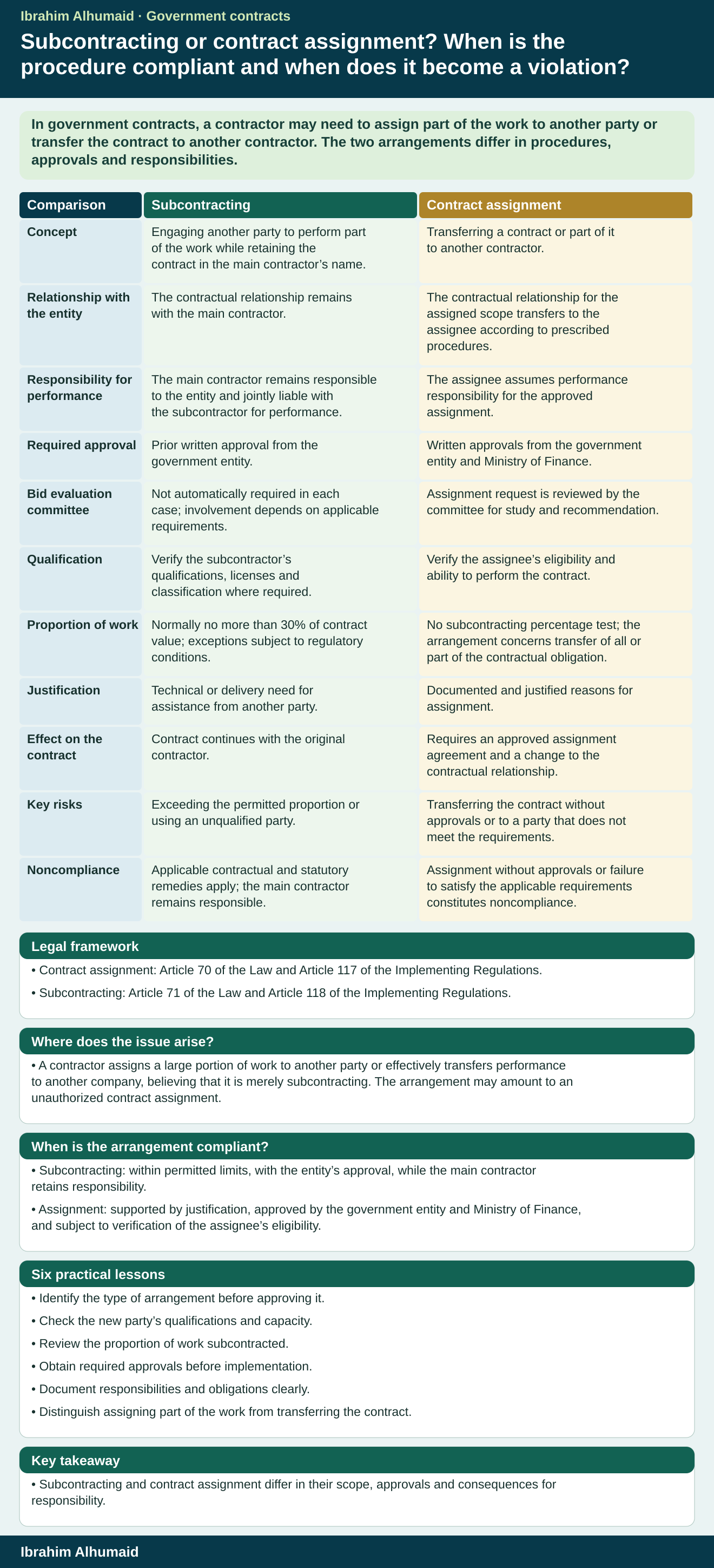
In government contracts, a contractor may need to assign part of the work to another party or transfer the contract to another contractor. The two arrangements differ in procedures, approvals and responsibilities.
| Comparison | Subcontracting | Contract assignment |
|---|---|---|
| Concept | Engaging another party to perform part of the work while retaining the contract in the main contractor’s name. | Transferring a contract or part of it to another contractor. |
| Relationship with the entity | The contractual relationship remains with the main contractor. | The contractual relationship for the assigned scope transfers to the assignee according to prescribed procedures. |
| Responsibility for performance | The main contractor remains responsible to the entity and jointly liable with the subcontractor for performance. | The assignee assumes performance responsibility for the approved assignment. |
| Required approval | Prior written approval from the government entity. | Written approvals from the government entity and Ministry of Finance. |
| Bid evaluation committee | Not automatically required in each case; involvement depends on applicable requirements. | Assignment request is reviewed by the committee for study and recommendation. |
| Qualification | Verify the subcontractor’s qualifications, licenses and classification where required. | Verify the assignee’s eligibility and ability to perform the contract. |
| Proportion of work | Normally no more than 30% of contract value; exceptions subject to regulatory conditions. | No subcontracting percentage test; the arrangement concerns transfer of all or part of the contractual obligation. |
| Justification | Technical or delivery need for assistance from another party. | Documented and justified reasons for assignment. |
| Effect on the contract | Contract continues with the original contractor. | Requires an approved assignment agreement and a change to the contractual relationship. |
| Key risks | Exceeding the permitted proportion or using an unqualified party. | Transferring the contract without approvals or to a party that does not meet the requirements. |
| Noncompliance | Applicable contractual and statutory remedies apply; the main contractor remains responsible. | Assignment without approvals or failure to satisfy the applicable requirements constitutes noncompliance. |
Legal framework
Contract assignment: Article 70 of the Law and Article 117 of the Implementing Regulations.
Subcontracting: Article 71 of the Law and Article 118 of the Implementing Regulations.
Where does the issue arise?
A contractor assigns a large portion of work to another party or effectively transfers performance to another company, believing that it is merely subcontracting. The arrangement may amount to an unauthorized contract assignment.
When is the arrangement compliant?
Subcontracting: within permitted limits, with the entity’s approval, while the main contractor retains responsibility.
Assignment: supported by justification, approved by the government entity and Ministry of Finance, and subject to verification of the assignee’s eligibility.
Six practical lessons
Identify the type of arrangement before approving it.
Check the new party’s qualifications and capacity.
Review the proportion of work subcontracted.
Obtain required approvals before implementation.
Document responsibilities and obligations clearly.
Distinguish assigning part of the work from transferring the contract.
Key takeaway
Subcontracting and contract assignment differ in their scope, approvals and consequences for responsibility.
Regulatory clarification: subcontracting above 30% and below 50% is subject to the specified prior approvals and qualification conditions. Official legal reference — Ministry of Finance.
Prepared by Ibrahim Alhumaid.