Category: Suppliers
A Supplier Has Been Barred from Government Dealings During Bid Evaluation, Award or Contract Performance: What Is the Correct Procedure?
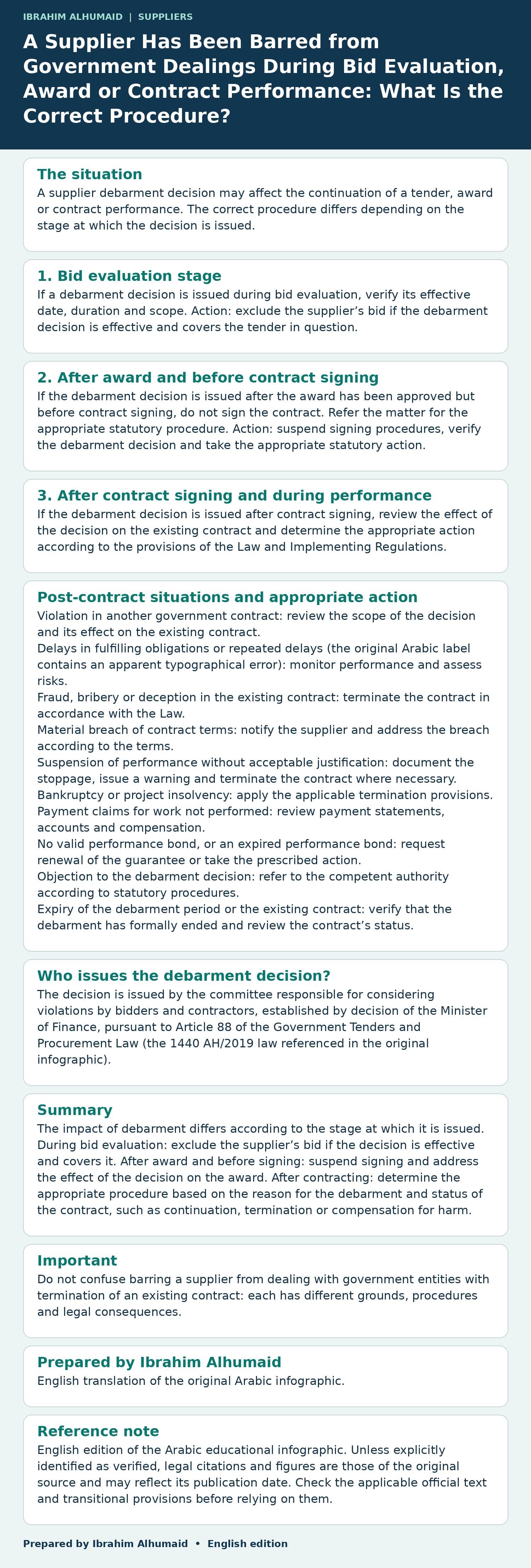
English transcript
The situation
A supplier debarment decision may affect the continuation of a tender, award or contract performance. The correct procedure differs depending on the stage at which the decision is issued.
1. Bid evaluation stage
If a debarment decision is issued during bid evaluation, verify its effective date, duration and scope. Action: exclude the supplier’s bid if the debarment decision is effective and covers the tender in question.
2. After award and before contract signing
If the debarment decision is issued after the award has been approved but before contract signing, do not sign the contract. Refer the matter for the appropriate statutory procedure. Action: suspend signing procedures, verify the debarment decision and take the appropriate statutory action.
3. After contract signing and during performance
If the debarment decision is issued after contract signing, review the effect of the decision on the existing contract and determine the appropriate action according to the provisions of the Law and Implementing Regulations.
Post-contract situations and appropriate action
Violation in another government contract: review the scope of the decision and its effect on the existing contract.
Delays in fulfilling obligations or repeated delays (the original Arabic label contains an apparent typographical error): monitor performance and assess risks.
Fraud, bribery or deception in the existing contract: terminate the contract in accordance with the Law.
Material breach of contract terms: notify the supplier and address the breach according to the terms.
Suspension of performance without acceptable justification: document the stoppage, issue a warning and terminate the contract where necessary.
Bankruptcy or project insolvency: apply the applicable termination provisions.
Payment claims for work not performed: review payment statements, accounts and compensation.
No valid performance bond, or an expired performance bond: request renewal of the guarantee or take the prescribed action.
Objection to the debarment decision: refer to the competent authority according to statutory procedures.
Expiry of the debarment period or the existing contract: verify that the debarment has formally ended and review the contract’s status.
Who issues the debarment decision?
The decision is issued by the committee responsible for considering violations by bidders and contractors, established by decision of the Minister of Finance, pursuant to Article 88 of the Government Tenders and Procurement Law (the 1440 AH/2019 law referenced in the original infographic).
Summary
The impact of debarment differs according to the stage at which it is issued. During bid evaluation: exclude the supplier’s bid if the decision is effective and covers it. After award and before signing: suspend signing and address the effect of the decision on the award. After contracting: determine the appropriate procedure based on the reason for the debarment and status of the contract, such as continuation, termination or compensation for harm.
Important
Do not confuse barring a supplier from dealing with government entities with termination of an existing contract: each has different grounds, procedures and legal consequences.
Prepared by Ibrahim Alhumaid
English translation of the original Arabic infographic.
Reference note
English edition of the Arabic educational infographic. Unless explicitly identified as verified, legal citations and figures are those of the original source and may reflect its publication date. Check the applicable official text and transitional provisions before relying on them.