Category: Suppliers
Supplier Qualification in Government Tenders: Criteria and Procedures
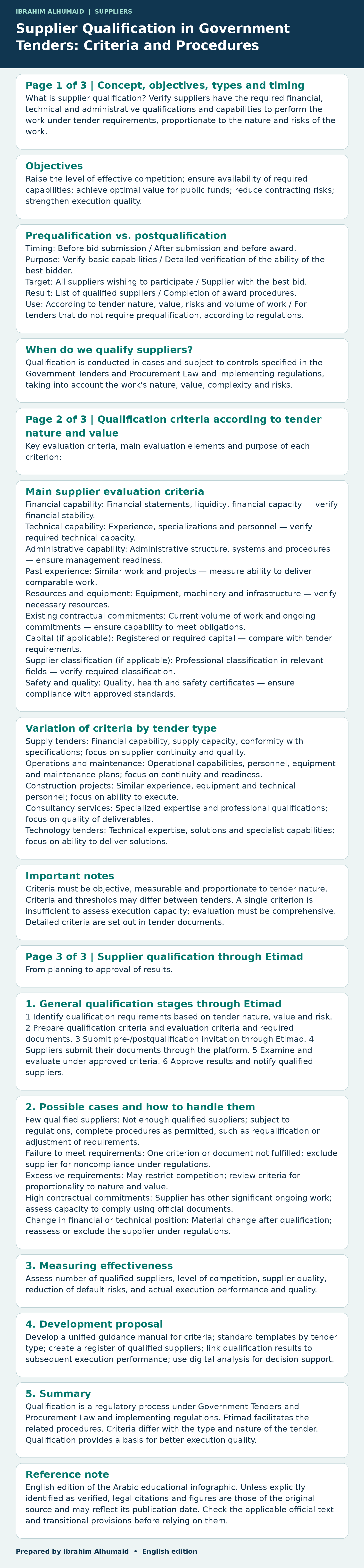
English transcript
Page 1 of 3 | Concept, objectives, types and timing
What is supplier qualification? Verify suppliers have the required financial, technical and administrative qualifications and capabilities to perform the work under tender requirements, proportionate to the nature and risks of the work.
Objectives
Raise the level of effective competition; ensure availability of required capabilities; achieve optimal value for public funds; reduce contracting risks; strengthen execution quality.
Prequalification vs. postqualification
Timing: Before bid submission / After submission and before award.
Purpose: Verify basic capabilities / Detailed verification of the ability of the best bidder.
Target: All suppliers wishing to participate / Supplier with the best bid.
Result: List of qualified suppliers / Completion of award procedures.
Use: According to tender nature, value, risks and volume of work / For tenders that do not require prequalification, according to regulations.
When do we qualify suppliers?
Qualification is conducted in cases and subject to controls specified in the Government Tenders and Procurement Law and implementing regulations, taking into account the work's nature, value, complexity and risks.
Page 2 of 3 | Qualification criteria according to tender nature and value
Key evaluation criteria, main evaluation elements and purpose of each criterion:
Main supplier evaluation criteria
Financial capability: Financial statements, liquidity, financial capacity — verify financial stability.
Technical capability: Experience, specializations and personnel — verify required technical capacity.
Administrative capability: Administrative structure, systems and procedures — ensure management readiness.
Past experience: Similar work and projects — measure ability to deliver comparable work.
Resources and equipment: Equipment, machinery and infrastructure — verify necessary resources.
Existing contractual commitments: Current volume of work and ongoing commitments — ensure capability to meet obligations.
Capital (if applicable): Registered or required capital — compare with tender requirements.
Supplier classification (if applicable): Professional classification in relevant fields — verify required classification.
Safety and quality: Quality, health and safety certificates — ensure compliance with approved standards.
Variation of criteria by tender type
Supply tenders: Financial capability, supply capacity, conformity with specifications; focus on supplier continuity and quality.
Operations and maintenance: Operational capabilities, personnel, equipment and maintenance plans; focus on continuity and readiness.
Construction projects: Similar experience, equipment and technical personnel; focus on ability to execute.
Consultancy services: Specialized expertise and professional qualifications; focus on quality of deliverables.
Technology tenders: Technical expertise, solutions and specialist capabilities; focus on ability to deliver solutions.
Important notes
Criteria must be objective, measurable and proportionate to tender nature. Criteria and thresholds may differ between tenders. A single criterion is insufficient to assess execution capacity; evaluation must be comprehensive. Detailed criteria are set out in tender documents.
Page 3 of 3 | Supplier qualification through Etimad
From planning to approval of results.
1. General qualification stages through Etimad
1 Identify qualification requirements based on tender nature, value and risk. 2 Prepare qualification criteria and evaluation criteria and required documents. 3 Submit pre-/postqualification invitation through Etimad. 4 Suppliers submit their documents through the platform. 5 Examine and evaluate under approved criteria. 6 Approve results and notify qualified suppliers.
2. Possible cases and how to handle them
Few qualified suppliers: Not enough qualified suppliers; subject to regulations, complete procedures as permitted, such as requalification or adjustment of requirements.
Failure to meet requirements: One criterion or document not fulfilled; exclude supplier for noncompliance under regulations.
Excessive requirements: May restrict competition; review criteria for proportionality to nature and value.
High contractual commitments: Supplier has other significant ongoing work; assess capacity to comply using official documents.
Change in financial or technical position: Material change after qualification; reassess or exclude the supplier under regulations.
3. Measuring effectiveness
Assess number of qualified suppliers, level of competition, supplier quality, reduction of default risks, and actual execution performance and quality.
4. Development proposal
Develop a unified guidance manual for criteria; standard templates by tender type; create a register of qualified suppliers; link qualification results to subsequent execution performance; use digital analysis for decision support.
5. Summary
Qualification is a regulatory process under Government Tenders and Procurement Law and implementing regulations. Etimad facilitates the related procedures. Criteria differ with the type and nature of the tender. Qualification provides a basis for better execution quality.
Reference note
English edition of the Arabic educational infographic. Unless explicitly identified as verified, legal citations and figures are those of the original source and may reflect its publication date. Check the applicable official text and transitional provisions before relying on them.