Category: Suppliers
Is a Supplier Responsible for Ambiguity in the Specifications After a Government Tender Is Awarded and the Contract Signed?
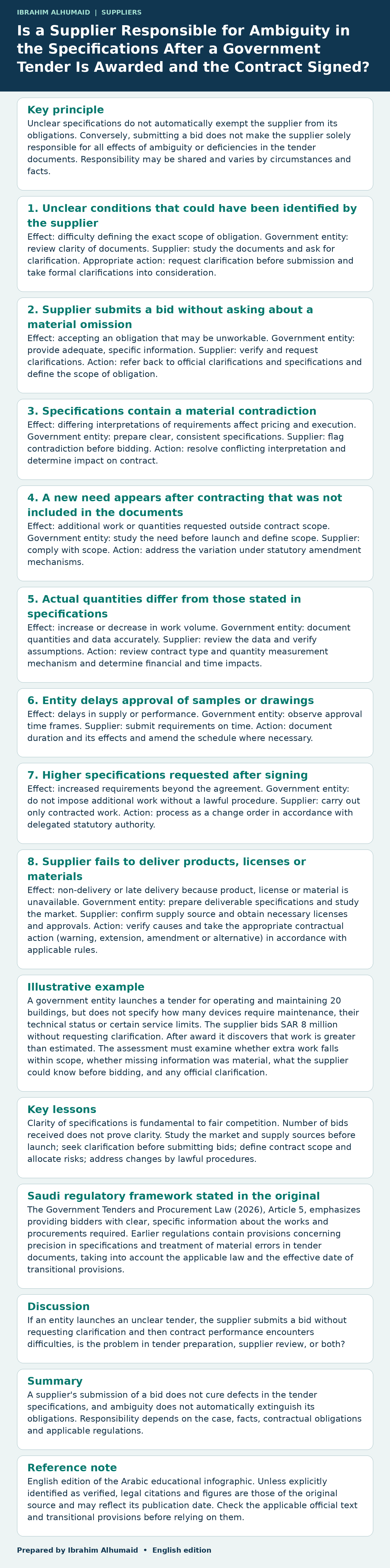
English transcript
Key principle
Unclear specifications do not automatically exempt the supplier from its obligations. Conversely, submitting a bid does not make the supplier solely responsible for all effects of ambiguity or deficiencies in the tender documents. Responsibility may be shared and varies by circumstances and facts.
1. Unclear conditions that could have been identified by the supplier
Effect: difficulty defining the exact scope of obligation. Government entity: review clarity of documents. Supplier: study the documents and ask for clarification. Appropriate action: request clarification before submission and take formal clarifications into consideration.
2. Supplier submits a bid without asking about a material omission
Effect: accepting an obligation that may be unworkable. Government entity: provide adequate, specific information. Supplier: verify and request clarifications. Action: refer back to official clarifications and specifications and define the scope of obligation.
3. Specifications contain a material contradiction
Effect: differing interpretations of requirements affect pricing and execution. Government entity: prepare clear, consistent specifications. Supplier: flag contradiction before bidding. Action: resolve conflicting interpretation and determine impact on contract.
4. A new need appears after contracting that was not included in the documents
Effect: additional work or quantities requested outside contract scope. Government entity: study the need before launch and define scope. Supplier: comply with scope. Action: address the variation under statutory amendment mechanisms.
5. Actual quantities differ from those stated in specifications
Effect: increase or decrease in work volume. Government entity: document quantities and data accurately. Supplier: review the data and verify assumptions. Action: review contract type and quantity measurement mechanism and determine financial and time impacts.
6. Entity delays approval of samples or drawings
Effect: delays in supply or performance. Government entity: observe approval time frames. Supplier: submit requirements on time. Action: document duration and its effects and amend the schedule where necessary.
7. Higher specifications requested after signing
Effect: increased requirements beyond the agreement. Government entity: do not impose additional work without a lawful procedure. Supplier: carry out only contracted work. Action: process as a change order in accordance with delegated statutory authority.
8. Supplier fails to deliver products, licenses or materials
Effect: non-delivery or late delivery because product, license or material is unavailable. Government entity: prepare deliverable specifications and study the market. Supplier: confirm supply source and obtain necessary licenses and approvals. Action: verify causes and take the appropriate contractual action (warning, extension, amendment or alternative) in accordance with applicable rules.
Illustrative example
A government entity launches a tender for operating and maintaining 20 buildings, but does not specify how many devices require maintenance, their technical status or certain service limits. The supplier bids SAR 8 million without requesting clarification. After award it discovers that work is greater than estimated. The assessment must examine whether extra work falls within scope, whether missing information was material, what the supplier could know before bidding, and any official clarification.
Key lessons
Clarity of specifications is fundamental to fair competition. Number of bids received does not prove clarity. Study the market and supply sources before launch; seek clarification before submitting bids; define contract scope and allocate risks; address changes by lawful procedures.
Saudi regulatory framework stated in the original
The Government Tenders and Procurement Law (2026), Article 5, emphasizes providing bidders with clear, specific information about the works and procurements required. Earlier regulations contain provisions concerning precision in specifications and treatment of material errors in tender documents, taking into account the applicable law and the effective date of transitional provisions.
Discussion
If an entity launches an unclear tender, the supplier submits a bid without requesting clarification and then contract performance encounters difficulties, is the problem in tender preparation, supplier review, or both?
Summary
A supplier's submission of a bid does not cure defects in the tender specifications, and ambiguity does not automatically extinguish its obligations. Responsibility depends on the case, facts, contractual obligations and applicable regulations.
Reference note
English edition of the Arabic educational infographic. Unless explicitly identified as verified, legal citations and figures are those of the original source and may reflect its publication date. Check the applicable official text and transitional provisions before relying on them.