Category: Suppliers
16 Prohibited Practices and Mistakes That Could Cost a Supplier a Government Tender Opportunity
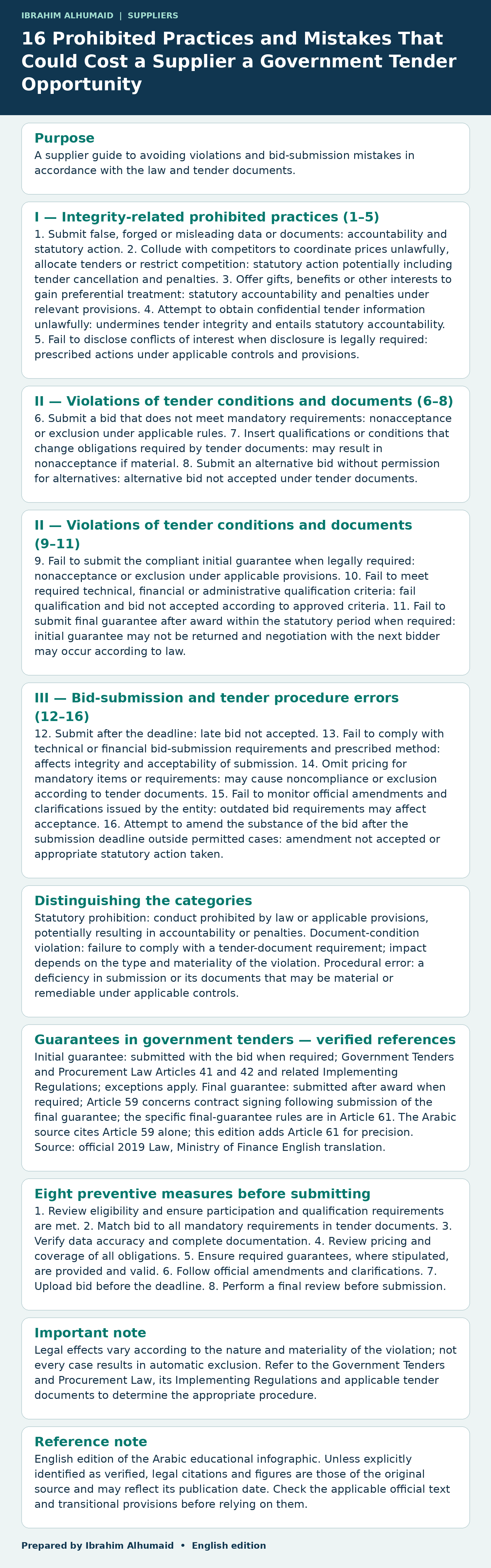
English transcript
Purpose
A supplier guide to avoiding violations and bid-submission mistakes in accordance with the law and tender documents.
I — Integrity-related prohibited practices (1–5)
1. Submit false, forged or misleading data or documents: accountability and statutory action. 2. Collude with competitors to coordinate prices unlawfully, allocate tenders or restrict competition: statutory action potentially including tender cancellation and penalties. 3. Offer gifts, benefits or other interests to gain preferential treatment: statutory accountability and penalties under relevant provisions. 4. Attempt to obtain confidential tender information unlawfully: undermines tender integrity and entails statutory accountability. 5. Fail to disclose conflicts of interest when disclosure is legally required: prescribed actions under applicable controls and provisions.
II — Violations of tender conditions and documents (6–8)
6. Submit a bid that does not meet mandatory requirements: nonacceptance or exclusion under applicable rules. 7. Insert qualifications or conditions that change obligations required by tender documents: may result in nonacceptance if material. 8. Submit an alternative bid without permission for alternatives: alternative bid not accepted under tender documents.
II — Violations of tender conditions and documents (9–11)
9. Fail to submit the compliant initial guarantee when legally required: nonacceptance or exclusion under applicable provisions. 10. Fail to meet required technical, financial or administrative qualification criteria: fail qualification and bid not accepted according to approved criteria. 11. Fail to submit final guarantee after award within the statutory period when required: initial guarantee may not be returned and negotiation with the next bidder may occur according to law.
III — Bid-submission and tender procedure errors (12–16)
12. Submit after the deadline: late bid not accepted. 13. Fail to comply with technical or financial bid-submission requirements and prescribed method: affects integrity and acceptability of submission. 14. Omit pricing for mandatory items or requirements: may cause noncompliance or exclusion according to tender documents. 15. Fail to monitor official amendments and clarifications issued by the entity: outdated bid requirements may affect acceptance. 16. Attempt to amend the substance of the bid after the submission deadline outside permitted cases: amendment not accepted or appropriate statutory action taken.
Distinguishing the categories
Statutory prohibition: conduct prohibited by law or applicable provisions, potentially resulting in accountability or penalties. Document-condition violation: failure to comply with a tender-document requirement; impact depends on the type and materiality of the violation. Procedural error: a deficiency in submission or its documents that may be material or remediable under applicable controls.
Guarantees in government tenders — verified references
Initial guarantee: submitted with the bid when required; Government Tenders and Procurement Law Articles 41 and 42 and related Implementing Regulations; exceptions apply. Final guarantee: submitted after award when required; Article 59 concerns contract signing following submission of the final guarantee; the specific final-guarantee rules are in Article 61. The Arabic source cites Article 59 alone; this edition adds Article 61 for precision. Source: official 2019 Law, Ministry of Finance English translation.
Eight preventive measures before submitting
1. Review eligibility and ensure participation and qualification requirements are met. 2. Match bid to all mandatory requirements in tender documents. 3. Verify data accuracy and complete documentation. 4. Review pricing and coverage of all obligations. 5. Ensure required guarantees, where stipulated, are provided and valid. 6. Follow official amendments and clarifications. 7. Upload bid before the deadline. 8. Perform a final review before submission.
Important note
Legal effects vary according to the nature and materiality of the violation; not every case results in automatic exclusion. Refer to the Government Tenders and Procurement Law, its Implementing Regulations and applicable tender documents to determine the appropriate procedure.
Reference note
English edition of the Arabic educational infographic. Unless explicitly identified as verified, legal citations and figures are those of the original source and may reflect its publication date. Check the applicable official text and transitional provisions before relying on them.