Tenders
Supplier tender pricing errors and prohibited practices: how should the bid evaluation committee detect and address them?
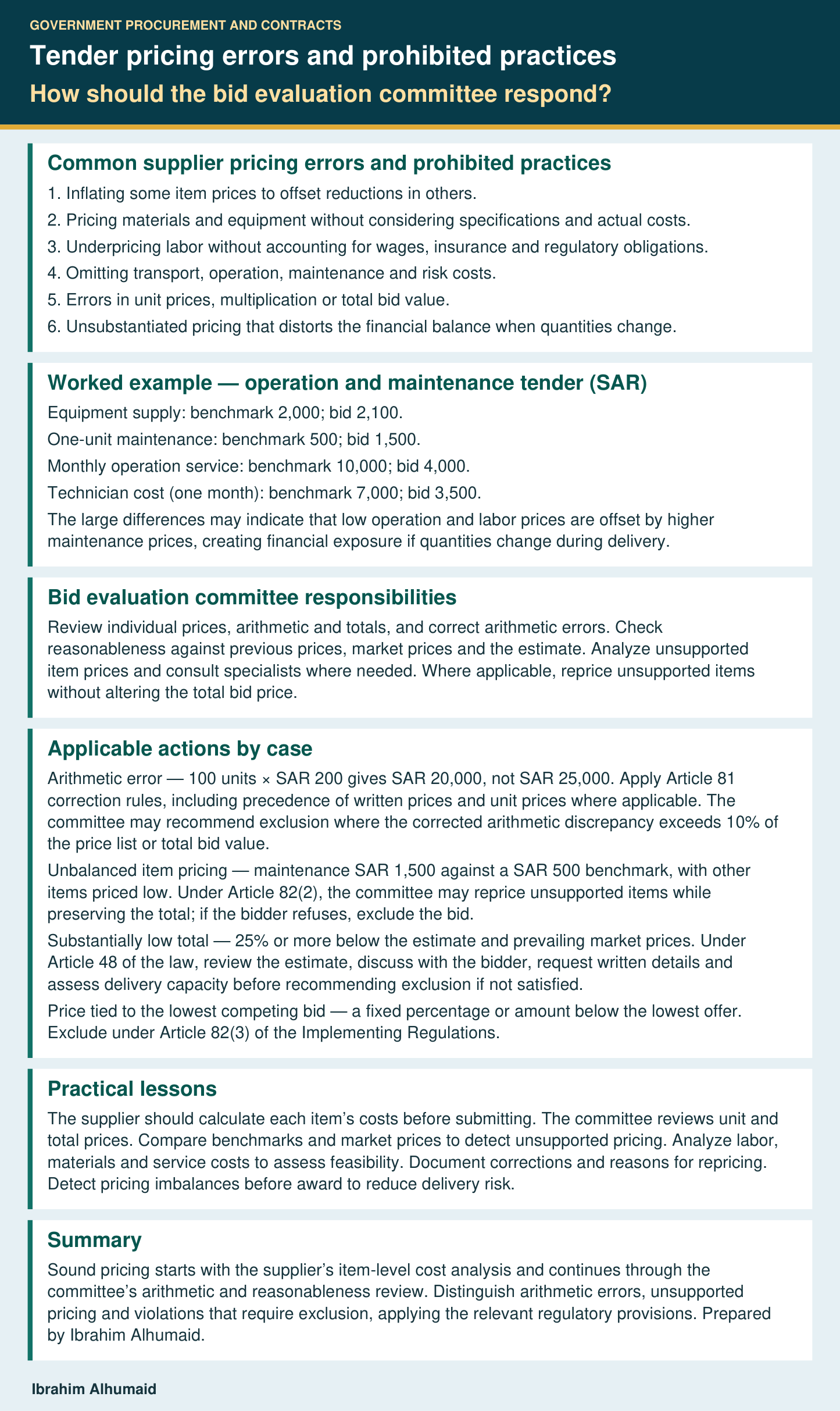
Common supplier pricing errors and prohibited practices
1. Inflating some item prices to offset reductions in others.
2. Pricing materials and equipment without considering specifications and actual costs.
3. Underpricing labor without accounting for wages, insurance and regulatory obligations.
4. Omitting transport, operation, maintenance and risk costs.
5. Errors in unit prices, multiplication or total bid value.
6. Unsubstantiated pricing that distorts the financial balance when quantities change.
Worked example — operation and maintenance tender (SAR)
Equipment supply: benchmark 2,000; bid 2,100.
One-unit maintenance: benchmark 500; bid 1,500.
Monthly operation service: benchmark 10,000; bid 4,000.
Technician cost (one month): benchmark 7,000; bid 3,500.
The large differences may indicate that low operation and labor prices are offset by higher maintenance prices, creating financial exposure if quantities change during delivery.
Bid evaluation committee responsibilities
Review individual prices, arithmetic and totals, and correct arithmetic errors. Check reasonableness against previous prices, market prices and the estimate. Analyze unsupported item prices and consult specialists where needed. Where applicable, reprice unsupported items without altering the total bid price.
Applicable actions by case
Arithmetic error — 100 units × SAR 200 gives SAR 20,000, not SAR 25,000. Apply Article 81 correction rules, including precedence of written prices and unit prices where applicable. The committee may recommend exclusion where the corrected arithmetic discrepancy exceeds 10% of the price list or total bid value.
Unbalanced item pricing — maintenance SAR 1,500 against a SAR 500 benchmark, with other items priced low. Under Article 82(2), the committee may reprice unsupported items while preserving the total; if the bidder refuses, exclude the bid.
Substantially low total — 25% or more below the estimate and prevailing market prices. Under Article 48 of the law, review the estimate, discuss with the bidder, request written details and assess delivery capacity before recommending exclusion if not satisfied.
Price tied to the lowest competing bid — a fixed percentage or amount below the lowest offer. Exclude under Article 82(3) of the Implementing Regulations.
Practical lessons
The supplier should calculate each item’s costs before submitting. The committee reviews unit and total prices. Compare benchmarks and market prices to detect unsupported pricing. Analyze labor, materials and service costs to assess feasibility. Document corrections and reasons for repricing. Detect pricing imbalances before award to reduce delivery risk.
Summary
Sound pricing starts with the supplier’s item-level cost analysis and continues through the committee’s arithmetic and reasonableness review. Distinguish arithmetic errors, unsupported pricing and violations that require exclusion, applying the relevant regulatory provisions. Prepared by Ibrahim Alhumaid.
References: Law (1440 AH), Article 48; Implementing Regulations, Articles 81–82 and 84. The source image contains a reference typo in the last row; corrected here to Article 82(3). Apply applicable transitional provisions.