Category: Committees
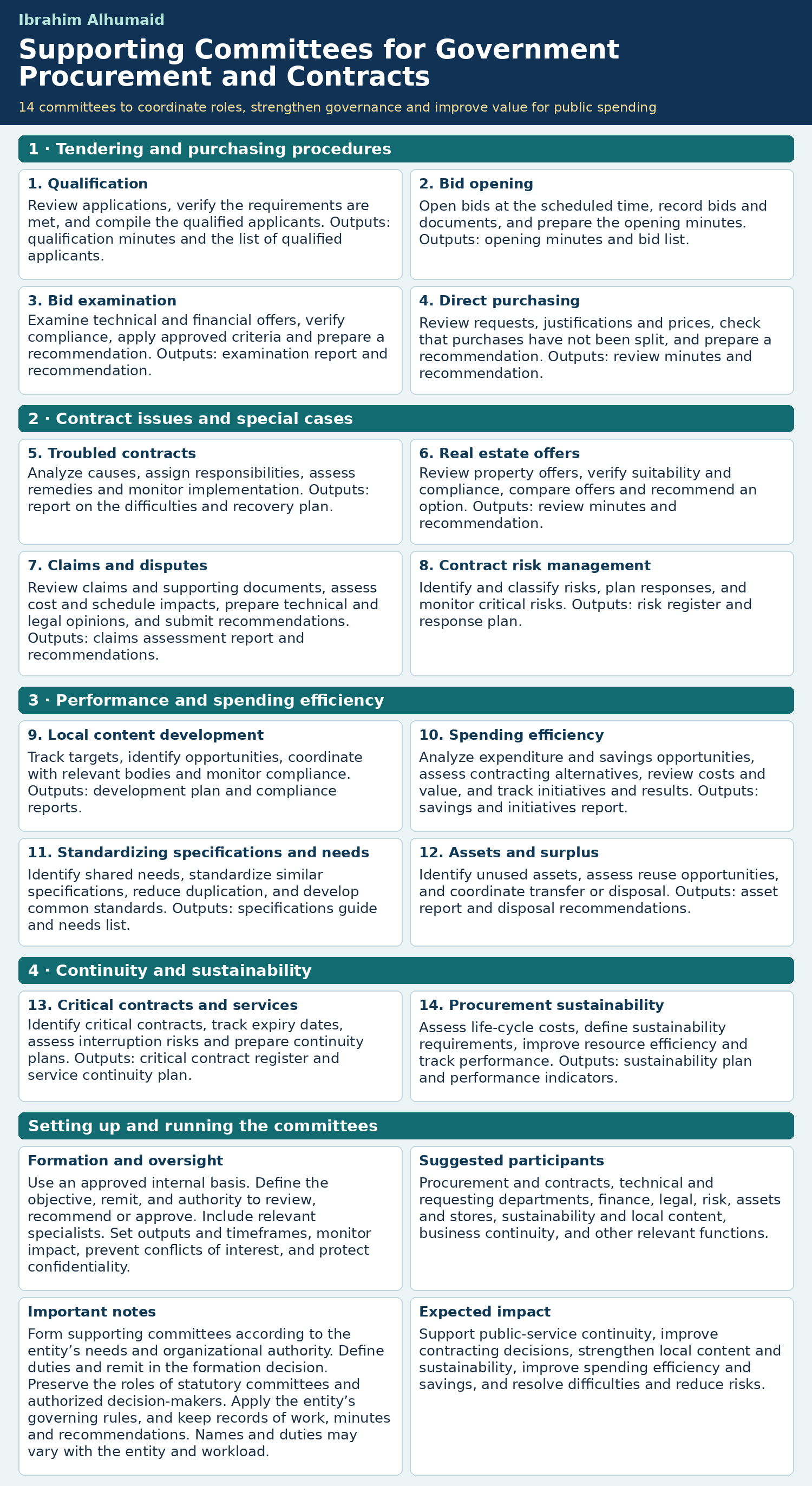
Supporting Committees for Government Procurement and Contracts
Read the full English text
1 · Tendering and purchasing procedures
1. Qualification
Review applications, verify the requirements are met, and compile the qualified applicants. Outputs: qualification minutes and the list of qualified applicants.
2. Bid opening
Open bids at the scheduled time, record bids and documents, and prepare the opening minutes. Outputs: opening minutes and bid list.
3. Bid examination
Examine technical and financial offers, verify compliance, apply approved criteria and prepare a recommendation. Outputs: examination report and recommendation.
4. Direct purchasing
Review requests, justifications and prices, check that purchases have not been split, and prepare a recommendation. Outputs: review minutes and recommendation.
2 · Contract issues and special cases
5. Troubled contracts
Analyze causes, assign responsibilities, assess remedies and monitor implementation. Outputs: report on the difficulties and recovery plan.
6. Real estate offers
Review property offers, verify suitability and compliance, compare offers and recommend an option. Outputs: review minutes and recommendation.
7. Claims and disputes
Review claims and supporting documents, assess cost and schedule impacts, prepare technical and legal opinions, and submit recommendations. Outputs: claims assessment report and recommendations.
8. Contract risk management
Identify and classify risks, plan responses, and monitor critical risks. Outputs: risk register and response plan.
3 · Performance and spending efficiency
9. Local content development
Track targets, identify opportunities, coordinate with relevant bodies and monitor compliance. Outputs: development plan and compliance reports.
10. Spending efficiency
Analyze expenditure and savings opportunities, assess contracting alternatives, review costs and value, and track initiatives and results. Outputs: savings and initiatives report.
11. Standardizing specifications and needs
Identify shared needs, standardize similar specifications, reduce duplication, and develop common standards. Outputs: specifications guide and needs list.
12. Assets and surplus
Identify unused assets, assess reuse opportunities, and coordinate transfer or disposal. Outputs: asset report and disposal recommendations.
4 · Continuity and sustainability
13. Critical contracts and services
Identify critical contracts, track expiry dates, assess interruption risks and prepare continuity plans. Outputs: critical contract register and service continuity plan.
14. Procurement sustainability
Assess life-cycle costs, define sustainability requirements, improve resource efficiency and track performance. Outputs: sustainability plan and performance indicators.
Setting up and running the committees
Formation and oversight
Use an approved internal basis. Define the objective, remit, and authority to review, recommend or approve. Include relevant specialists. Set outputs and timeframes, monitor impact, prevent conflicts of interest, and protect confidentiality.
Suggested participants
Procurement and contracts, technical and requesting departments, finance, legal, risk, assets and stores, sustainability and local content, business continuity, and other relevant functions.
Important notes
Form supporting committees according to the entity’s needs and organizational authority. Define duties and remit in the formation decision. Preserve the roles of statutory committees and authorized decision-makers. Apply the entity’s governing rules, and keep records of work, minutes and recommendations. Names and duties may vary with the entity and workload.
Expected impact
Support public-service continuity, improve contracting decisions, strengthen local content and sustainability, improve spending efficiency and savings, and resolve difficulties and reduce risks.