Tenders
When Do Technical Specifications Stop Safeguarding Quality and Start Restricting Competition?
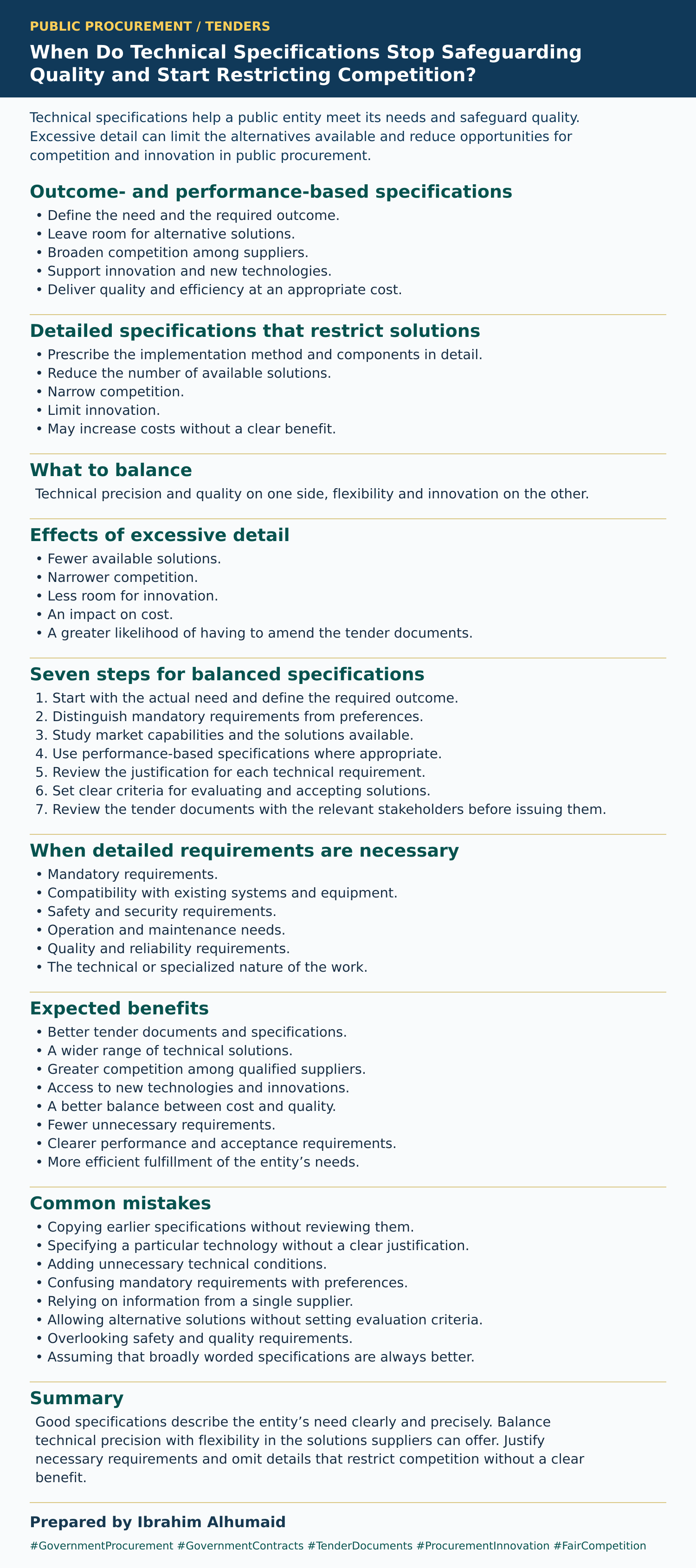
English transcript
Technical specifications help a public entity meet its needs and safeguard quality. Excessive detail can limit the alternatives available and reduce opportunities for competition and innovation in public procurement.
Outcome- and performance-based specifications
- Define the need and the required outcome.
- Leave room for alternative solutions.
- Broaden competition among suppliers.
- Support innovation and new technologies.
- Deliver quality and efficiency at an appropriate cost.
Detailed specifications that restrict solutions
- Prescribe the implementation method and components in detail.
- Reduce the number of available solutions.
- Narrow competition.
- Limit innovation.
- May increase costs without a clear benefit.
What to balance
Technical precision and quality on one side, flexibility and innovation on the other.
Effects of excessive detail
- Fewer available solutions.
- Narrower competition.
- Less room for innovation.
- An impact on cost.
- A greater likelihood of having to amend the tender documents.
Seven steps for balanced specifications
- Start with the actual need and define the required outcome.
- Distinguish mandatory requirements from preferences.
- Study market capabilities and the solutions available.
- Use performance-based specifications where appropriate.
- Review the justification for each technical requirement.
- Set clear criteria for evaluating and accepting solutions.
- Review the tender documents with the relevant stakeholders before issuing them.
When detailed requirements are necessary
- Mandatory requirements.
- Compatibility with existing systems and equipment.
- Safety and security requirements.
- Operation and maintenance needs.
- Quality and reliability requirements.
- The technical or specialized nature of the work.
Expected benefits
- Better tender documents and specifications.
- A wider range of technical solutions.
- Greater competition among qualified suppliers.
- Access to new technologies and innovations.
- A better balance between cost and quality.
- Fewer unnecessary requirements.
- Clearer performance and acceptance requirements.
- More efficient fulfillment of the entity’s needs.
Common mistakes
- Copying earlier specifications without reviewing them.
- Specifying a particular technology without a clear justification.
- Adding unnecessary technical conditions.
- Confusing mandatory requirements with preferences.
- Relying on information from a single supplier.
- Allowing alternative solutions without setting evaluation criteria.
- Overlooking safety and quality requirements.
- Assuming that broadly worded specifications are always better.
Summary
Good specifications describe the entity’s need clearly and precisely. Balance technical precision with flexibility in the solutions suppliers can offer. Justify necessary requirements and omit details that restrict competition without a clear benefit.
Prepared by Ibrahim Alhumaid · #GovernmentProcurement #GovernmentContracts #TenderDocuments #ProcurementInnovation #FairCompetition