Category: Tenders
Ten Government Procurement Cases: Is the Timing Right?
English transcript
Timing can change the permitted action
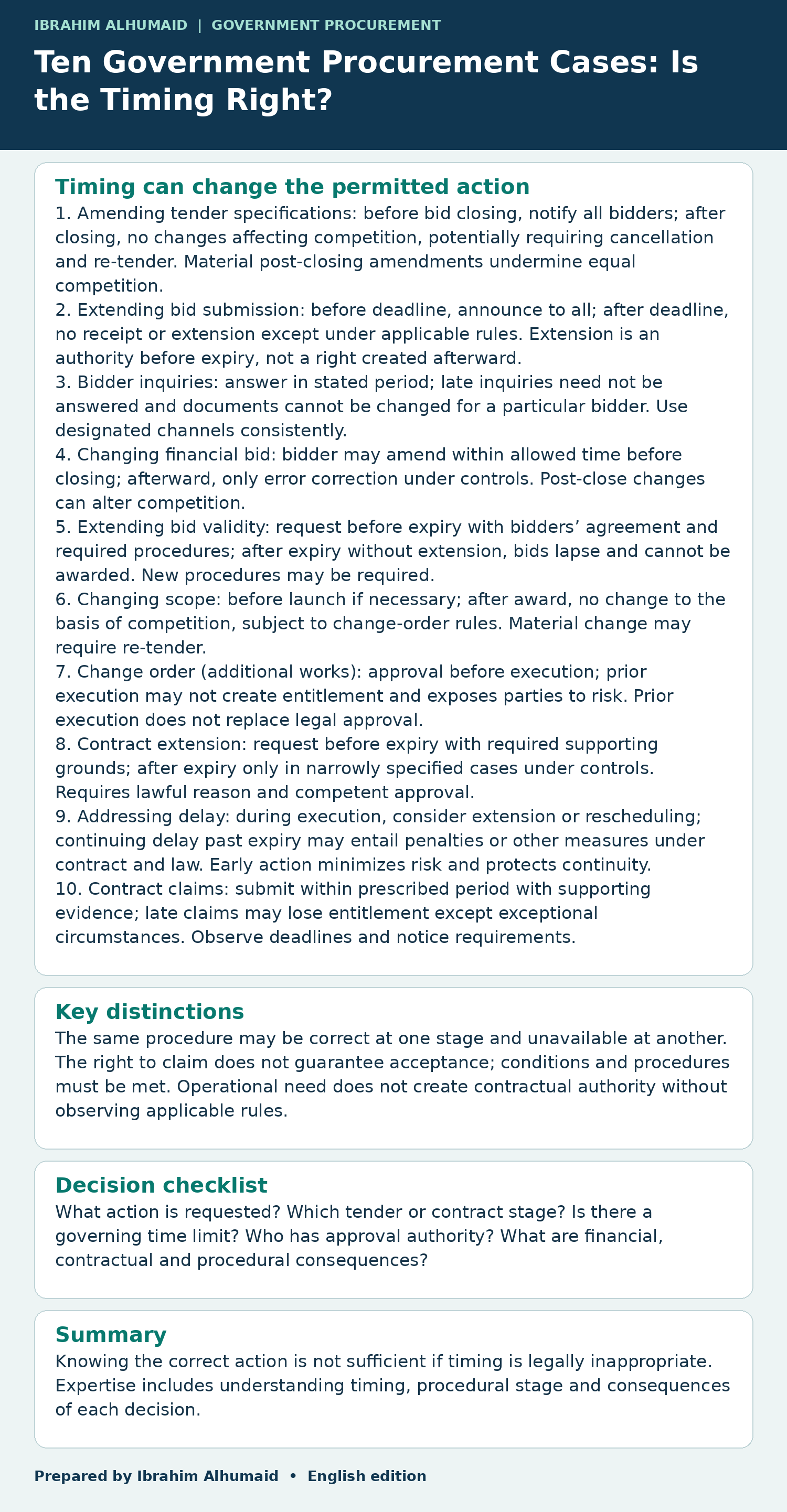
1. Amending tender specifications: before bid closing, notify all bidders; after closing, no changes affecting competition, potentially requiring cancellation and re-tender. Material post-closing amendments undermine equal competition.
2. Extending bid submission: before deadline, announce to all; after deadline, no receipt or extension except under applicable rules. Extension is an authority before expiry, not a right created afterward.
3. Bidder inquiries: answer in stated period; late inquiries need not be answered and documents cannot be changed for a particular bidder. Use designated channels consistently.
4. Changing financial bid: bidder may amend within allowed time before closing; afterward, only error correction under controls. Post-close changes can alter competition.
5. Extending bid validity: request before expiry with bidders’ agreement and required procedures; after expiry without extension, bids lapse and cannot be awarded. New procedures may be required.
6. Changing scope: before launch if necessary; after award, no change to the basis of competition, subject to change-order rules. Material change may require re-tender.
7. Change order (additional works): approval before execution; prior execution may not create entitlement and exposes parties to risk. Prior execution does not replace legal approval.
8. Contract extension: request before expiry with required supporting grounds; after expiry only in narrowly specified cases under controls. Requires lawful reason and competent approval.
9. Addressing delay: during execution, consider extension or rescheduling; continuing delay past expiry may entail penalties or other measures under contract and law. Early action minimizes risk and protects continuity.
10. Contract claims: submit within prescribed period with supporting evidence; late claims may lose entitlement except exceptional circumstances. Observe deadlines and notice requirements.
Key distinctions
The same procedure may be correct at one stage and unavailable at another. The right to claim does not guarantee acceptance; conditions and procedures must be met. Operational need does not create contractual authority without observing applicable rules.
Decision checklist
What action is requested? Which tender or contract stage? Is there a governing time limit? Who has approval authority? What are financial, contractual and procedural consequences?
Summary
Knowing the correct action is not sufficient if timing is legally inappropriate. Expertise includes understanding timing, procedural stage and consequences of each decision.